Patients & CaregiversHealthcare Professionals - Opens new windowWorldwide - Opens new window
HomeAbout Merck Products Newsroom Investor Relations CareersResearchLicensingThe Merck Manuals

The Merck Manual of Geriatrics logo
red line
click here to go to the Contents page of The Merck Manual of Geriatrics
click here to go to the title page of The Merck Manual of Geriatrics
click here to search The Merck Manual of Geriatrics
click here to go to the Index of The Merck Manual of Geriatrics
red line
Section 11. Cardiovascular Disorders
Chapter 95. Aneurysms
Topics:    Introduction | Thoracic Aortic Aneurysms | Abdominal Aortic Aneurysms | Popliteal Aneurysms | Femoral Aneurysms | Carotid Aneurysms | Aortic Dissection

red line

Aortic Dissection

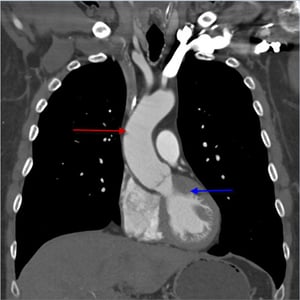
A hemorrhage into the media after an initial intimal tear.

Aortic dissection is often inappropriately called a dissecting aneurysm; aortic dissection differs from the localized stretching of the vessel walls that defines a true aneurysm. The tear occurs because of medial necrosis or severe atrophy, often as a result of chronic, sustained hypertension. Dissection secondary to Marfan's syndrome is rare among persons > 55.

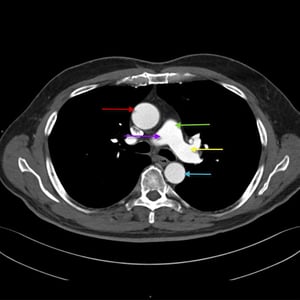
The initial intimal tear is almost always just distal to the aortic valve (proximal dissection) or just beyond the left subclavian artery (distal dissection). Proximal dissections are reported more often, but the prevalence of distal dissections may be underestimated because clinical findings can be more subtle.

Symptoms and Signs

Symptoms vary. Pain may be excruciating, radiating throughout the chest and back; mild and limited to one small area of the back or chest; or totally absent. The clinical findings reflect what the hematoma that forms in the media does: The hematoma may extend distally along the aorta; clot at any point along the aorta; extend distally into any major aortic branch and compress the lumen; become the major blood-flow channel in any aortic branch; reenter the aorta or a branch through a second, more distal intimal tear; or perforate the adventitia at any point.

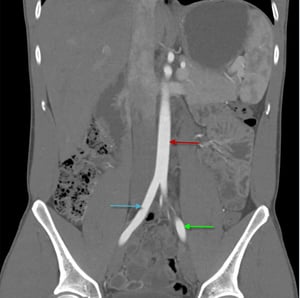
Distal dissection: The dissection may cause mild or severe back pain, but pain is often absent. The presenting symptom is often related to regional ischemia. Patients may have abdominal pain due to mesenteric ischemia, flank pain and hematuria due to renal infarction, paraplegia due to anterior spinal artery involvement, or leg pain due to iliac artery occlusion. Ischemia may be promptly and spontaneously reversed if the dissecting hematoma reenters the normal lumen; for example, femoral pulses that were missing may suddenly reappear. Symptoms representing many areas of acute ischemia should always suggest a possible aortic dissection.

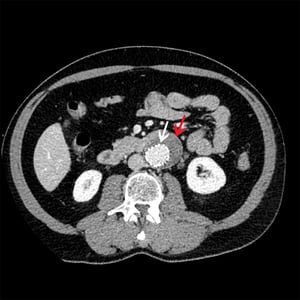
Spontaneous healing of a dissection usually involves clotting of the hematoma followed by fibrosis around it. However, the aortic wall remains weak, and a true saccular aneurysm can develop. Because the wall has little support, the aneurysm usually expands and soon thereafter ruptures. During acute dissection, rapid expansion of a saccular aneurysm portends imminent rupture. Expansion occurring weeks or months later is generally less dire, although the aneurysm may rupture within days. Patients with a thoracic aortic dissection may present with symptoms of a sudden abdominal aortic aneurysm.

If a distal dissection perforates, the perforation usually occurs near the initial tear, with blood tracking into the left pleural cavity. Frequently, an initial small perforation is sealed off by a clot. A small left pleural effusion on chest x-ray may be the only clue.

Proximal dissection: Because proximal dissections often involve the aortic valve ring, the extracranial arteries, and the pericardium, they are more dangerous than distal dissections. A regurgitation murmur and a loud sound on aortic closure can usually be heard. Less frequently, the dissection produces hemodynamically significant acute aortic regurgitation, which results in low cardiac output, with pulmonary edema and hypotension. Rarely, silent dissection produces chronic aortic regurgitation, and the physician discovers either an asymptomatic diastolic murmur or a murmur and left ventricular failure.

Neurologic symptoms (eg, hemiplegia, aphasia) are common presenting symptoms. The dissection may occlude the innominate and left carotid arteries. If focal neurologic signs are present, the corresponding carotid pulse is usually diminished or absent. A lower blood pressure in the right arm is expected with left hemiplegia, because compression of the innominate artery affects both the subclavian and carotid arteries.

If the false channel is prominent in the transverse aortic wall, findings of mediastinal compression (hoarseness, unilateral external jugular vein distention, and a unilateral Horner's syndrome) can occur. Death often results from rupture of the dissection into the pericardial space.

Diagnosis

Aortic dissection can be a great masquerader, with an onset that can be acute or insidious. Because the diagnosis is easily missed, certain findings should always trigger consideration of this disorder (see Table 95-1).

Initially, chest x-ray is important for evaluation of the aortic shadow. The aorta almost always is somewhat prominent, especially in the elderly, so this finding is not specific to dissection. The aortic shadow is usually tortuous and uncoiled because of long-standing hypertension, and sometimes it is very dilated. Aortic calcification not extending to the shadow's borders suggests a false channel and is specific to dissection only if a lateral view shows a lack of calcium in the anterior or posterior wall.

If the index of suspicion is high after clinical evaluation and review of chest x-rays, then MRI, transesophageal echocardiography, or contrast CT is indicated. Transthoracic two-dimensional echocardiography is useful only for proximal dissection. It can usually show the false channel and detect even subclinical degrees of aortic regurgitation. It may also show early mitral valve closure, which indicates acute aortic regurgitation.

CT and MRI can show the false channel and follow the aorta to its bifurcation, revealing cutoff of branches. Both techniques appear to be at least as sensitive as arteriography.

Transesophageal echocardiography is a very sensitive and specific method of diagnosing aortic dissection. It detects very small intimal tears from very limited dissections, many of which are asymptomatic. However, it is not as useful as CT and MRI in assessing the abdominal aorta and its branches.

Aortography, usually performed in retrograde fashion through a femoral artery, is rarely needed even for patients about to have surgical repair. Although its ability to distinguish an active from a clotted false channel has prognostic value, the procedure is dangerous because of the risk of perforation.

Treatment

Distal dissection: Patients with an uncomplicated distal dissection can be treated medically. Systemic blood pressure must be lowered to decrease the rising pressure against the aortic wall: it should be controlled immediately using a titratable drug given by continuous IV infusion. A sympathetic ganglionic blocker (eg, trimethaphan camsylate) or an alpha-beta-blocker (eg, labetalol) can be used. At the same time, oral therapy with a beta-blocker and a diuretic is begun. The dose of oral drugs is increased until the IV infusion is no longer needed. If beta-blockers are contraindicated, verapamil can be used. Centrally acting vasodilators (eg, methyldopa, clonidine) have little or no effect on cardiac output and can be used if necessary. Pure vasodilators (eg, prazosin, nitroprusside, hydralazine) and angiotensin-converting enzyme inhibitors (eg, captopril, enalapril) should be avoided because they lead to increased left ventricular contraction--producing increased pressure against the aortic wall--and may do more harm than good.

Surgery must be considered if pain is not reduced within the first few hours of medical therapy and eliminated within the first 2 days. After discharge, patients should be followed weekly for the first month and at least every 3 months afterward. Chest x-rays should be obtained after 1 month and every 3 to 4 months for the first 2 years to look for development of a saccular aneurysm. Mortality rates after 3 and 5 years for patients with uncomplicated distal dissections are about the same, whether these patients are treated medically or surgically. With effective medical or surgical treatment, the likelihood of recurrent dissection is low.

Proximal dissection: If managed only medically, proximal dissections tend to cause serious complications. Perforation rates are high; pericardial tamponade is the most common cause of death. For stable patients, hypertension should first be controlled with IV drugs, and then surgery should be performed. Synthetic grafts can be placed inside the thoracic aorta; this procedure reduces mortality. A graft with an attached aortic valve can be used for patients with severe aortic regurgitation. After graft insertion, the false channel can be obliterated into the true lumen. A distal saccular aneurysm or interference with blood flow through any major distal aortic branch mandates repair at the local site. Thus, a combined thoracoabdominal approach is often necessary.

The small, atypical intimal tears detected only by transesophageal echocardiography should be treated medically.

Contact Merck Site MapPrivacy PolicyTerms of UseCopyright 1995-2008 Merck & Co., Inc.