





Delirium is an acute, transient, usually reversible, fluctuating disturbance in attention, cognition, and consciousness level. Causes include almost any disorder or drug. Diagnosis is clinical, with laboratory and usually imaging tests to identify the cause. Treatment is correction of the cause and supportive measures.
(See also Overview of Delirium and Dementia.)
Delirium may occur at any age but is more common among older people. At least 10% of older patients who are admitted to the hospital have delirium; 15 to 50% experience delirium at some time during hospitalization. Delirium is also common after surgery and among nursing home residents and intensive care unit (ICU) patients. When delirium occurs in younger people, it is usually due to use of a drug (recreational drug or medication) or a life-threatening systemic disorder.
Delirium is sometimes called acute confusional state or toxic or metabolic encephalopathy.
Delirium and dementia are separate disorders but are sometimes difficult to distinguish. In both, cognition is disordered; however, the following helps distinguish them:
Delirium affects mainly attention, is typically caused by acute illness or drug toxicity (sometimes life threatening), and is often reversible.
Dementia affects mainly memory, is typically caused by anatomic changes in the brain, has slower onset, and is generally irreversible.
Other specific characteristics also help distinguish the 2 disorders (see table Differences Between Delirium and Dementia). Delirium often develops in patients with dementia; it is called delirium superimposed on dementia (DSD). DSD can occur in up to 49% of patients with dementia during hospitalization. Also, patients with delirium have a higher risk of developing dementia (1).
General reference
1. Fong TG, Inouye SK:The inter-relationship between delirium and dementia: The importance of delirium prevention. Nat Rev Neurol 18 (10):579–596, 2022. doi: 10.1038/s41582-022-00698-7
Etiology of Delirium
The most common causes of delirium are the following:
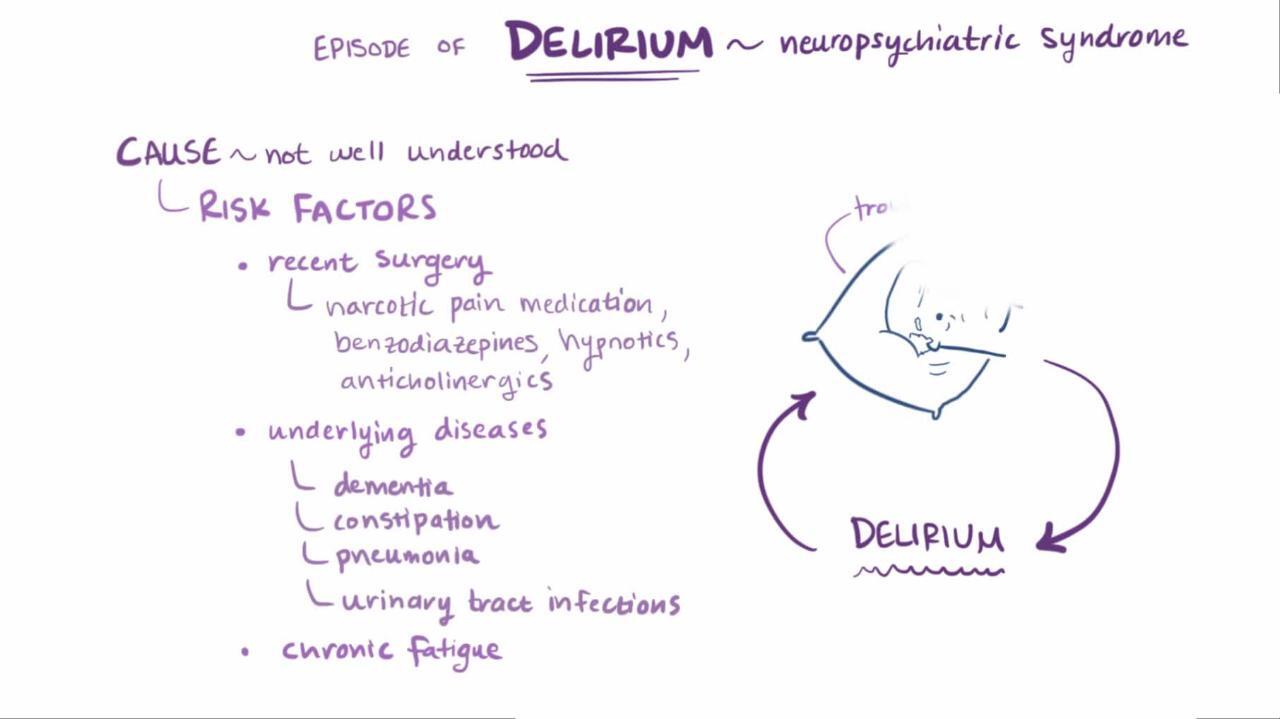
Drugs, particularly anticholinergics, psychoactive drugs or medications, and opioids
Dehydration
Infection
Many other conditions can cause delirium (see table Causes of Delirium). In about 10 to 20% of patients, no cause is identified.
Predisposing factors include brain disorders (eg, dementia, stroke, Parkinson disease), advanced age, sensory impairment (eg, impaired vision or hearing), alcohol intoxication, and multiple coexisting disorders.
Precipitating factors include use of drugs (particularly ≥ 3 new medications), infection, dehydration, shock, hypoxia, anemia, immobility, undernutrition, use of bladder catheters (whether urinary retention is present or not), hospitalization, pain, sleep deprivation, and emotional stress. Unrecognized liver or kidney failure may cause medication toxicity and delirium by impairing the metabolism and reducing the clearance of a previously well-tolerated medication.
Delirium can be a common presenting symptom in older patients with a viral disease. For example, coronavirus disease 2019 (COVID-19) can often cause delirium without other typical symptoms or signs of COVID-19. Delirium is more likely to result in poor hospital outcomes (eg, need for ICU care) and death in patients with COVID-19 (1).
Recent exposure to anesthesia also increases risk, especially if exposure is prolonged and if anticholinergics are given during surgery. After surgery, pain and the use of opioid analgesics can also contribute to delirium. Decreased sensory stimuli at night may trigger delirium in at-risk patients.
For older patients in an ICU, risk of delirium (ICU psychosis) is particularly high. Nonconvulsive status epilepticus is an underrecognized cause of altered mental status in ICU patients that should be considered.
Etiology reference
1. Kennedy M, Helfand BKI, Gou RY, et al: Delirium in older patients with COVID-19 presenting to the emergency department. JAMA Netw Open 3 (11):e2029540, 2020. doi:10.1001/jamanetworkopen.2020.29540
Pathophysiology of Delirium
Mechanisms are not fully understood but may involve
Reversible impairment of cerebral oxidative metabolism
Multiple neurotransmitter abnormalities, especially cholinergic deficiency
Generation of inflammatory markers, including C-reactive protein, interleukin-1 beta and 6, and tumor necrosis factor–alpha
Stress of any kind upregulates sympathetic tone and downregulates parasympathetic tone, impairing cholinergic function and thus contributing to delirium. Older people are particularly vulnerable to reduced cholinergic transmission, increasing their risk of delirium.
Regardless of the cause, the cerebral hemispheres or arousal mechanisms of the thalamus and brain stem reticular activating system become impaired.
Symptoms and Signs of Delirium
Delirium is characterized primarily by
Difficulty focusing, maintaining, or shifting attention (inattention)
Consciousness level fluctuates; patients are disoriented to time and sometimes place or person. They may have hallucinations, delusions, and paranoia. Confusion regarding day-to-day events and daily routines is common, as are changes in personality and affect. Thinking becomes disorganized, and speech is often disordered, with prominent slurring, rapidity, neologisms, aphasic errors, or chaotic patterns.
Symptoms of delirium fluctuate over minutes to hours; they may lessen during the day and worsen at night.
Other symptoms may include inappropriate behavior, fearfulness, and paranoia. Patients may become irritable, agitated, hyperactive, and hyperalert, or, conversely, they may become quiet, withdrawn, and lethargic. Very old people with delirium tend to become quiet and withdrawn—changes that may be mistaken for depression. Some patients alternate between the two.
Usually, patterns of sleeping and eating are grossly distorted.
Because of the many cognitive disturbances, insight is poor, and judgment is impaired.
Other symptoms and signs depend on the cause.
Diagnosis of Delirium
Mental status examination
Standard diagnostic criteria to confirm delirium
Thorough history
Directed physical examination and selective testing to determine cause
Delirium, particularly in older patients, is often overlooked by clinicians. Clinicians should consider delirium (and dementia) in any older patient who presents with impairment in memory or attention.
Mental status examination
Patients with any sign of cognitive impairment require a formal mental status examination.
Attention is assessed first. Simple tests include immediate repetition of the names of 3 objects, digit span (ability to repeat 7 digits forward and 5 backward), and naming the days of the week forward and backward. Inattention (patient does not register directions or other information) must be distinguished from poor short-term memory (patient registers information but rapidly forgets it). Further cognitive testing is futile for patients who cannot register information.
After initial assessment, standard diagnostic criteria, such as the Diagnostic and Statistical Manual of Mental Disorders, 5th Edition (DSM-5) or Confusion Assessment Method (CAM), may be used.
The following features are required for diagnosis of delirium using DSM-5 criteria:
Disturbance in attention (eg, difficulty focusing or following what is said) and awareness (ie, reduced orientation to the environment)
The disturbance develops over a short period of time (over hours to days) and tends to fluctuate during the day.
Acute change in cognition (eg, deficits of memory, language, perception, thinking)
In addition, there must be evidence from the history, physical examination, and/or laboratory testing suggesting that the disturbance is caused by a medical disorder, a substance (including drugs or toxins), or substance withdrawal.
CAM uses the following criteria:
An altered level of consciousness (eg, hyperalert, lethargic, stuporous, comatose) or disorganized thinking (eg, rambling, irrelevant conversation, illogical flow of ideas)
History
History is obtained by interviewing family members, caregivers, and friends. It can determine whether the change in mental status is recent and is distinct from any baseline dementia (see table Differences Between Delirium and Dementia). The history helps distinguish a mental disorder from delirium. Mental disorders, unlike delirium, almost never cause inattention or fluctuating consciousness, and onset of mental disorders is nearly always subacute.
Sundowning (behavioral deterioration during evening hours), which is common among institutionalized patients with dementia, may be difficult to differentiate; newly symptomatic deterioration should be presumed to be delirium until proved otherwise.
History should also include use of alcohol and all recreational, over-the-counter, and prescription drugs, focusing particularly on drugs with anticholinergic and/or other central nervous system (CNS) effects and on new additions, discontinuations, or changes in dose, including overdosing. Nutritional supplements (eg, herbal products) should also be included.
Physical examination
Examination, particularly in patients who are not fully cooperative, should focus on the following:
Vital signs
Hydration status
Potential foci for infection
Skin and head and neck
Neurologic examination
Findings can suggest a cause, as with the following:
Fever, meningismus, or Kernig and Brudzinski signs suggest CNS infection.
Tremor and myoclonus suggest uremia, liver failure, drug intoxication, medication toxicity, or certain electrolyte disorders (eg, hypocalcemia, hypomagnesemia).
Ophthalmoplegia and ataxia suggest Wernicke encephalopathy.
Focal neurologic abnormalities (eg, cranial nerve palsies, motor or sensory deficits) or papilledema suggests a structural CNS disorder.
Scalp or facial lacerations, bruising, swelling, and other signs of head trauma suggest traumatic brain injury.
Testing
Testing usually includes
CT or MRI
Tests for suspected infections (eg, complete blood count [CBC], blood cultures, chest x-ray, urinalysis)
Evaluation for hypoxia (pulse oximetry or arterial blood gases)
A urine drug screen
If the diagnosis is still unclear, testing may include cerebrospinal fluid (CSF) analysis (particularly to rule out meningitis, encephalitis, or subarachnoid hemorrhage), measurement of serum ammonia, and testing to check for heavy metals.
If nonconvulsive seizure activity, including status epilepticus, is suspected (suggested by subtle motor twitches, automatisms, and a fluctuating pattern of bewilderment and drowsiness), electroencephalography (EEG) monitoring should be done.
Treatment of Delirium
Correction of the cause and removal of aggravating factors
Supportive care
Management of agitation
Correcting the cause (eg, treating infection, giving fluids and electrolytes for dehydration) and removing aggravating factors (eg, stopping medications or drugs) may result in resolution of delirium. Nutritional deficiencies (eg, of thiamin or vitamin B12) should be corrected, and good nutrition and hydration should be provided.
General measures
The environment should be stable, quiet, and well-lit and include visual cues to orient the patient (eg, calendar, clocks, family photographs). Frequent reorientation and reassurance by hospital staff or family members may also help. Sensory deficits should be minimized (eg, by replacing hearing-aid batteries, by encouraging patients who need eyeglasses or hearing aids to use them).
Approach to treatment should be interdisciplinary (with a physician, physical and occupational therapists, nurses, and social workers); it should involve strategies to enhance mobility and range of motion, treat pain and discomfort, prevent skin breakdown, ameliorate incontinence, and minimize risk of aspiration.
Agitation may threaten the well-being of the patient, a caregiver, or a staff member. Simplifying medication regimens and avoiding use of IV lines, bladder catheters, and physical restraints (particularly in the long-term care setting) as much as possible can help prevent exacerbation of agitation and reduce risk of injury. However, in certain circumstances, physical restraints may be needed to prevent patients from harming themselves or others. Restraints should be applied by a staff member trained in their use; they should be released at least every 2 hours to prevent injury and discontinued as soon as possible. Use of hospital-employed assistants (sitters) as constant observers may help avoid the need for restraints.
Explaining the nature of delirium to family members can help them cope. They should be told that delirium is usually reversible but that cognitive deficits often take weeks or months to abate after resolution of the acute illness.
Medications
Prognosis for Delirium
Morbidity and mortality rates are high in patients who have delirium and are admitted to the hospital or who develop delirium during hospitalization; 35 to 40% of hospitalized patients with delirium die within 1 year. These rates may be high partly because such patients tend to be older and to have other serious disorders.
Delirium due to certain conditions (eg, hypoglycemia, drug or alcohol intoxication, infection, iatrogenic factors, medication toxicity, electrolyte imbalance) typically resolves rapidly with treatment. However, recovery may be slow (days to even weeks or months), especially in older patients, resulting in longer hospital stays, increased risk and severity of complications, increased costs, and long-term disability. Some patients never fully recover from delirium. For up to 2 years after delirium occurs, risk of cognitive and functional decline, institutionalization, and death is increased. In a meta-analysis, delirium in surgical and nonsurgical patients was significantly associated with cognitive impairment lasting ≥ 3 months after the delirium episode (1).
Prognosis reference
1. Goldberg TE, Chen C, Wang Y, et al: Association of delirium with long-term cognitive decline: A meta-analysis. JAMA Neurol 77 (11):1373–1381, 2020. doi:10.1001/jamaneurol.2020.2273. Online ahead of print.
Prevention of Delirium
Because delirium greatly worsens prognosis for hospitalized patients, prevention should be emphasized. Hospital staff members should be trained to take measures to maintain orientation, mobility, and cognition and to ensure sleep, good nutrition and hydration, and sufficient pain relief, particularly in older patients. Family members can be encouraged to help with these strategies.
The number and doses of medications should be reduced if possible.
Geriatrics Essentials for Delirium
Delirium is more common among older people. About 15 to 50% of older patients experience delirium at some time during a hospital stay. For older patients in an ICU, risk of delirium (ICU psychosis) is particularly high.
Stress of any kind impairs cholinergic function, thus contributing to delirium. Older people are particularly vulnerable to reduced cholinergic transmission, increasing their risk of delirium. Anticholinergic medications can contribute.
Delirium is often the first sign of another, sometimes serious disorder in older people.
Causes of delirium in older people often include less severe conditions:
Dehydration
A nonneurologic disorder (eg, urinary tract infection, influenza, thiamin deficiency, vitamin B12 deficiency)
Pain
Urinary retention or severe constipation
Sensory deprivation
Sleep deprivation
Stress (any type)
Use of a bladder catheter
Certain age-related changes make older people more susceptible to developing delirium:
An increased sensitivity to drugs (particularly sedatives, anticholinergics, and antihistamines)
Changes in the brain (eg, atrophy, lower levels of acetylcholine)
The presence of conditions that increase the risk of delirium (eg, stroke, dementia, Parkinson disease, other neurodegenerative disorders, polypharmacy, dehydrations, undernutrition, immobility)
The most obvious symptom of delirium, confusion, may be harder to recognize in older people. Younger people with delirium may be agitated, but very old people tend to become quiet and withdrawn—changes that may be mistaken for depression. In such cases, recognizing delirium is even harder.
If a psychosis develops in an older person, it usually indicates delirium or dementia. Psychosis due to a psychiatric disorder rarely begins during old age.
Delirium can be a common presenting symptom in older patients with viral diseases. For example, COVID-19 may manifest as delirium without other typical symptoms or signs of COVID-19. Delirium is also associated with poor hospital outcomes (eg, need for ICU care) and death in patients with COVID-19 (1).
Memory impairment and inattention may also be the initial symptoms of delirium in older people.
In older people, delirium tends to last longer, and recovery may be slow (days to even weeks or months), resulting in longer hospital stays, increased risk and severity of complications, increased costs, and long-term disability. Some patients never fully recover from delirium.
Because older patients are more likely to have dementia, delirium is often overlooked by clinicians. Clinicians should consider delirium in any older patient who presents with impairment in memory or attention.
Pearls & Pitfalls
|
Treatment of delirium managed by an interdisciplinary team with multi-faceted measures can benefit older patients because delirium and the hospitalization it usually requires can result in iatrogenic problems (eg, undernutrition, dehydration, pressure ulcers). These problems may have serious consequences in older patients.
Geriatrics essentials reference
1. Kennedy M, Helfand BKI, Gou RY, et al: Delirium in older patients with COVID-19 presenting to the emergency department. JAMA Netw Open 3 (11):e2029540, 2020. doi:10.1001/jamanetworkopen.2020.29540
Key Points
Delirium, which is very common among hospitalized older patients, is often caused by drugs, dehydration, and infections (eg, urinary tract infections) but can have many other causes.
Consider delirium in older patients, particularly those presenting with impaired memory or attention.
History taken from family members, caregivers, and friends and mental status examination are key to recognizing delirium.
Thoroughly assess patients with delirium for possible neurologic and systemic causes and triggers.
Thoroughly review the patient's medications, and stop any potentially contributory medications.
Approximately 35 to 40% of hospitalized patients with delirium die within 1 year.
Treat the cause of delirium, and provide supportive care, including medications when necessary.


