![]()
PainPain is a complex, subjective, and unpleasant sensation derived from sensory stimuli and modified by memory, expectations, and emotions. Diagnosis is by history and physical examination. Treatment may include drugs and nondrug treatments. Geriatric Essentials
EpidemiologyPain is more common among the elderly than among younger adults. In one study, pain prevalence in the elderly ranged from 36 to 88%, and prevalence may be higher among nursing home residents. In the US, about 1/5 of elderly people take analgesics at least several times per week, and 2/3 of these people take prescription analgesics for > 6 mo. In the elderly, the most common sites of pain are joints, and the most common causes of pain are musculoskeletal disorders. PathophysiologyAcute pain (lasting about < 1 mo) is usually caused by activation of somatic or visceral nociceptors in response to tissue damage. Chronic (persistent) pain may have multiple causes. Ongoing tissue damage contributes in some chronic disorders (eg, arthritis, cancer). Repetitive activation of nociceptors can sensitize neural pathways to the painful stimulus. Also, psychologic factors (eg, depression, anxiety) can prolong or amplify pain. Neuropathic pain (pain caused by damage or dysfunction of a nerve or nerve pathway) causes chronic pain more often than acute pain. Pain may be primarily nociceptive, neuropathic, or psychologically mediated (caused primarily by psychologic factors); or it may be mixed or unspecified (due to unknown mechanisms-see Table 43-1). The effect of age on pain perception is unknown. Perception may be influenced by many sociologic factors. Some ethnic groups express pain more willingly than do others, but whether they experience pain differently is unknown. Symptoms and SignsAcute pain begins suddenly, often in response to an obvious cause (eg, trauma, surgery). When pain is severe, autonomic signs (eg, tachycardia, pallor, diaphoresis, mild hypertension) are common. Chronic pain is characterized by a distant, often vague onset. The cause is often a chronic disorder (eg, diabetic neuropathy, osteoarthritis, osteoporosis) but may be unapparent. Sometimes the cause is clear, but the pain lasts longer than the expected time for healing. Autonomic signs are usually absent. Neuropathic pain often manifests as dysesthesias (spontaneous or evoked burning pain, often with superimposed lancinating pain). Hyperesthesia, hyperalgesia, allodynia (pain from a nonnoxious stimulus), hyperpathia (extremely unpleasant, exaggerated pain), or deep aching pain may also occur. Neuropathic pain tends to follow the distribution of a neural pathway. Chronic pain in elderly patients may gradually lead to lassitude, insomnia, other sleep disturbances, decreased appetite, loss of taste for food, weight loss, decreased libido, and constipation. Patients may become preoccupied with physical symptoms, become inactive, and withdraw socially. Depression is common. Psychologic and social impairment may severely limit function and activity. Inactivity can lead to deconditioning, impaired ambulation, and delayed rehabilitation. Pain may lead to polypharmacy (prescription of multiple drugs) and increased use and costs of health care resources. DiagnosisHealth care practitioners should always ask about pain; many elderly patients take pain for granted and do not mention it unless they are asked. Some elderly people may deny pain but admit to aching or discomfort. A thorough pain history includes onset, quality (eg, burning, cramping, boring, lancinating), intensity, duration, location, and timing of pain as well as aggravating and relieving factors. The effect of pain on mood, sleep, daily activities, appetite, and bowel and bladder functions should be determined. The history should focus on current and prior drug use, including analgesic use (eg, the analgesic used, dose, effectiveness, adverse effects) as well as coexisting disorders (eg, minor injury, inflammatory arthritis), which may be overlooked as factors that precipitate or temporarily worsen pain. Assessment of patients with impaired cognition (particularly delirium or dementia) or language function (eg, aphasia) may be challenging. Patients with dementia may be able to describe their current symptoms but unable to reliably report their previous symptoms. Sometimes caregivers can describe behaviors that suggest pain (eg, sudden social withdrawal, irritability, grimacing). Unexplained changes in behavior of patients who cannot communicate may indicate pain. Complete assessment may be difficult in nursing homes and home care settings because medical records, consultants, diagnostic procedures, and facilities for other procedures are often unavailable.
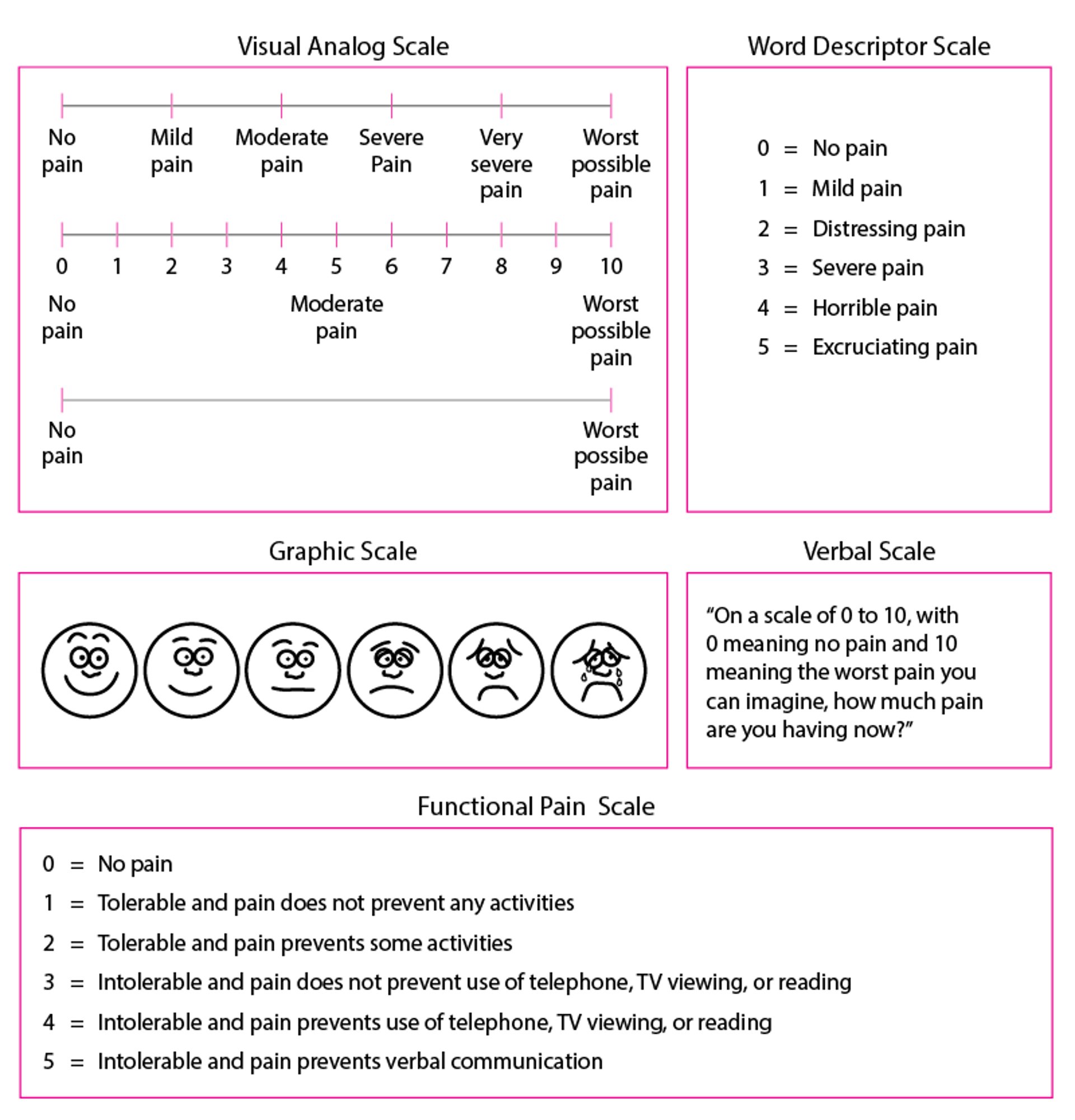
Several multidimensional pain scales (eg, the McGill Pain Questionnaire) exist, but they are complex and too difficult for routine clinical use. Recording pain as it occurs (eg, in a pain diary) increases the accuracy of reporting. Pain that worsens in a predictable temporal pattern may suggest that modifying drug dose, drug timing, or other factors may provide relief. Psychiatric and social histories help in the evaluation of chronic pain. Depression, secondary gain, personality disorders, and psychologic stress should be evaluated. Physical examination includes checking for the changes in vital signs and autonomic functions common in acute pain. Examination should also focus on the musculoskeletal system and include palpation for trigger points, evaluation for swelling and inflammation, and evaluation for pain with passive range of motion or straight leg raising. In patients with dementia, pain is suggested by facial grimacing, frowning, or repetitive eye blinking. Neurologic examination should include a search for signs of sensory, motor, and autonomic deficits and signs that may indicate nerve damage, suggesting neuropathic pain. The cause of pain is sometimes obvious. If not, the history is usually more likely than examination or testing to identify the cause. For example, sometimes pain has certain characteristics (eg, burning quality, distribution along a nerve pathway) that suggest neuropathic pain. Occasionally, examination identifies an unexpected cause of pain. Some causes of pain (eg, osteoporotic vertebral fractures, small fractures of the pelvis, polymyalgia rheumatica) may be difficult to recognize. However, in the elderly, pain often has multiple causes, and no single predominant cause can be identified. Determining the cause may be particularly difficult in patients with coexisting disorders, impaired cognition or language function, depression, or anxiety. For some patients, brief hospitalization may be required to establish a diagnosis, formulate a plan of care, and establish pain control. TreatmentThere are few controlled data on pain management strategies in elderly people, particularly in the oldest old. Information has been largely extrapolated based on younger patients. Several organizations have published clinical practice guidelines for pain management. Statements about management of pain from the American Pain Society are available at www.ampainsoc.org/advocacy/. Guidelines from the American Geriatrics Society are available at www.americangeriatrics.org/products/chronic_pain.pdf. However, published guidelines are often not followed. Inadequate pain relief is very common. Poor pain management decreases quality of life, indicates poor quality of care (especially among patients near the end of life or in long-term care settings), and may contribute to suicide. Treatment goals, expectations, benefits, and risks should be discussed with the patient. Factors such as disability, limited economic resources, complex drug regimens, and lack of transportation can make adherence to treatment difficult and should be considered when treatment decisions are made. An interdisciplinary approach can be particularly useful. Drugs plus nondrug treatment can control pain more effectively than either method alone. The health care setting may affect pain management. Some patients prefer home to an institution, even though pain may be worse because sophisticated pain management is unavailable at home. Also, home care can place substantial demands on family caregivers, who see their loved ones in pain and do not know what to do. Caregivers may need to decide when and how to administer drugs. Sometimes caregivers miss work or interrupt their own sleep to provide care. They may be further stressed by the conflict between wanting to help the patient control pain and being overly concerned about dependence and addiction. In such situations, a patient with inadequate pain control is often taken to a local emergency department, where care may be compromised because individualized goals for the patient's care are unknown. Health care institutions can also compromise pain control. For example, they may overenforce regulations, excessively limiting use of heating pads (for fear of thermal injuries), visiting hours, or use of television and radios (which provide useful distraction). In patients with severe pain, adequate pain control may be hampered by health care practitioners' misconceptions and concerns about dependence and addiction. Each patient's situation should be realistically evaluated, and unreasonable concerns should be put aside. In terminally ill patients, adequate pain control is often more important than the adverse effects of analgesics. The goals of treatment must be clearly established and adhered to by all people involved in care. Analgesic regimens: The elderly are more likely than younger people to experience adverse effects of analgesics. Thus, dosing usually requires careful titration (starting low and going slowly), with frequent assessment and dosage adjustments. Patients with acute pain should be reassessed when the drug's effect is predicted to begin, to peak, or both. Drug regimens should be as simple as possible, particularly in nursing homes and private homes. Nonetheless, combining different classes of drugs (eg, an opioid plus acetaminophen, an NSAID, or an adjuvant analgesic drug) may help. Oral analgesic administration is usually preferred because it is convenient and results in relatively steady blood levels. Usually, onset of pain relief occurs within 30 min, and peak efficacy occurs about 2 h after administration. IV administration provides the most rapid but shortest-lasting pain relief. Transcutaneous administration of some analgesics provides efficient long-lasting pain relief. IM and sc injections are not usually the route of choice because absorption and blood levels (and thus pain relief) fluctuate widely and the injection causes pain. For chronic pain, long-acting drugs or sustained-release formulations are preferred; these drugs require fewer doses, although care should be taken to avoid drug accumulation. Rapid-onset, short-acting drugs should also be available as supplements for breakthrough pain. For acute or rapidly fluctuating pain, short-acting drugs with rapid onset are preferred. IV injection is ideal but may not always be practical. If a procedure or activity known to be painful is anticipated, pretreatment for pain is possible. Pretreatment is usually more effective than waiting for pain to occur and lowers the total drug requirement. Acetaminophen: Acetaminophen is the analgesic of choice for most elderly people with mild to moderate pain. Despite its relative lack of anti-inflammatory activity, acetaminophen is usually the best drug for initial treatment of osteoarthritis. Acetaminophen 650 to 1000 mg qid is safer for most patients than NSAIDs and other analgesics. The total daily dose should not exceed 4000 mg because long-term use of higher doses can result in irreversible hepatic necrosis. Long-term use of lower doses may result in elevated liver enzymes. The acetaminophen dose should be reduced for alcoholics and for patients with elevated liver enzymes; warfarin doses may require adjustment. NSAIDs: NSAIDs are indicated when inflammation contributes significantly to pain. They are also useful for other types of pain when acetaminophen is inadequate, and many are longer-acting than acetaminophen. NSAIDs are often useful with other analgesics (eg, with opioids for treating bone pain due to cancer). An advantage of NSAIDs over opioids is their relative lack of sedative and respiratory depressant effects. Overall, NSAIDs seem to be equally effective, but efficacy may vary among patients, and several NSAIDs may be tried before relief is obtained (see Table 43-2). Adverse effects also vary, and a patient may tolerate one NSAID better than another. NSAIDs tend to have a ceiling analgesic dose; ie, increasing the dose beyond a certain dose does not increase analgesia. The therapeutic effects of NSAIDs are due to inhibition of cyclooxygenase (COX), which is required for the synthesis of prostaglandins. There are 2 COX isoforms: COX-1 is expressed in most tissues, including gastric mucosa, and COX-2 is induced in inflammatory cells and synovium during inflammation. COX-2 is also present in kidneys but not in platelets. Most NSAIDs inhibit both COX-1 and COX-2. However, selective COX-2 inhibitors (coxibs; eg, celecoxib) inhibit COX-2 preferentially and thus cause less gastric irritation and ulceration. Rates of GI bleeding are lower than those with nonselective NSAIDs, but bleeding can still be life threatening. COX-2 inhibitors inhibit platelet function far less than nonselective NSAIDs. However, COX-2 inhibitors increase risk of MI and stroke; current data suggest that cardiovascular risk increases after prolonged, continuous use and may be dose-related. COX-2 inhibitors should not be prescribed for long periods of time, and their use should be limited to patients who have a high risk of GI bleeding, who are intolerant of nonselective NSAIDs, or who have a history of intolerance. If such patients have cardiovascular risk factors, most NSAIDs, including COX-2 selective inhibitors, should be avoided, and alternatives should be sought. Some evidence suggests that increased cardiovascular risk may be a class effect of all NSAIDs (for COX-2 inhibitors and nonselective NSAIDs), except for those that substantially inhibit thromboxane activity (eg, aspirin). The most common adverse effect of all NSAIDs is GI upset, which may require stopping the drug. Taking NSAIDs with food may help minimize GI symptoms. Ulceration and GI bleeding can also occur; usually, they are more likely to occur with high doses, with frequent or prolonged NSAID use, or with NSAIDs that have low selectivity for COX-2. GI upset and ulceration with or without bleeding can occur simultaneously or independently of each other. Risk of ulcers and GI bleeding for people > 65 is 3 to 4 times higher than that for middle-aged people. Concomitant use of cytoprotective drugs (eg, the prostaglandin misoprostol, proton pump inhibitors) may decrease the incidence in high-risk patients. Both nonselective and selective NSAIDs can impair renal function and cause Na and water retention; they should be used cautiously in the elderly, particularly in those who have a renal disorder, heart failure, hypovolemia, or a liver disorder. Rare toxic effects in the elderly include cognitive impairment and personality changes. Indomethacin causes more confusion in the elderly than other NSAIDs and should be avoided. Nonacetylated salicylates (eg, salsalate) may have less renal toxicity and fewer antiplatelet effects than other NSAIDs, but they may not be as effective. Opioids: Opioids are the most potent analgesics. Opioids act by blocking receptors in the CNS and by other mechanisms; opioids relieve all types of pain. In the elderly, opioids have an increased half-life and possibly a greater analgesic effect than in younger patients. Nonetheless, the most common error in prescribing these drugs is to give them too infrequently, allowing breakthrough pain. Many opioids must be given every 2 to 3 h, although longer-acting formulations are available. Opioids vary in potency and adverse effects (see Table 43-3). Choice of opioid depends on the strength, rapidity of onset, and duration needed. Route of administration may be important. A few opioids have specific advantages and disadvantages. Fentanyl causes less histamine release and thus less vasodilation and hypotension. Fentanyl may be useful for pretreatment of pain resulting from brief procedures and for patients at risk of hypotension (eg, due to trauma or burns). Meperidine is usually avoided in the elderly. Meperidine is less effective when given orally and can cause confusion; also, it is metabolized to an active form that tends to accumulate and thus may lead to CNS excitement and seizures. Opioid agonist-antagonists, which have both agonist and antagonist effects on opiate receptors, often have psychotomimetic effects (eg, delirium) in the elderly. For this reason, pentazocine and butorphanol are rarely appropriate for the elderly. The analgesic effect of propoxyphene is similar to that of aspirin or acetaminophen, but dependency and renal impairment may occur; thus, propoxyphene generally should not be used in the elderly. In patients with renal insufficiency, excretion of morphine and codeine may be delayed, resulting in undesirably long therapeutic or adverse effects, particularly with sustained-release formulations. In these patients, hydromorphone or oxycodone is less likely to accumulate and may be preferred. Opioids can be given transdermally. However, transdermal fentanyl should be used only in patients who have already been stabilized on opioids (ie, who are not opioid-naive). Transdermal fentanyl is long-lasting and thus useful for patients who lack the supervision they need to correctly take drugs with frequent dosing. However, peak analgesic effect of transdermal fentanyl occurs 18 to 24 h after application. If this drug is used, a rapid-onset analgesic is required in the meantime. Also, the reservoir for this system is the skin, not the patch; therefore, if overdosing occurs, removing the patch does little to stop drug delivery within the first 18 h after removal. Continuous opioid infusion (IV, sc, intrathecally, or epidurally) provides steady-state analgesic drug levels. Continuous infusion has become the method of choice for perioperative pain management, even in frail elderly patients. Continuous infusion may also be useful if regional techniques and NSAIDs are ineffective or inappropriate in patients near the end of life. Patient-controlled analgesia (PCA) enables a patient to increase drug delivery as needed. This technique results in a more stable blood drug level, avoiding the roller-coaster effects of IM dosing. PCA also reduces overall drug use and has fewer adverse effects. Patients with confusion or dementia cannot safely or effectively use PCA. IM injection is rarely desirable. Initially, blood drug levels are high, resulting in more frequent adverse effects; then the levels decrease rapidly, resulting in pain recurrence. Opioids have no ceiling analgesic effect as dosage is increased. The maximum dose is whatever is needed to relieve pain. However, adverse effects (eg, respiratory depression) may limit dose. Two dosing rules are useful but unproven:
Opioids cause dose-related sedation, cognitive impairment, and respiratory depression. Some tolerance to these effects develops (usually within a few days). Most, if not all, elderly patients taking opioids should not drive and should take precautions to prevent falls or other accidents. Opioids may cause persistent sedation in patients who require high doses (eg, because of widespread end-stage cancer). Sedation that interferes with quality of life can be treated with stimulant drugs such as methylphenidate. Methylphenidate 5 to 10 mg may be given before a family visit, dinner, or some other event that requires increased alertness. Opioids may cause confusion. If confusion is due to an opioid, pupils are usually very constricted. Sometimes decreasing the dose or frequency of administration may relieve confusion without significantly decreasing analgesia. If this approach is ineffective, a different analgesic may be necessary. Opioids almost always cause constipation or urinary retention. Patients do not develop tolerance to these adverse effects. When an opioid is started, the patient's intake of fluid and fiber should be increased to try to prevent constipation, but a stimulant laxative is almost always needed. If a laxative must be taken for a long time, an osmotic laxative (eg, sorbitol) is used, but some patients require regular enemas. For urinary retention, double voiding or use of the Credé's method during voiding may help. Opioids occasionally cause nausea, sometimes with vertigo. Nausea may be due to several mechanisms: stimulation of the vestibular system, gastric or colonic paresis, or stimulation of midbrain chemoreceptors. Some patients develop tolerance to nausea within a few days. If vertigo persists, an antihistamine antiemetic (eg, meclizine) may be appropriate, although it may exacerbate constipation, urinary retention, and sedation. Tolerance to the analgesic effects of opioids is difficult to predict; it develops much more slowly than tolerance to adverse effects (particularly sedation and respiratory depression) and is often absent or inapparent. In some patients, pain is controlled by stable doses of opioids for many years. Patients with cancer may require progressively higher doses of opioids, possibly because their pain increases as the cancer advances. Fear of dependence and addiction is common among patients as well as some health care practitioners; such fears should be discussed and unreasonable concerns put aside so that opioids can be used without unnecessary inhibition. Dependence (indicated by withdrawal symptoms after abrupt opioid cessation) usually develops only after constant and prolonged drug exposure. Withdrawal symptoms can usually be prevented or ameliorated by tapering opioids over a few days, typically a 25% decrease in the dose every 24 to 48 h. Severe withdrawal can usually be treated with clonidine in titrated doses. True addiction (psychologic craving and use for effects other than pain relief) is rare among patients taking opioids for medical reasons. Opioid addiction seems to be less common among elderly than among younger patients. Adjuvant analgesic drugs: Various drugs that are not formally classified as analgesics are helpful for certain types of pain (see Table 43-4), particularly for neuropathic pain. Adjuvant analgesics provide relief in about 50 to 70% of patients with neuropathic pain; however, relief is usually only partial, so another analgesic or nondrug treatment is usually necessary. Gabapentin is the most widely used adjuvant analgesic. However, the doses needed are often very high, and toxicity often limits its use. The starting dose is usually 100 mg tid but may be as low as 100 mg once/day for frail patients. The dose is titrated slowly up to 600 mg tid. Doses up to 3600 mg/day have been used in some patients. Dose reductions of gabapentin are recommended in renal insufficiency. Dizziness and drowsiness are common adverse effects. Other drugs used for neuropathic pain include duloxetine and pregabalin. Duloxetine is particularly useful when depression is also present. The analgesic mechanism of antidepressants probably involves interruption of brain mechanisms mediated by norepinephrine and serotonin. The capacity of antidepressants to alter mood may also be helpful, especially for patients with depression. For tricyclic antidepressants, there is little evidence that one is better than another; however, amitriptyline, which is highly sedating and anticholinergic, should be avoided in the elderly. Oral mexiletine sometimes relieves pain due to diabetic neuropathy. Doses used to relieve pain are often ½ to 2/3 of the doses used to treat cardiac arrhythmia, which have a high risk-benefit ratio. Calcitonin may reduce chronic pain due to osteoporosis and acute pain due to osteoporotic vertebral fractures. Bisphosphonates (eg, alendronate, ibandronate, pamidronate, risedronate, zoledronate) can reduce pain due to bone metastases. Local anesthetics injected into trigger points are sometimes effective, particularly when combined with physical therapy. For example, in myofascial pain syndromes, injection followed by stretching and reconditioning of the muscles usually lessens symptoms. Local anesthetics injected into joints can relieve acute monarticular or oligoarticular arthralgia with effusion. Topical drugs are widely used, particularly for pain originating in peripheral nerves. Capsaicin cream, other compounded creams (eg, local anesthetic creams, NSAID creams), or a lidocaine 5% patch should be considered for many types of pain. Risk of systemic adverse effects is small unless topical drugs are applied to inflamed mucous membranes, making systemic absorption more likely. Nondrug treatment: Physical therapy techniques (eg, exercise, heat and cold therapy) can sometimes reduce pain due to musculoskeletal disorders. Endurance and muscle-strengthening exercises, done regularly and at moderate intensity, can improve function as well as reduce this type of pain. Pain due to muscle spasm may be reduced by gentle stretching, range-of-motion exercises, muscle massages, cold therapy (eg, cold packs, ice massage, vapo-coolant spray), or heat therapy (eg, heating pads, warm compresses, infrared heat, whirlpool). Diathermy and ultrasound may relieve musculoskeletal pain originating in deep tissues. Immobilization of a painful joint may help; however, in the elderly, immobilization for more than a few days increases risk of adhesive capsulitis and permanent restriction of joint motion. Severe, intractable joint pain due to osteoarthritis may require total joint arthroplasty. Transcutaneous electrical nerve stimulation (TENS) can relieve many types of pain. TENS decreases postoperative use of analgesics and improves mobility. Pain originating in specific peripheral nerves can be treated with cryotherapy. A cryoprobe is used to apply extreme cold to the affected nerves. It can be used during thoracotomy to help relieve postoperative pain. In a few patients with a short life expectancy, refractory pain can be treated with neuroablation (neural pathway destruction). The most common technique is cordotomy (ablation of the ascending spinothalamic tract). Cordotomy can be effective for several years, but paresthesias and dysesthesias may develop. If pain is confined to one or a few specific dermatomes, rhizotomy (ablation of the dorsal roots) can be used. Alternative therapies (eg, acupuncture, homeopathy, spiritual healing, vitamins, medicinal herbs, natural remedies) are used by many patients to control pain, with or without their physician's recommendation or knowledge. Many alternative herbal or so-called natural products are not regulated as strictly as drugs and may cause toxicity. Nursing issues: Nurses should assess pain frequently and communicate their findings to physicians, particularly when patients are reluctant to do so. Nurses should give opioids as prescribed. If opioids are to be used as needed, they should be given liberally, before pain becomes severe, unless they are contraindicated (eg, due to temporary respiratory depression). If opioid use is scheduled, the schedule should be followed unless a specific reason dictates otherwise. Nurses can help teach patients and caregivers how to manage pain. Patient and caregiver education: Education programs significantly improve overall pain control. These programs, provided in groups or tailored to individual needs and level of understanding, can teach patients and caregivers about the nature of pain and about use of pain diaries, pain assessment instruments, analgesics, and nondrug self-help strategies. This topic was last updated December 2005. |
Copyright © 2009 Merck Sharp & Dohme Corp., a subsidiary of Merck & Co., Inc., Whitehouse Station, N.J., U.S.A. Privacy Terms of Use Sitemap