Patients & CaregiversHealthcare Professionals - Opens new windowWorldwide - Opens new window
HomeAbout Merck Products Newsroom Investor Relations CareersResearchLicensingThe Merck Manuals

The Merck Manual of Geriatrics logo
red line
click here to go to the Contents page of The Merck Manual of Geriatrics
click here to go to the title page of The Merck Manual of Geriatrics
click here to search The Merck Manual of Geriatrics
click here to go to the Index of The Merck Manual of Geriatrics
red line
Section 6. Neurologic Disorders
Chapter 46. Movement Disorders
Topics:    Introduction | Tremor | Parkinson's Disease | Progressive Supranuclear Palsy | Multiple System Atrophy | Fragile X-Associated Tremor/Ataxia Syndrome | Tardive Dyskinesia and Tardive Akathisia | Myoclonus

red line

Parkinson's Disease

Parkinson's disease is an idiopathic, slowly progressive, degenerative CNS disorder characterized by tremor (usually resting tremor), muscular rigidity, bradykinesia, hypokinesia, and eventually postural instability. Some patients develop dementia. Similar symptoms (called parkinsonism) may occur secondary to other disorders, drugs (especially antipsychotic drugs), or toxins. Diagnosis is by history and physical examination. Initial drug treatment includes carbidopa/levodopa or dopamine agonists. Other options include monoamine oxidase type B inhibitors, catechol-O-methyltransferase inhibitors, amantadine, and, for drug-resistant tremor or levodopa-induced motor complications, possibly deep brain stimulation.

Geriatric Essentials

  • Parkinson's disease is the most common cause of parkinsonian symptoms, but other disorders can cause similar symptoms, as can certain drugs, most notably antipsychotic drugs.
  • Patients often have insomnia or daytime sleepiness (eg, secondary to sedating antiparkinsonian drugs, nocturnal exacerbation of parkinsonian symptoms, or nocturia).
  • Patients may have masked facies and bradykinesia, which may be mistaken for depression. Nevertheless, true depression is common among patients with Parkinson's disease.
  • Some changes of normal aging (eg, slowing down, stiffness, loss of balance, difficulty walking, stooped posture) may be mistaken for parkinsonism.
  • Treatment is best managed by a multidisciplinary team. Physical and occupational therapy, assistive devices, and measures to prevent falls are essential.
  • Constipation should be prevented or relieved with dietary fiber, fruit juices, and sometimes laxatives.
  • Antiparkinsonian drugs tend to cause confusion and psychosis in elderly patients. For some patients, atypical antipsychotics can help. Anticholinergic drugs, which often cause sedation, confusion, urinary retention, dry mouth, and blurred vision, should not be used in elderly patients.
  • End-of-life issues (eg, appointment of a surrogate to make medical care decisions, guidelines for use of tube feeding) should be discussed early.

Parkinson's disease (also called primary or idiopathic Parkinson's disease) affects about 0.3% of the general population, 3% of people >= 65, and 10% of people > 80. The mean age at onset is about 60. Parkinson's disease is more common among whites than among Asians or blacks. About 15 to 20% of affected patients have a family history of Parkinson's disease. Some genes have been identified in a small number of affected families: on chromosome 4, genes for alpha-synuclein and ubiquitin and on chromosome 12, a gene for LRRK2 (these genes are autosomal dominant); on chromosome 6, a gene for parkin and on chromosome 1, a gene for DJ-1 (these genes are autosomal recessive).

Motor symptoms similar to those of Parkinson's disease (eg, bradykinesia, rigidity, resting tremor) are called parkinsonian symptoms, or parkinsonism. Parkinsonism is most often caused by Parkinson's disease. However, parkinsonism may be secondary to other disorders, often as the predominant clinical manifestation (see Table 46-4).

Parkinsonism can be caused by drugs, especially antipsychotics.

Parkinsonism is a common cause of disability in elderly people.

Pathophysiology

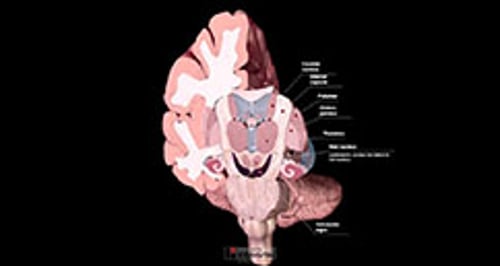
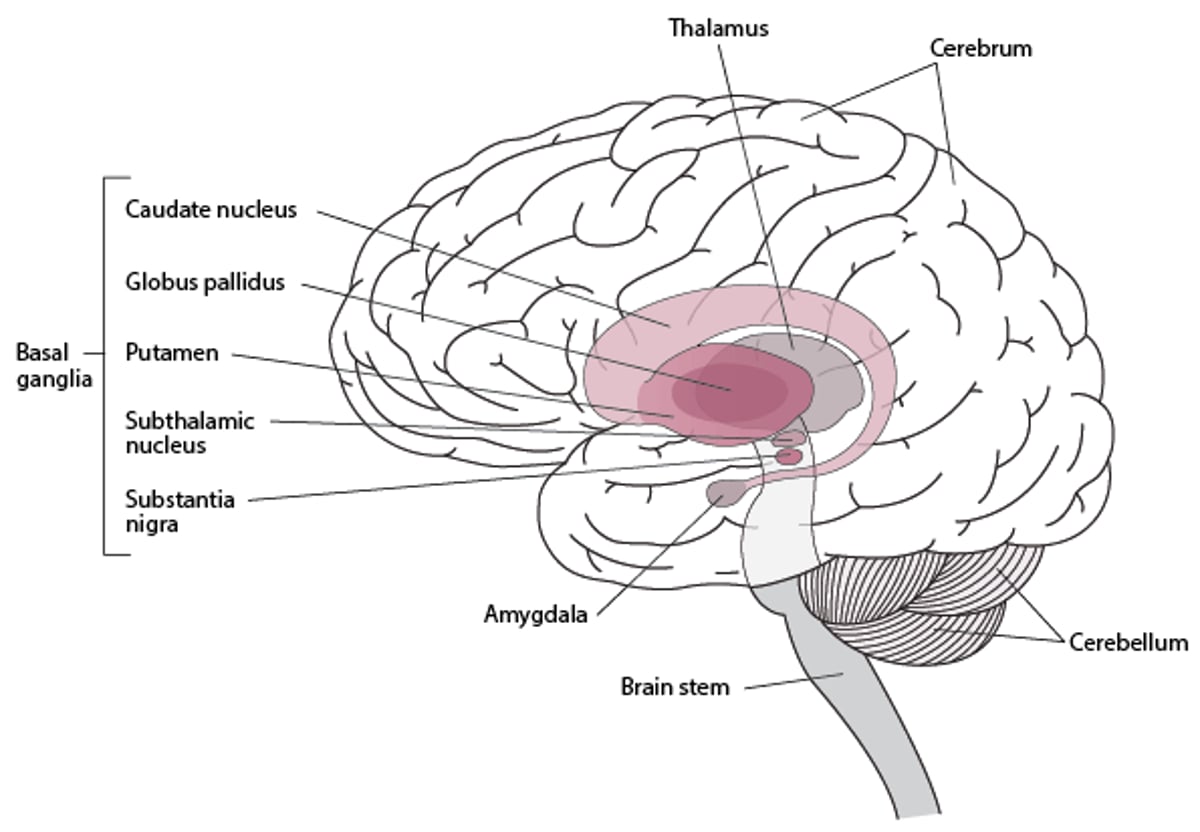
In Parkinson's disease, striatal dopamine is deficient, and dopaminergic neurons are lost in the substantia nigra. In secondary parkinsonism, dopaminergic nigral neurons may be lost, the nigral striatal pathway may be impaired, striatal cellular elements may be lost, or postsynaptic dopamine receptors may be blocked. Selective destruction of dopaminergic nigral neurons may result from damage by free radicals produced during oxidative stress. The cause of oxidative stress is unknown.

Symptoms and Signs

Parkinson's disease begins insidiously; its cardinal features of tremor, rigidity, and bradykinesia may appear alone or in combination. One of the most common initial symptoms is resting tremor, often asymmetric, classically involving the fingers in a pill-rolling motion. The tremor is slow and coarse. It is maximal at rest, lessens during movement, and, like most tremors, is absent during sleep; it is exacerbated by emotional tension or fatigue. Usually, the hands, arms, and legs are most affected. The jaw may also be affected, but not the voice or head. Tremor may become less prominent as the disease progresses.

Rigidity is manifested as muscle stiffness. Movement becomes slow (bradykinetic), decreased (hypokinetic), and difficult to initiate (akinetic). Rigidity and bradykinesia may contribute to muscular aches and fatigue. During routine tasks, voluntary movement may suddenly and unexpectedly halt as if frozen (called freezing), and patients may be unable to complete the action. For example, while walking, patients may suddenly feel as if their feet are frozen to the ground. Examination may detect cogwheel rigidity. Performance of rapid alternating movements is impaired mainly because of rigidity. Rapid finger tapping may decrease in amplitude and increase in speed until the fingers seem stuck together.

Gait becomes shuffled, and one or both arms may not swing. A tendency for movements to become smaller and faster may affect several functions. Speech tends to become more rapid until words run together into a mumble. Handwriting tends to involve smaller and tighter loops (micrographia). Gait involves quicker and smaller steps, sometimes breaking into a run (festination).

Erect and sitting postures are abnormal; an erect posture is not readily assumed or maintained. The head tends to fall forward on the chest. A loss of postural reflexes causes the body to fall forward (propulsion) or backward (retropulsion) unless it is supported. Bradykinesia hinders the patient from taking a step or moving the arms to stop the fall. A conspicuous feature of parkinsonism, kyphosis of the spine, causes a stooped posture.

The face can become masklike, with lack of expression, open mouth, and diminished eye blinking. Nonsuppressible eye closure can be induced when the frontal muscle between the eyes is tapped (glabellar reflex; if persistent, called Myerson's sign). Patients have difficulty swallowing and may drool. Speech becomes hypophonic, with characteristic monotonous, stuttering dysarthria. The skin has an oily quality; seborrheic dermatitis may develop.

Mood abnormalities, usually depression or anxiety, are common and may be the heralding symptom. Sometimes bradykinesia and decreased facial expression make patients appear depressed, even when mood is unaffected.

Cognitive impairment and dementia occur in about 30 to 40% of patients. Cognitive impairment can be secondary to drugs, concomitant changes due to Alzheimer's disease, severe depression, sleep disorders, or Parkinson's disease itself. Elderly patients and patients without tremor are at greater risk of dementia associated with Parkinson's disease. Dementia usually occurs when Parkinson's disease is advanced and often indicates disease progression.

Elderly patients with Parkinson's disease may also have insomnia or daytime sleepiness. Low nocturnal dopamine levels worsen symptoms of Parkinson's disease, causing frequent nighttime awakenings. Insomnia may also result from too much sleep during the day, possibly because sedating antiparkinsonian drugs are used. Frequent nocturia, another feature of Parkinson's disease, may cause nocturnal awakenings. Sleep disorders (eg, sleep apnea, REM [rapid eye movement] sleep behavior disorders) may also contribute to insomnia.

Constipation is also common. It can be secondary to antiparkinsonian drugs, physical inactivity, or Parkinson's disease itself.

Parkinson's disease invariably progresses. Some patients become disabled within 10 yr, but most remain functional longer.

Diagnosis

Parkinson's disease is diagnosed clinically if 2 of the 3 cardinal features (resting tremor, rigidity, and bradykinesia) are present. Almost all patients have bradykinesia; tremor or rigidity may be absent.

Essential tremor, which is commonly confused with Parkinson's disease, can be differentiated because essential tremor is an action (kinetic) tremor. Also, the patient's face is animated, rate of movement and muscle tone are normal, and gait abnormalities are absent.

Some changes of normal aging (eg, slowing down, stiffness, difficulty walking, stooped posture, loss of balance) may suggest Parkinson's disease. However, Parkinson's disease, unlike normal aging, causes symptoms that begin asymmetrically and thus can often be differentiated.

Lesions of the corticospinal tracts can cause spasticity rather than the rigidity that occurs in Parkinson's disease. Spasticity due to corticospinal tract lesions, unlike the rigidity of Parkinson's disease, occurs preferentially in distal antigravity muscles; it increases tendon reflexes and causes extensor plantar responses (Babinski's sign). Spasticity also increases muscle tone in proportion to rate and degree of stretch placed on a muscle until resistance suddenly melts away (clasp-knife rigidity).

Causes of secondary parkinsonism are identified primarily by the history and, when indicated, by neuroimaging. History should include questions about head trauma, stroke, hydrocephalus, drug use, toxin exposure, and symptoms or history of other degenerative neurologic disorders. However, differentiating between Parkinson's disease and secondary parkinsonism is sometimes difficult, particularly early in the disease.

Treatment

Any underlying disorders are treated. Drugs that cause or worsen parkinsonism, especially antipsychotics, should be stopped. No cure is available for Parkinson's disease or secondary parkinsonism, unless it is due to drugs. Patients with mild symptoms often do not require drug treatment. Most other patients require lifelong drug treatment to control symptoms. Treatment should be individualized according to the type and severity of symptoms, the degree of functional impairment, the degree of cognitive impairment, any coexisting disorders, and the risk-benefit ratio. Treatment may require an interdisciplinary team that includes a neurologist, a psychiatrist, a nurse, a physical therapist, an occupational therapist, and a speech therapist.

Nondrug treatment: A regular exercise program may be helpful. Elderly patients who are limber and active may better adapt to the progressively increasing stiffness and slowness. Physical therapy may restore confidence in walking and maintaining balance, may help patients develop simple ways of managing unpredictable and disabling freezing episodes (eg, counting out loud while taking steps), and can include training to use a cane or walker if necessary. Occupational therapy may be indicated to train patients in strategies for carrying out daily tasks (eg, dressing, cooking) and in use of adaptive equipment to simplify tasks. An occupational therapist may visit the home to help plan the appropriate placement of railings, grab bars, or other assistive devices that may reduce the risk of falls. Continued therapy is warranted.

Constipation is common and can often be prevented by regular exercise and regular dietary intake of fruit, high-fiber foods, prune and other juices, and other liquids. Treatment of established constipation requires the addition of laxatives (eg, senna concentrate, 1 to 6 tablets/day; tablets contain 8.6 mg sennosides).

Drug treatment: Drugs used to treat Parkinson's disease may cause confusion and psychosis in elderly patients (see Table 46-5). In general, the lowest number of drugs and the lowest doses that can control symptoms are used to reduce the risk of adverse effects. Levodopa is often the first and is ultimately the most important drug used; it can be given as an immediate- or a sustained-release preparation and is usually combined with carbidopa. Dopamine agonists (pramipexole, ropinirole) are alternatives for initial drug therapy. Other drugs (eg, amantadine, selegiline, anticholinergic drugs) may be used in addition to levodopa or, occasionally early in Parkinson's disease, instead of levodopa for a brief time. Levodopa provides the greatest benefit: a greater reduction in motor symptoms with fewer CNS effects, which are undesirable. Selegiline is occasionally used in elderly patients; however, it does not provide much symptomatic benefit. Anticholinergic drugs provide the least benefit and are avoided whenever possible in the elderly. In some patients, giving catechol-O-methyltransferase (COMT) inhibitors with levodopa provides added benefit. Confusion and disorientation, which are common adverse effects of dopamine agonists, can be treated by reducing the doses or stopping antiparkinsonian drugs if possible. Anticholinergic drugs should be stopped first, followed by amantadine, selegiline, dopamine agonists, and COMT inhibitors. The levodopa dose can be reduced if patients can tolerate a reduction, but the drug can rarely be stopped.

Symptoms of recent onset, especially if tremor predominates and functional impairment is mild, can be treated with amantadine (for patients with adequate renal function, 100 mg po bid or tid). Amantadine promotes dopamine release in the corpus striatum but has mild anticholinergic effects. Used as monotherapy, it may lose its effectiveness after several months.

Selegiline may protect nigral cells from damage due to oxidative stress. Selegiline also selectively inhibits monoamine oxidase type B (MAO-B), one of 2 major enzymes that break down dopamine, and thus increases dopamine activity. Doses of 5 mg po bid may be used early in the disease to minimally suppress symptoms. Adverse effects are unusual but may include nausea, insomnia, and confusion. Although chemically related to other MAO inhibitors, selegiline usually does not cause hypertensive crisis when tyramine cheeses are eaten. Selegiline should not be used with tricyclic antidepressants, meperidine, or other opioids.

When functional impairment increases, patients should be treated with drugs whose predominant effect is to replenish or activate striatal dopamine (eg, dopamine precursors, dopamine agonists). Because dyskinesia and motor fluctuations are less common than with levodopa during the first several years of therapy, a dopamine agonist is sometimes used as a first-line drug.

Levodopa is combined with carbidopa or benserazide to reduce peripheral decarboxylation of levodopa to dopamine and thus reduce the peripheral effects of levodopa. Carbidopa is a decarboxylation inhibitor that does not cross the blood-brain barrier.

Treatment usually begins with a half tablet of the 25/100 combination (25 mg carbidopa and 100 mg levodopa) bid or tid. After 1 wk, the dose can be increased to a full tablet tid if needed and if tolerated. After several weeks, the dose can be increased if needed by a half to a full tablet/day q 5 to 7 days. Some clinicians add a dopamine agonist when the required levodopa dose approaches 800 mg/day rather than increase the levodopa dose further. When peripheral adverse effects (eg, flushing, abdominal cramping, anorexia, nausea, palpitations) occur, increasing the amount of carbidopa or giving the drug with food may help. High protein meals may decrease absorption of levodopa; therefore, patients should take levodopa 30 min before or 1 h after a high-protein meal if drug levels in the blood are thought to be fluctuating. When CNS adverse effects (eg, nightmares, confusion, hypotension, drowsiness, dyskinesia) occur, decreasing the dose of levodopa may be necessary. An orally dissolvable immediate-release form of carbidopa/levodopa is also available; because it can be taken without water, it is particularly useful for patients who have difficulty swallowing. It is used in the same dosages and dosing frequency as immediate-release carbidopa/levodopa. Controlled-release carbidopa/levodopa (25/100 and 50/200) can be used when motor symptoms fluctuate; this form is less bioavailable, so the total daily dose should usually be about a 20 to 25% higher than immediate-release carbidopa/levodopa.

After 2 to 5 yr of treatment, levodopa becomes less effective for most patients: Its effect wears off (providing less symptom control) at the end of the dosing period, or the on-off effect (sudden, unpredictable fluctuations between mobility and immobility) occurs. Whether these effects are caused by levodopa or Parkinson's disease is controversial. Eventually, the period of improvement after each dose shortens, and the on-off effect occurs more frequently. When such changes occur, levodopa may be given at more frequent intervals (sometimes q 2 h), controlled-release levodopa can be substituted, or adjunctive drugs (dopamine agonists, COMT inhibitors, and selegiline) may be used.

Patients taking levodopa may also develop dyskinesia. It may be treated by reducing the total levodopa dose and adding a dopamine agonist or amantadine. If patients continue to have motor fluctuations or dyskinesia, surgery may be an option.

Dopamine agonists may be given initially as monotherapy or with carbidopa/levodopa. Use of dopamine agonists requires caution because nausea, orthostatic hypotension, and confusion are common initial adverse effects. CNS adverse effects are more common among the elderly and among patients with dementia. Dopamine agonists are given orally, usually tid. Bromocriptine and pergolide are rarely used because cardiac valvular fibrosis and pleural fibrosis are concerns. If used, bromocriptine is started at 1.25 mg po once/day and increased by 1.25-mg increments q 2 to 5 days to 5 to 15 mg tid. Pergolide is started at 0.05 mg po once/day and increased by 0.05-mg increments q 2 to 3 days to 0.25 to 1.5 mg tid. Ropinirole is started at 0.25 mg po tid and increased as needed to 3 mg tid over 8 wk in increments of 0.75 mg/wk for 4 wk, then 1.5 mg thereafter to reach a dose of 2 to 8 mg tid. Pramipexole is begun at 0.125 mg po tid and increased over 3 wk to 0.5 mg tid, then as needed to a maximum of 1.5 mg tid; the dose must be reduced in patients with renal insufficiency.

Apomorphine is an injectable dopamine agonist used as rescue therapy when off effects are severe. Onset of action is rapid (5 to 10 min), and duration is short (60 to 90 min). Apomorphine 2 to 6 mg sc can be given up to 5 times/day as needed. Adverse effects are similar to those of other dopamine agonists and may include nausea, vomiting, orthostatic hypotension, confusion, and hallucinations. Nausea can be prevented by starting trimethobenzamide 300 mg po tid 3 days before apomorphine and continuing it for the first 2 mo of treatment.

COMT inhibitors inhibit the breakdown of dopamine and are used only adjunctively with carbidopa/levodopa. Entacapone 200 mg po is given with each dose of levodopa, up to 8 times/day (eg, if levodopa is taken 5 times/day, entacapone 200 mg is taken 5 times/day). A single tablet containing carbidopa, levodopa, and entacapone is available in 3 preparations: (1) carbidopa 12.5 mg, levodopa 50 mg, entacapone 200 mg; (2) carbidopa 25 mg, levodopa 100 mg, entacapone 200 mg; and (3) carbidopa 37.5 mg, levodopa 150 mg, entacapone 200 mg. Tolcapone, another COMT inhibitor, is rarely used because of liver toxicity. If tolcapone is used, the dose is 100 mg po tid; written consent is required. Liver function tests must be done every 2 wk for the first year and monthly thereafter. If patients do not respond in the first month or if liver enzymes are elevated, tolcapone should be stopped.

Anticholinergic drugs are avoided whenever possible in the elderly because these drugs often cause sedation, confusion, urinary retention, dry mouth, and blurred vision. Specific contraindications include glaucoma, benign prostatic hypertrophy, and dementia.

Quetiapine (25 to 500 mg po at night or 25 to 250 mg po bid) is usually the initial drug used to treat psychosis in Parkinson's disease because quetiapine has fewer extrapyramidal effects than do other antipsychotics. In patients who cannot tolerate or do not benefit from quetiapine, clozapine (usually 6.25 to 75 mg po at night), which does not have extrapyramidal effects, may be used. However, clozapine can cause bone marrow suppression; therefore, a WBC count should be done weekly for 6 mo and every 2 wk thereafter.

Depression should be treated, usually with SSRIs (eg, escitalopram, fluoxetine, sertraline, paroxetine). Tricyclic antidepressants are usually avoided because of their anticholinergic and other adverse effects. Treatment of insomnia depends on the cause. For patients with insomnia due to exacerbation of parkinsonian symptoms at night, higher bedtime doses or sustained-release forms of levodopa may help; some patients prefer to set their alarm clocks and take levodopa in the middle of the night. If insomnia is due to too much sleep during the day, the daytime dosages of sedating antiparkinsonian drugs may need to be reduced.

Surgical treatment: If motor fluctuations, dyskinesia, or disabling tremor is refractory to drugs, surgery is considered. High-frequency electrical stimulation of the subthalamic nucleus is the treatment of choice, although stimulation of the globus pallidus interna may be considered. If the predominant symptom is severe tremor, deep brain stimulation of the ventral intermediate nucleus of the thalamus may be considered. Ablative surgery such as pallidotomy or thalamotomy is usually not recommended.

Nursing issues: The goal of nursing care for patients with Parkinson's disease is to maintain function and promote quality of life. Clinical care must include systematic assessment with standardized assessment tools (eg, Katz Activities of Daily Living Scale, Hamilton Depression Scale) to follow patients as they cope with difficult symptoms and a chronic debilitating disorder. Nurses must vigilantly watch for new symptoms resulting from drug treatment or from the sequelae of tremors and musculoskeletal changes. Patient education and family support are crucial. Nurses should inform patients and family members about available support groups and societies. Frequent nursing assessment, support in daily functioning (eg, eating, feeding, toileting, mobility, sleeping), and regular communication about depression and perceived quality of life are essential.

End-of-life issues: Many patients eventually become severely impaired and immobile and are at risk of aspiration. Eating, even with assistance, may become impossible. Many patients also develop dementia. Drugs, although effective for years, may not be able to control all symptoms as the disease progresses. For all of these reasons, health care practitioners should discuss end-of-life care issues early with patients; issues include whether tube feedings should be given and how aggressively acute disorders (eg, infections, respiratory failure) should be treated. Patients should also be advised to appoint a surrogate who can make medical care decisions if they become incapacitated.

This topic was last updated June 2006.

Contact Merck Site MapPrivacy PolicyTerms of UseCopyright 1995-2008 Merck & Co., Inc.