





Heat illness encompasses a number of disorders ranging in severity from muscle cramps and heat exhaustion to heatstroke (which can be a life-threatening emergency). Current estimates of heat-related mortality obtained from the Centers for Disease Control and Prevention indicate that heat illnesses in the United States are responsible for over 700 fatalities per year (1). The number is expected to climb significantly over the next few decades as global temperatures continue to rise (2).
Patients with heat exhaustion maintain the ability to dissipate heat and have normal central nervous system (CNS) function. In heatstroke, compensatory mechanisms for heat dissipation fail, and CNS function is impaired. Heatstroke should be considered in all patients with hyperthermia and altered mental status.
Malignant hyperthermia, neuroleptic malignant syndrome, and serotonin syndrome are other disorders in which hyperthermia (elevated body temperature) can be life threatening.
General references
1. Vaidyanathan A, Malilay J, Schramm P: Heat-related deaths—United States, 2004–2018. MMWR 69(24);729-734, 2020.
2. Khatana SAM, Werner RM, Groenveld PW: Association of extreme heat with all-cause mortality in the contiguous US, 2008-2017. JAMA Netw Open 5(5):e2212957, 2022. doi: 10.1001/jamanetworkopen.2022.12957
Pathophysiology of Heat Illness
Heat input comes from
The environment
Metabolism
Heat output occurs through the skin via the following:
Radiation: Transfer of body heat directly into a cooler environment by infrared radiation, a process that does not require air motion or direct contact
Evaporation: Cooling by water vaporization (eg, sweat)
Convection: Transfer of heat to cooler air (or liquid) that passes over exposed skin
Conduction: Transfer of heat from a warmer surface to a cooler surface that is in direct contact
The contribution of each of these mechanisms varies with environmental temperature and humidity. When environmental temperature is lower than body temperature, radiation provides 65% of cooling. Evaporation normally provides 30% of cooling, and exhalation of water vapor and production of urine and feces provide about 5%.
When environmental temperature is >35° C, evaporation accounts for virtually all dissipation of heat. However, the effectiveness of sweating is limited by the body's surface area and the ambient humidity. When humidity is > 75%, evaporative heat loss markedly decreases. Thus, if both environmental temperature and humidity are high, the risk of heat illness markedly increases.
The body can compensate for large variations in heat load, but prolonged or excessive exposure to heat that exceeds capacity for heat dissipation increases core temperature. Modest, transient core temperature elevations are tolerable, but severe elevations (typically > 41° C) can lead to protein denaturation and the release of inflammatory cytokines. As a result, cellular dysfunction may occur and an inflammatory cascade may be activated, leading to multiorgan dysfunction similar to that which follows prolonged shock.
Compensatory mechanisms include an acute-phase response that moderates the inflammatory response (eg, by stimulating production of proteins that decrease production of free radicals and inhibit release of proteolytic enzymes). Also, increased core temperature triggers expression of heat-shock proteins. These proteins transiently enhance heat tolerance by poorly understood mechanisms (eg, possibly by preventing protein denaturation) and by regulation of cardiovascular responses. With prolonged or extreme temperature elevation, compensatory mechanisms are overwhelmed, allowing inflammation and multiple organ dysfunction syndrome to occur.
Heat output is modulated by changes in cutaneous blood flow and sweat production. Cutaneous blood flow is 200 to 250 mL/minute at normal temperatures but increases to 7 to 8 L/minute with heat stress (and facilitates heat loss by convective, conductive, radiant and evaporative mechanisms), requiring a marked increase in cardiac output. Also, heat stress increases sweat production from negligible to > 2 L/hour, which can rapidly lead to severe dehydration and electrolyte loss. However, prolonged exposure triggers physiologic changes to accommodate heat load (acclimatization); eg, sweat sodium levels are 40 to 100 mEq/L (or 40 to 100 mmol/L) in people who are not acclimatized but decrease to 10 to 70 mEq/L (mmol/L) in acclimatized people.
Etiology of Heat Illness
Heat disorders are caused by some combination of increased heat input and decreased output (see table Common Factors Contributing to Heat Disorders).
Excess heat input typically results from strenuous exertion, high environmental temperatures, or both. Medical disorders and use of stimulant drugs can increase heat production.
Impaired cooling can result from obesity, high humidity, high environmental temperatures, wearing heavy clothing, and anything that impairs sweating or evaporation of sweat.
Clinical effects of heat illnesses are exacerbated by the following:
Inability to tolerate increased cardiovascular demands (eg, due to aging, heart failure, chronic kidney disease, respiratory disorders, liver failure)
Dehydration
Electrolyte disturbance
Use of certain drugs (see table Common Factors Contributing to Heat Disorders)
Older people and the very young are at increased risk. Older adults are at high risk because they more often take medications that can increase risk, have higher rates of dehydration and heart failure, and have age-related loss of heat-shock proteins. Children are at high risk due to their greater surface-area-to-body-mass ratio (resulting in greater heat gain from the environment on a hot day), and slower rates of sweat production. Children are slower to acclimatize and have less of a thirst response. Both older adults and young children may be relatively immobile and thus have difficulty leaving a hot environment.
Prevention of Heat Illness
Physicians should recommend the following measures (1) to help prevent heat illness:
During excessively hot weather, older adults and children should not remain in unventilated residences without air-conditioning.
Children and older adults should not be left in automobiles in the hot sun.
If possible, strenuous exertion in a very hot environment or an inadequately ventilated space should be avoided, and heavy, insulating clothing should not be worn.
Weight loss after exercise or work can be used to monitor dehydration; people who lose 2 to 3% of their body weight should be reminded to drink extra fluids and should be within 1 kg of starting weight before the next day’s exposure. If people lose > 4%, activity should be limited for 1 day.
If exertion in the heat is unavoidable, fluid should be replaced by drinking frequently, and evaporation should be facilitated by wearing open-mesh clothing or by using fans.
Hydration
Maintaining adequate levels of fluid and sodium helps prevent heat illnesses. Thirst is a poor indicator of dehydration and the need for fluid replacement during exertion because thirst is not stimulated until plasma osmolality rises 1 to 2% above normal. Thus, fluids should be drunk every few hours regardless of thirst. Because maximum net water absorption in the gut is about 20 mL/minute (1200 mL/hour—lower than the maximum sweating rate of 2000 mL/hour), prolonged exertion that causes very high sweat loss requires rest periods that reduce sweating rate and allow time for rehydration.
The best hydrating fluid to use depends on the expected loss of water and electrolytes, which depends on the duration and degree of exertion along with environmental factors and whether the person is acclimatized. For maximum fluid absorption, a carbohydrate-containing beverage can be absorbed by the body up to 30% faster than plain water. A beverage containing 6 or 7% carbohydrate concentration is absorbed most rapidly. Higher carbohydrate concentrations should be avoided because they can cause stomach cramps and delay absorption. However, for most situations and activities, plain water is adequate for hydration as long as overhydration is avoided. Significant hyponatremia has occurred in endurance athletes who drink free water very frequently before, during, and after exercise without replacing sodium losses. Special hydrating solutions (eg, sports drinks) are not required, but their flavoring enhances consumption, and their modest salt content is helpful if fluid requirements are high.
Laborers, soldiers, endurance athletes, or others who sweat heavily can lose ≥
Pearls & Pitfalls
|
Acclimatization
Successively and incrementally increasing the level and amount of work done in the heat eventually results in acclimatization, which enables people to work safely at temperatures that were previously intolerable or life threatening. To reach maximum benefit, acclimatization usually requires spending 8 to 11 days in the hot environment with some daily exercise (eg, 1 to 2 hours/day with intensity increased from day to day). Acclimatization markedly increases the amount of sweat (and hence cooling) produced at a given level of exertion and markedly decreases the electrolyte content of sweat and the risk of a heat illness. People who are not acclimatized are more likely to suffer from heat cramps or other heat illness during prolonged exertion and may need to increase their sodium intake.
Pearls & Pitfalls
|
Moderation of activity level
When possible, people should adjust their activity level based on the environment and any heat loss-impairing gear (eg, firefighting or chemical protective outfits) that must be worn. Work periods should shorten and rest periods increase when
Temperature increases
Humidity increases
Workload is heavier
Sun gets stronger
There is no air movement
When protective clothing or gear is worn
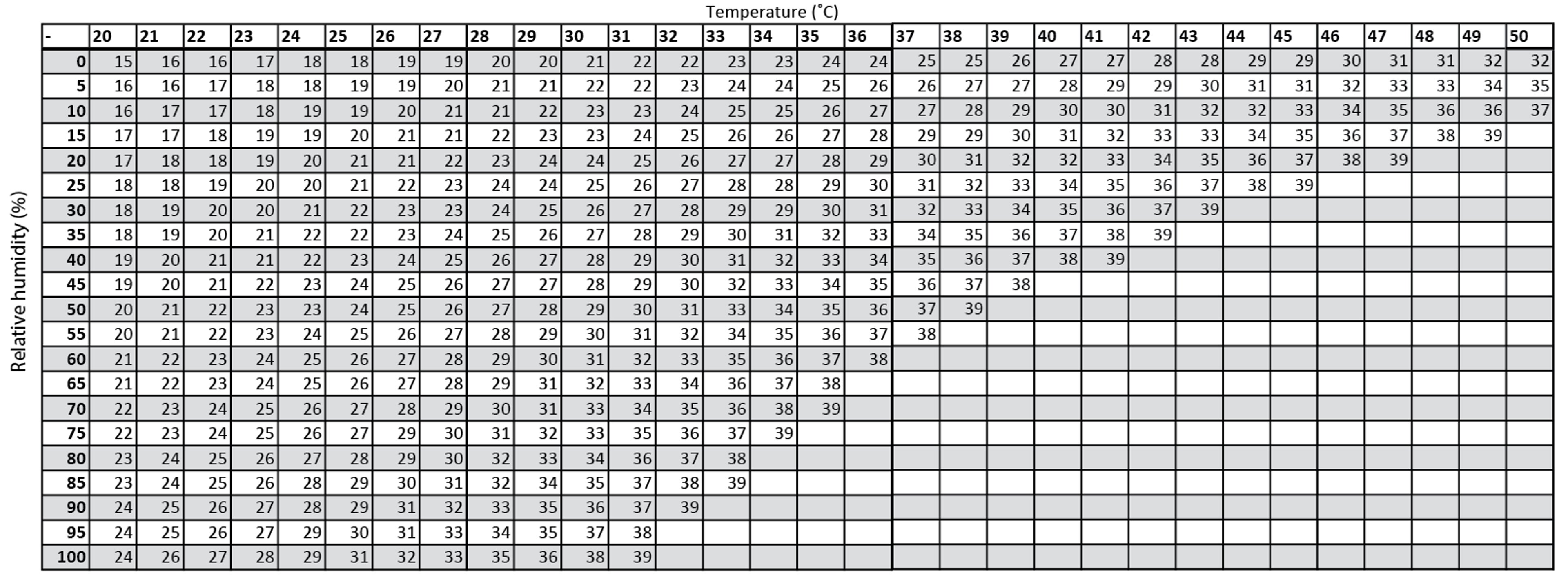
The best indicator of environmental heat stress is the wet bulb globe temperature (WBGT), which is widely used by the military, industry, and sports. In addition to temperature, the WBGT reflects the effects of humidity, wind, and solar radiation. The WBGT can be used as a guide for recommended activity (see table Wet Bulb Globe Temperature and Recommended Activity Levels).
Although the WBGT is complex and may not be available, it can be estimated based on only temperature and relative humidity in sunny conditions and when the wind is light (see figure Wet bulb globe temperature based on temperature and relative humidity).
Wet bulb globe temperature based on temperature and relative humidity
Values are derived from an approximate formula that depends on temperature and humidity and that is valid for full sunshine and a light wind. Heat stress may be overestimated in other conditions. |

General reference
1. Lipman GS, Gaudio FG, Eifling KP, et al: Wilderness Medical Society clinical practice guidelines for the prevention and treatment of heat illness: 2019 Update. Wilderness Environ Med. 30(4S):S33-S46, 2019. doi: 10.1016/j.wem.2018.10.004
Key Points
When environmental temperature is > 35° C, cooling relies largely on evaporation, but when humidity is > 75%, evaporation markedly decreases, so when temperature and humidity are both high, risk of heat illness is high.
Among the many risk factors for heat illness are certain drugs and disorders (including those that disturb electrolyte balance or decrease cardiovascular reserve) and extremes of age.
Prevention includes common sense measures and maintaining and replacing fluids and sodium.
Acclimatization, requiring daily exercise for 8 to 11 days, decreases risk of heat illness.
Activity levels should be restricted as temperature, humidity, sunlight, and amount of clothing or gear increase and when air movement decreases.


