





Systemic sclerosis is a rare, chronic autoimmune connective tissue disorder characterized by degenerative changes and scarring in the skin, joints, and internal organs and by blood vessel abnormalities.
The cause of systemic sclerosis is unknown.
Swelling of the fingers, intermittent coolness and blue discoloration of the fingers, joints freezing in permanent (usually flexed) positions (contractures), and damage to the gastrointestinal system, lungs, heart, or kidneys may develop.
People often have antibodies in the blood characteristic of an autoimmune disorder.
There is no cure for systemic sclerosis, but symptoms and organ dysfunction can be treated.
Systemic sclerosis causes an overproduction of collagen and other proteins in various tissues. The cause of systemic sclerosis is not known. The disorder is 4 times more common among women and most common among people aged 20 to 50. It is rare among children. Symptoms of systemic sclerosis may occur as part of mixed connective tissue disease, and some people with mixed connective tissue disease ultimately develop severe systemic sclerosis.

Systemic sclerosis can be categorized as
Limited systemic sclerosis (CREST syndrome)
Diffuse systemic sclerosis
Systemic sclerosis without scleroderma (systemic sclerosis sine scleroderma)
Limited systemic sclerosis affects just the skin or mainly only certain parts of the skin and is also called CREST syndrome. People who have this type develop skin tightening (scleroderma) over the face, hands, forearms, lower legs, and feet. People may also have gastroesophageal reflux disease. This type is progresses slowly and is often complicated by pulmonary hypertension, a condition in which blood pressure in the arteries of the lungs (the pulmonary arteries) is abnormally high.
Diffuse systemic sclerosis often causes skin damage that is widespread throughout the body. People who have this type have Raynaud syndrome and gastrointestinal problems. This type may progress rapidly. Major complications include interstitial lung diseases, which affect the tissue and space around the air sacs of the lungs (alveoli), and a severe kidney problem called scleroderma renal crisis.
Systemic sclerosis without scleroderma rarely occurs without the skin tightening of scleroderma. However, people have antibodies in the blood characteristic of systemic sclerosis and have the same internal problems.
Symptoms of Systemic Sclerosis
The usual initial symptom of systemic sclerosis is swelling then thickening and tightening of the skin at the ends of the fingers. Raynaud syndrome, in which the fingers suddenly and temporarily become very pale and tingle or become numb, painful, or both in response to cold or emotional upset, is also common. Fingers may become bluish or white. Heartburn, difficulty in swallowing, and shortness of breath are occasionally the first symptoms of systemic sclerosis. Aches and pains in several joints often accompany early symptoms. Sometimes inflammation of the muscles (myositis), with its accompanying muscle pain and weakness, develops.
Skin changes
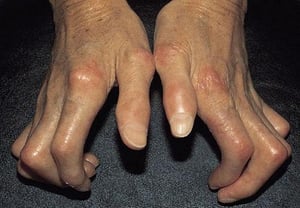
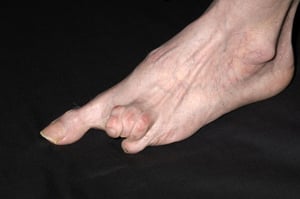
Systemic sclerosis can damage large areas of skin or only the fingers (sclerodactyly). Sometimes systemic sclerosis tends to stay restricted to the skin of the hands. Other times, the disorder progresses. The skin becomes more widely taut, shiny, and darker than usual. The skin on the face tightens, sometimes resulting in an inability to change facial expressions. However, in some people, the skin can soften over time. Sometimes dilated blood vessels (telangiectasia often referred to as spider veins) can appear on the fingers, chest, face, lips, and tongue, and bumps composed of calcium can develop on the fingers, on other bony areas, or at the joints. Sores can develop on the fingertips and knuckles.

By permission of the publisher. From Marder W, Lath V, Crofford L, Lowe L, McCune WJ: Atlas of Rheumatology. Edited by G Hunder. Philadelphia, Current Medicine, 2005.
By permission of the publisher. From Pandya A: Gastroenterology and Hepatology: Stomach and Duodenum. Edited by M Feldman. Philadelphia, Current Medicine, 1996.
DR P. MARAZZI/SCIENCE PHOTO LIBRARY


By permission of the publisher. From Marder W, Lath V, Crofford L, Lowe L, McCune WJ: Atlas of Rheumatology. Edited by G Hunder. Philadelphia, Current Medicine, 2005.


By permission of the publisher. From Pandya A: Gastroenterology and Hepatology: Stomach and Duodenum. Edited by M Feldman. Philadelphia, Current Medicine, 1996.


DR P. MARAZZI/SCIENCE PHOTO LIBRARY
Joint changes
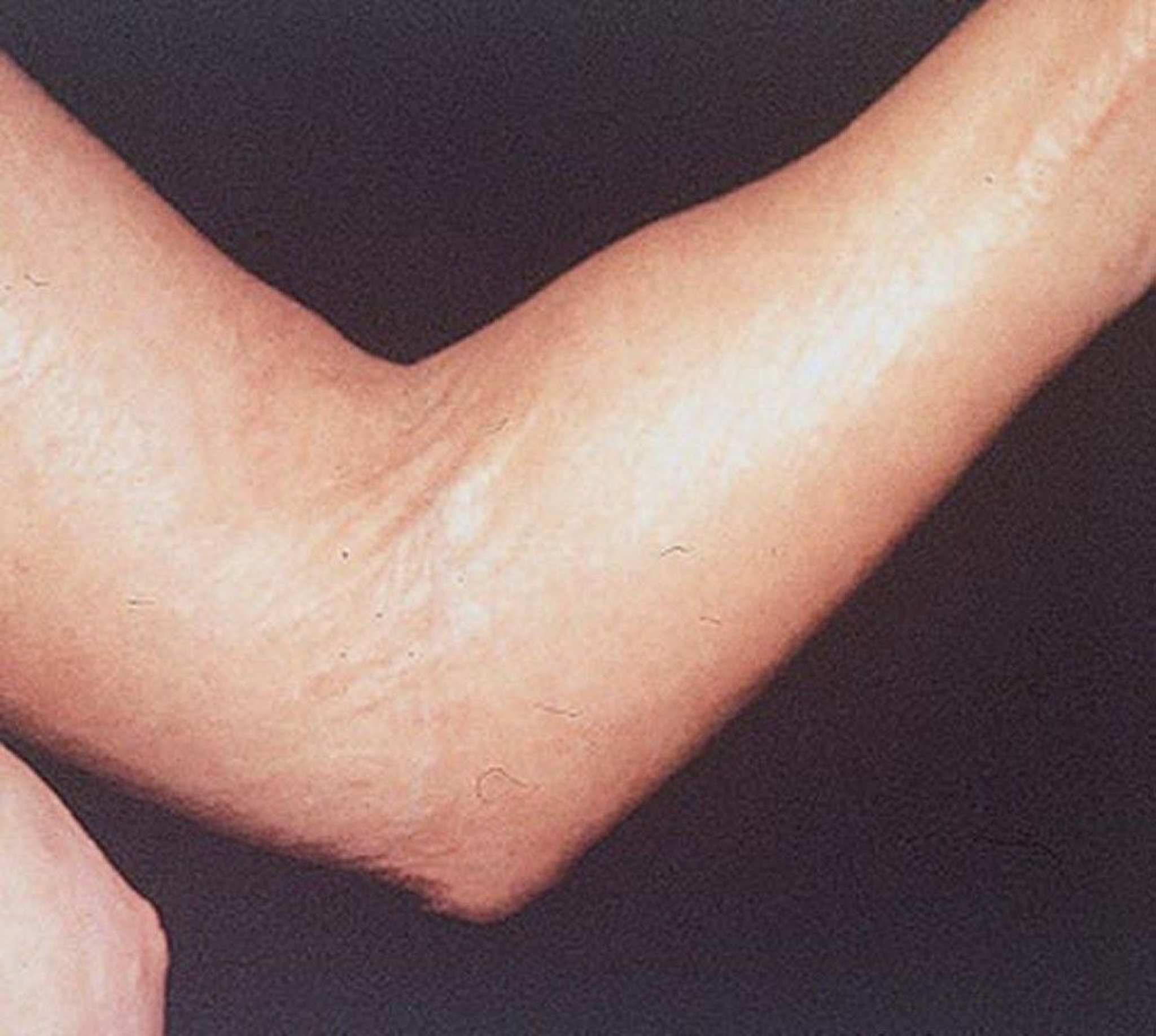
By permission of the publisher. From Marder W, Lath V, Crofford L, Lowe L, McCune WJ: Atlas of Rheumatology. Edited by G Hunder. Philadelphia, Current Medicine, 2005.
Sometimes, a grating sound can be felt or heard as inflamed tissues move over each other, particularly at and below the knees and at the elbows and wrists. The fingers, wrists, and elbows may become stuck (forming a contracture) in flexed positions because of scarring in the skin.
Gastrointestinal system changes
Nerve damage and then scarring commonly damage the lower end of the esophagus (the tube connecting the mouth and stomach). The damaged esophagus can no longer propel food to the stomach efficiently. Swallowing difficulties and heartburn eventually develop in many people who have systemic sclerosis. Abnormal cell growth in the esophagus (Barrett esophagus) occurs in about one third of people as a consequence of chronic acid reflux, increasing their risk of esophageal blockage (stricture) due to a fibrous band or their risk of esophageal cancer. Damage to the intestines can cause bacterial overgrowth, interfering with food absorption (malabsorption) and causing weight loss.
Lung and heart changes
Systemic sclerosis can cause scar tissue to accumulate in the lungs and interstitial lung disease, resulting in abnormal shortness of breath during exercise. The blood vessels that supply the lungs can be affected (their walls thicken), so they cannot carry as much blood. Therefore blood pressure within the arteries that supply the lungs can increase (a condition called pulmonary hypertension).
Systemic sclerosis can also cause several life-threatening heart abnormalities, including heart failure and abnormal rhythms.
Kidney changes
Severe kidney disease can result from systemic sclerosis. The first symptom of kidney damage may be an abrupt, progressive rise in blood pressure (scleroderma renal crisis). High blood pressure is an ominous sign, but early treatment usually controls it and may prevent or reverse the kidney damage.
CREST syndrome
CREST syndrome, also called limited systemic sclerosis, involves more peripheral areas of the skin (not the trunk). It typically does not affect the kidneys and lungs directly but may eventually increase pressure in the arteries that supply the lungs (called pulmonary hypertension). Pulmonary hypertension can cause heart and lung failure. CREST syndrome is named for its symptoms: Calcium deposits in the skin and throughout the body, Raynaud syndrome, Esophageal dysfunction, Sclerodactyly (skin tightening on the fingers), and Telangiectasia (dilated blood vessels or spider veins). In CREST syndrome, Raynaud syndrome can be severe enough to cause sores on the skin (ulcers) and permanently damage the fingers and toes. The drainage system from the liver may rarely become blocked by scar tissue (biliary cirrhosis), resulting in liver damage and jaundice.
Diagnosis of Systemic Sclerosis
Symptoms and a doctor's evaluation
Testing for antibodies
Established criteria
A doctor suspects systemic sclerosis in people who have Raynaud syndrome, typical joint and skin changes, or gastrointestinal, lung, and heart problems that cannot be otherwise explained. A doctor diagnoses systemic sclerosis by the characteristic changes in the skin, the results of blood tests, and presence of damage to internal organs. The symptoms may overlap with those of several other disorders, but the whole pattern is usually distinctive.
Laboratory tests alone cannot identify systemic sclerosis because test results, like the symptoms, vary greatly. However, antinuclear antibodies (ANA) are present in the blood of more than 90% of people with systemic sclerosis. An antibody to centromeres (part of a chromosome) is often present in people who have limited systemic sclerosis. Different antibodies, called anti-topoisomerase and RNA polymerase III, are often present in people who have diffuse systemic sclerosis. Thus, the diagnosis of systemic sclerosis is based on all of the information doctors gather, including symptoms, physical examination results, and all test results.
To help make the diagnosis, doctors may also consult a set of established criteria:
Skin thickening of the fingers of both hands
Sores or scars on the fingertips
Dilated blood vessels (telangiectasia)
Abnormal nail fold capillaries (blood vessels)
Pulmonary hypertension, interstitial lung disease, or both
Raynaud syndrome
Antibody to centromeres, anti-topoisomerase, or RNA polymerase III
Doctors may do pulmonary function testing, computed tomography (CT) of the chest, and echocardiography, sometimes periodically, to detect heart and lung problems.
Prognosis for Systemic Sclerosis
Sometimes systemic sclerosis worsens rapidly and becomes fatal (mainly with diffuse systemic sclerosis). At other times, it affects only the skin for decades before affecting internal organs, although some damage to internal organs (such as the esophagus) is almost inevitable. The course is unpredictable.
Overall, 92% of people who have limited systemic sclerosis and 65% of people who have diffuse systemic sclerosis live for at least 10 years after the diagnosis is made. The prognosis is worst for those who are male, develop the disease later in life, have diffuse systemic sclerosis, or have heart, lung, or, particularly, kidney damage. The prognosis for people who have limited systemic sclerosis (CREST syndrome) tends to be more favorable.
Treatment of Systemic Sclerosis
Measures to relieve symptoms and reduce organ damage
There is no cure for systemic sclerosis.
No drug can stop the progression of systemic sclerosis. However, drugs can relieve some symptoms and reduce organ damage.
Nonsteroidal anti-inflammatory drugs (NSAIDs) help relieve joint pain but may cause gastrointestinal problems. However, NSAIDs are not given to people who have systemic sclerosis and who have a history of stomach bleeding or ulcers, or who have chronic kidney disease.
If the person has weakness because of myositis
Doctors treat severe pulmonary hypertension
Heartburn can be relieved by eating small meals, taking antacids, and using proton pump inhibitors, which block stomach acid production. Sleeping with the head of the bed elevated and not lying down within 3 hours of the last meal often help.
Areas of the esophagus narrowed by scar tissue can be surgically widened (dilated).
bacterial overgrowth, such as bloating, gas, and diarrhea.
Drugs for high blood pressure, particularly angiotensin-converting enzyme (ACE) inhibitors, are useful in treating acute kidney injury and the rise in blood pressure (scleroderma renal crisis). If chronic kidney disease results and is severe enough to require permanent hemodialysis, a kidney transplant may be required.
Autologous stem cell transplantation may become a treatment option in the future for people who have severe diffuse systemic sclerosis.
Physical therapy and exercise can help maintain muscle strength but cannot totally prevent joints from freezing in contractures.
More Information
The following English-language resource may be useful. Please note that THE MANUAL is not responsible for the content of this resource.
Scleroderma Foundation: Provides information about living with systemic sclerosis and ongoing systemic sclerosis research


