
|
Pancreatic endocrine tumors are those that arise from the types of pancreatic cells that produce hormones. These tumors may or may not secrete hormones themselves and may or may not be cancerous (malignant). Even if they do not secrete hormones (nonfunctioning tumors) and are not cancerous, these tumors may cause symptoms by blocking the biliary tract or small intestine or by bleeding into the gastrointestinal tract. Functioning tumors secrete large amounts of a particular hormone, causing various syndromes.
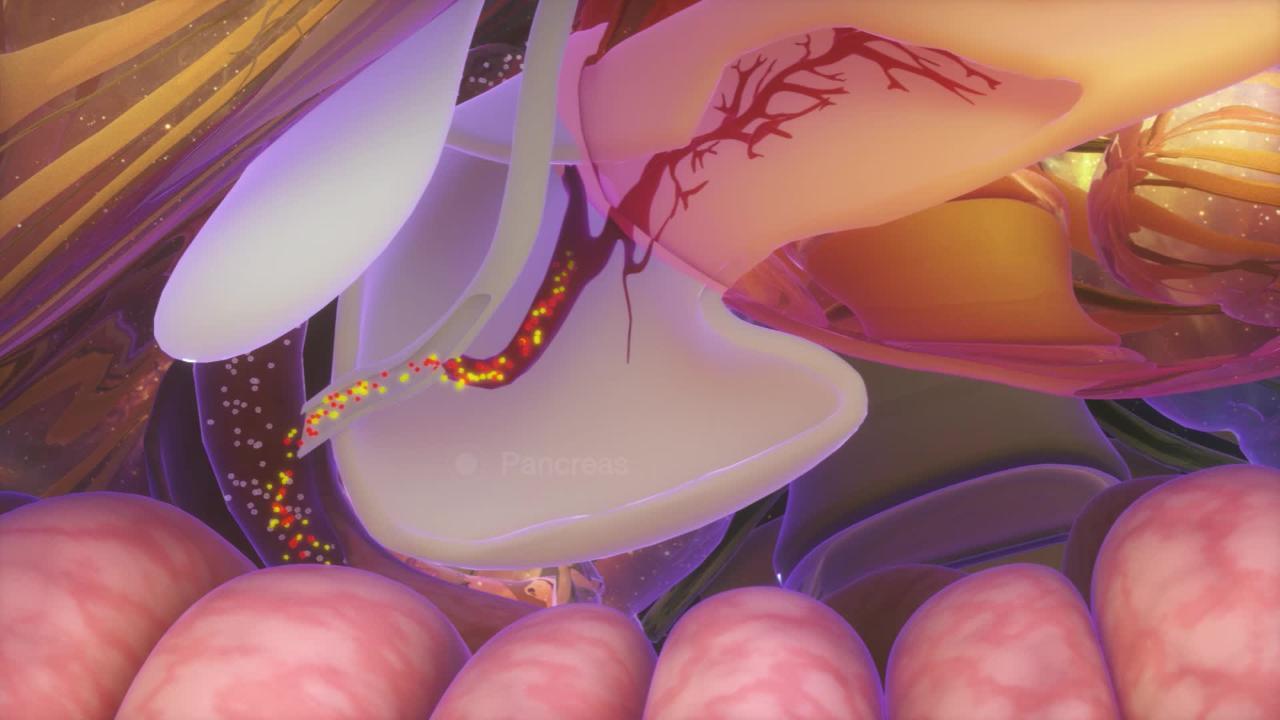
Insulinoma
An insulinoma
is a rare type of pancreatic tumor that secretes insulin, a hormone
that lowers the levels of sugar (glucose) in the blood.
Only 10% of insulinomas are cancerous.
Symptoms
Symptoms result from low levels of sugar (glucose) in the blood, which occur when the person does not eat for several hours (most often in the morning after an all-night fast). The symptoms include faintness, weakness, trembling, awareness of the heartbeat (palpitations), sweating, nervousness, and profound hunger. Other symptoms include headache, confusion, vision abnormalities, unsteadiness, and marked changes in personality. The low levels of sugar in the blood may even lead to a loss of consciousness, seizures, and coma.
Diagnosis and
Treatment
Diagnosing an insulinoma can be difficult. Doctors try to perform blood tests while the person has symptoms. Blood tests include measurements of blood glucose levels and insulin levels. Very low levels of glucose and high levels of insulin in the blood indicate the presence of an insulinoma. Because many people have symptoms only occasionally, doctors may admit them to the hospital. In the hospital, the person fasts for at least 24 hours, sometimes up to 72 hours, and is closely monitored. During that time, the symptoms usually appear, and blood tests are performed to measure the levels of glucose and insulin.
If the blood tests suggest the person has an insulinoma, the location must then be pinpointed. Imaging tests, such as endoscopic ultrasonography (which shows the lining of the digestive tract more clearly because the ultrasound probe is placed on the tip of the endoscope) or positron emission tomography (PET) scans, can be used to locate the tumor, but sometimes exploratory surgery is needed.
The primary treatment for an insulinoma is surgical removal, which has a cure rate of about 90%. When the insulinoma cannot be completely removed and symptoms continue, drugs such as diazoxide and octreotide can help keep blood glucose from falling too low. Chemotherapy drugs such as streptozotocin and 5-fluorouracil may help control the tumor.
Gastrinoma
A gastrinoma
is a tumor usually in the pancreas or duodenum (the first segment
of the small intestine) that produces excessive levels of the hormone
gastrin, which stimulates the stomach to secrete acid and enzymes,
causing peptic ulcers.
Most people with gastrinomas have several tumors clustered in or near the pancreas. About half of the tumors are cancerous. Sometimes a gastrinoma occurs as part of multiple endocrine neoplasia, a hereditary disorder in which tumors arise from the cells of various endocrine glands, such as the insulin-producing cells of the pancreas.
Symptoms and
Diagnosis
The excess gastrin secreted by the gastrinoma causes Zollinger-Ellison syndrome (see Zollinger-Ellison Syndrome: An Acid-Stimulating Cancer ), in which a person suffers the symptoms of aggressive peptic ulcers in the stomach, duodenum, and elsewhere in the intestine. However, as many as 25% of people with Zollinger-Ellison syndrome may not have an ulcer when the diagnosis is made. Rupture, bleeding, and obstruction of the intestine can occur and are life threatening. For more than half of the people with a gastrinoma, symptoms are no worse than those experienced by people with ordinary peptic ulcer disease. In 25 to 40% of people, diarrhea is the first symptom.
A doctor suspects a gastrinoma when a person has frequent peptic ulcers or several peptic ulcers that do not respond to the usual ulcer treatments. Blood tests to detect abnormally high levels of gastrin are the most reliable diagnostic tests.
Once blood tests diagnose gastrinoma, doctors use several imaging techniques, such as computed tomography (CT), endoscopic ultrasonography, PET scans, and arteriography (an x-ray taken after a radiopaque dye is injected into an artery), to locate tumors. These tumors may be difficult to find, however, because usually they are small.
Treatment
High doses of proton pump inhibitors (see Peptic Disorders: Acid-reducing Drugs and Drugs Used to Treat Peptic Disorders ) may be effective for reducing acid levels and relieving symptoms temporarily. About 20% of people who do not have multiple endocrine neoplasia can be cured with surgical removal of the gastrinoma. If these treatments do not work, an operation to remove the stomach completely (total gastrectomy) may be necessary. This operation does not remove the tumor, but the gastrin can no longer create ulcers after the acid-producing stomach is removed. If the stomach is removed, daily iron and calcium supplements taken by mouth and monthly injections of vitamin B12 are needed, because absorption of these nutrients is impaired when stomach juices that prepare these nutrients for absorption are no longer available.
If cancerous tumors have spread to other parts of the body, chemotherapy may help reduce the number of tumor cells and the levels of gastrin in the blood. However, such therapy does not cure the cancer, which is ultimately fatal.
Vipoma
A vipoma
is a rare type of pancreatic tumor that produces vasoactive intestinal
peptide (VIP), a substance that causes severe watery diarrhea.
About 50 to 75% of these tumors are cancerous. In about 6% of people, vipoma occurs as part of multiple endocrine neoplasia (see Multiple Endocrine Neoplasia Syndromes).
Symptoms
The major symptoms are prolonged massive watery diarrhea. People produce 1 to 3 quarts (1000 to 3000 mL) of stool per day, causing dehydration. In 50% of people, diarrhea is constant, and in the rest, the severity of the diarrhea varies over time.
Because the diarrhea removes many of the body's normal salts, people often develop low blood levels of potassium (hypokalemia), and excessively acidic blood (acidosis). These changes can cause lethargy, muscular weakness, nausea, vomiting, and crampy abdominal pain. Some people have flushing.
Diagnosis and
Treatment
A doctor bases the diagnosis on the person's symptoms and finding elevated levels of VIP in the blood. People with elevated levels of VIP should also have an endoscopic ultrasound or PET scan to detect the location of the vipoma.
Initially fluids and electrolytes must be replaced. Bicarbonate must be given to replace that lost in the stool and avoid acidosis. Because water and electrolytes continue to be lost in the stool as rehydration is achieved, doctors may find it difficult to continually replace water and electrolytes.
The drug octreotide usually controls diarrhea, but large doses may be needed. Surgical removal of the vipoma cures about 50% of people whose tumor has not spread. Surgery may temporarily relieve symptoms in people whose tumor has spread. Chemotherapy does not cure the disease.
Glucagonoma
A glucagonoma
is a tumor of the pancreas that produces the hormone glucagon, which
raises the level of sugar (glucose) in the blood and causes a distinctive
rash.
About 80% of glucagonomas are cancerous. However, they grow slowly, and many people survive for 15 years or more after the diagnosis. The average age at which symptoms begin is 50. About 80% of people with glucagonomas are women.
Symptoms and
Diagnosis
High levels of glucagon in the blood cause the symptoms of diabetes mellitus. Often, the person loses weight. In 90% of people, the most distinctive features are a chronic brownish red skin rash (necrolytic migratory erythema) and a smooth, shiny, bright red-orange tongue. The mouth also may have cracks at the corners. The rash, which causes scaling, starts in the groin and moves to the buttocks, forearms, and legs.
The diagnosis is made by identifying high levels of glucagon in the blood and then locating the tumor by performing an abdominal CT followed by an endoscopic ultrasound. An MRI or PET scan may be used if the CT scan does not show a tumor.
Treatment
Ideally, the tumor is surgically removed, which eliminates all symptoms. However, if removal is not possible or if the tumor has spread, chemotherapy may reduce the levels of glucagon and lessen the symptoms. However, chemotherapy does not improve survival.
The drug octreotide can be used to reduce glucagon levels, may clear up the rash, and may restore appetite, facilitating weight gain. But octreotide may elevate the levels of glucose in the blood even more. Zinc ointment may be used to treat the skin rash. Sometimes the rash is treated with intravenous amino acids or fatty acids.
Last full review/revision December 2007 by Elliot M. Livstone, MD
|