





Schistosomiasis is infection caused by certain flatworms (flukes), called schistosomes.
People acquire schistosomiasis by swimming or bathing in fresh water that is contaminated with the flukes.
The infection may cause an itchy rash, then after several weeks, fever, chills, muscle aches, fatigue, nausea, abdominal pain, and, later, other symptoms depending on which organ is affected.
Doctors confirm the diagnosis of schistosomiasis by identifying eggs in a sample of stool or urine.
Flukes are parasitic flatworms. There are many species of flukes. Different species tend to infect different parts of the body. Schistosomiasis is the most common type of fluke infection. It affects over 200 million people in tropical and subtropical regions of South America, Africa, and Asia. (See also Overview of Parasitic Infections.)
Five Schistosoma species develop into adult flukes in people and account for most of the cases of schistosomiasis:
Schistosoma hematobium infects the urinary tract (including the bladder). This species is widely distributed over the African continent and occurs in some parts of the Middle East, Turkey, and India.
Schistosoma mansoni, Schistosoma japonicum, Schistosoma mekongi, and Schistosoma intercalatum infect the intestine and liver. Schistosoma mansoni is widespread in Africa and is the only schistosome in the Western Hemisphere (in parts of South America and the Caribbean). Schistosoma japonicum and Schistosoma mekongi occur in Asia and Southeast Asia. Schistosoma intercalatum occurs in Central and West Africa.
None of these five Schistosoma species cause schistosomiasis in people who live in Canada or the United States, including Puerto Rico, where schistosomiasis used to be endemic.
Schistosomiasis is acquired by swimming, wading, or bathing in fresh water that is contaminated with the free-swimming stage of the parasite.
An infected person passes schistosome eggs in stool or urine. In water, the eggs release immature larvae (called miracidia), which enter specific types of water-dwelling snails, multiply, and mature into a form called cercariae, which can swim. The cercariae are released to swim free in the water. If they encounter a person’s skin, they burrow in and move through the bloodstream to the liver, where they mature into adult flukes. The adults travel to their final home in small veins in the bladder or intestine (depending on the species), where they live an of average 3 to 10 years. The adult flukes lay large numbers of eggs in the walls of the intestine or bladder. The eggs cause local tissue damage and inflammation, which may result in ulcers, bleeding, and scar tissue formation. Some eggs pass into the stool (feces) or urine. If urine or stool of infected people enters fresh water, the eggs hatch, releasing immature larvae, which enter snails to begin the cycle again.
Life Cycle of Schistosoma
|

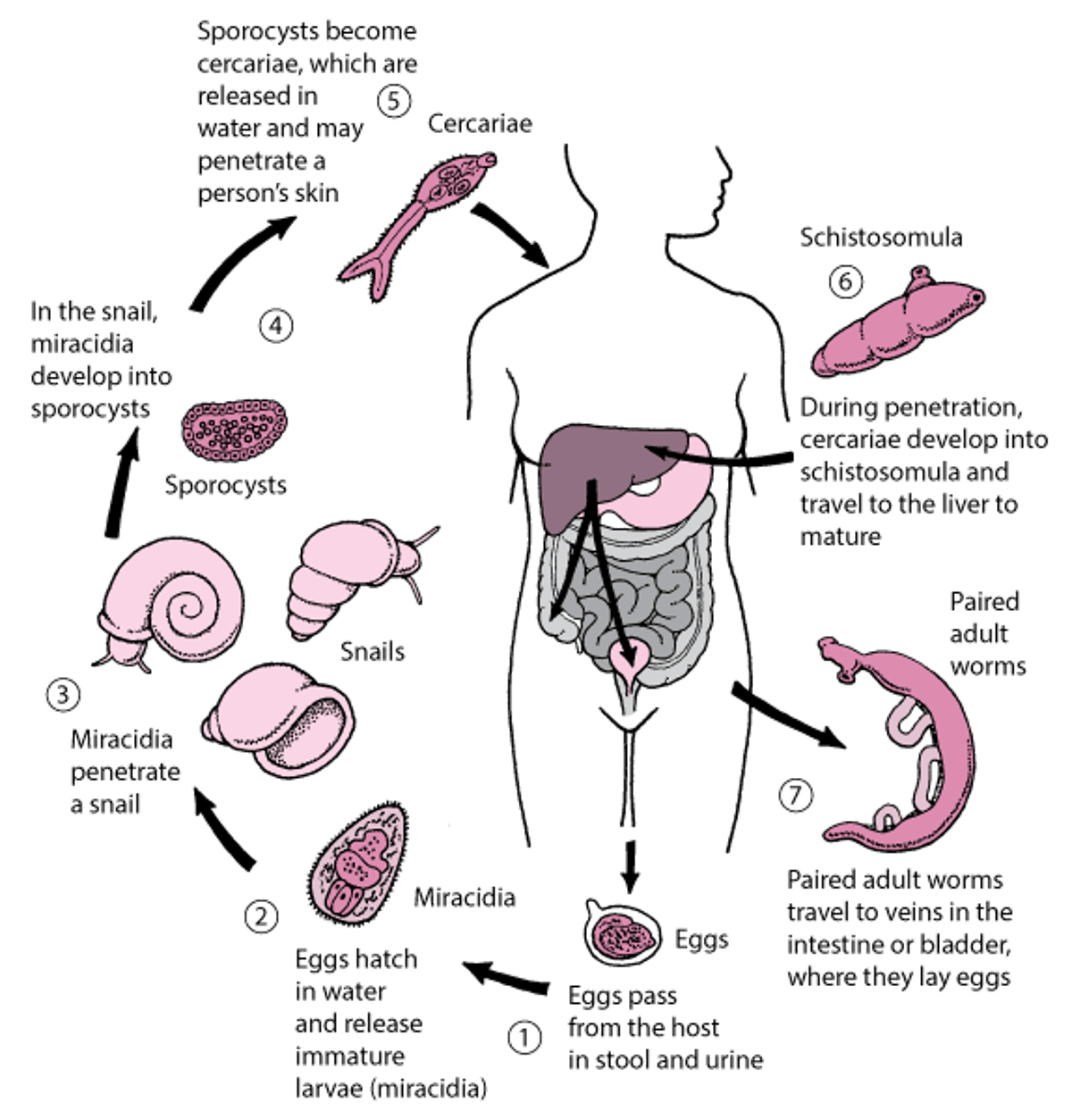
Schistosoma mansoni and Schistosoma japonicum typically lodge in small veins of the intestine. Some eggs flow from there through the bloodstream to the liver. The resulting liver inflammation can lead to scarring and increased pressure in the vein that carries blood between the intestinal tract and the liver (the portal vein). High blood pressure in the portal vein (portal hypertension) can cause enlargement of the spleen and bleeding from veins in the esophagus.
The eggs of Schistosoma hematobium typically lodge in the bladder, sometimes causing ulcers, bleeding into the urine, and scarring. Schistosoma hematobium infection increases the risk of bladder cancer.
All types of schistosomiasis can affect other organs (such as the lungs, spinal cord, and brain). Eggs that reach the lungs can result in inflammation and increased blood pressure in the arteries of the lungs (pulmonary hypertension), which can result in a type of heart failure called cor pulmonale.
Adult schistosomes live on average 3 to 10 years, but sometimes longer. Females are about 1/4 to 3/4 inch long. Males are slightly smaller.
Swimmer's itch
Certain Schistosoma species normally infect birds and mammals rather than people. However, sometimes cercariae of these species penetrate the skin of people. Because these schistosomes do not normally reside and develop in people, they cannot travel from the skin to other organs and mature into adult flukes. Thus, they affect only the skin, causing intense itching (sometimes called swimmer's itch). Some of these Schistosoma species, unlike the five species that cause schistosomiasis, are present in the United States and Canada.
Symptoms of Schistosomiasis
Most people with schistosomiasis have no symptoms. But when schistosomes first penetrate the skin, an itchy rash may develop at the site of penetration.
After about 2 to 4 weeks but as long as 12 weeks later (when the adult flukes begin laying eggs), some people develop acute schistosomiasis with rash, fever, chills, cough, muscle aches, fatigue, vague discomfort (malaise), nausea, and abdominal pain. Lymph nodes may temporarily enlarge, then return to normal. This group of symptoms is called Katayama fever.
If the infection lasts a long time (called chronic schistosomiasis), the body has an inflammatory response to the eggs, which causes other symptoms and scarring. Symptoms depend on the organs affected:
If blood vessels of the intestine are chronically infected: Abdominal discomfort, pain, and bleeding (seen in the stool), which may result in anemia
If the liver is affected and pressure in the portal vein is high (portal hypertension): An enlarged liver and spleen
If the bladder is chronically infected: Painful, frequent urination, bloody urine, and an increased risk of bladder cancer
If the urinary tract is chronically infected: Inflammation and eventual scarring that can block the tube from the kidney to the bladder (ureter), sometimes causing urine to back up and damage the kidney
If the brain or spinal cord is chronically infected (rare): Seizures, muscle weakness, or paralysis
If the lungs are chronically infected: High blood pressure in the arteries of the lungs (called pulmonary hypertension) and shortness of breath, light-headedness, and chest pain due to a type of heart failure called cor pulmonale
If the genitals are infected in females: Can involve the vulva, vagina, and cervix as well as the fallopian tubes and can result in vaginal bleeding during sex and pelvic (gynecologic) examinations, pain during sex, infertility, ectopic pregnancy, miscarriage, and increased risk of becoming infected with HIV (if exposed to the virus)
If the genitals are infected in males: Can involve the epididymis, testicles, spermatic cord, or prostate and can result in pelvic, coital, or ejaculatory pain, blood in semen (hematospermia), abnormal swelling of genital organs, and infertility
Diagnosis of Schistosomiasis
Examination of samples of stool, urine, or sometimes tissue from the intestine or bladder
Sometimes blood tests
A doctor suspects schistosomiasis in people who have traveled to, immigrated from, or live in areas where schistosomiasis occurs if they report typical symptoms and they have swum or waded in fresh water.
A doctor can confirm the diagnosis of schistosomiasis by examining samples of stool or urine for eggs. Usually, several samples are needed. If no eggs are found in the stool or urine but symptoms and circumstances suggest schistosomiasis, the doctor sometimes takes a sample of tissue from the intestine or bladder to be examined under a microscope for eggs. Eggs cannot be seen in stool or urine early in the infection—that is, soon after the parasites penetrate the skin or during acute schistosomiasis (Katayama fever).
Blood tests can be done to determine whether someone has been infected with Schistosoma mansoni or another species, but the tests do not indicate how severe the infection is, how long the person has had it, or whether live adult worms are present. In people who are not residents of endemic areas, blood tests should be done 6 to 8 weeks after the last exposure to fresh water in areas where schistosomiasis occurs. With Katayama fever, the number of eosinophils, a type of white blood cell, is often increased in the blood.
After schistosomiasis is diagnosed, ultrasonography is frequently used to assess the severity of schistosomiasis in the urinary tract or liver. Alternatively, computed tomography (CT) or magnetic resonance imaging (MRI) may be done.
Treatment of Schistosomiasis
Schistosoma
People with swimmer's itch do not need to take drugs to kill the schistosomes. Cool compresses, baking soda, anti-itch lotions, and/or corticosteroid creams or ointments may be used to help relieve intense itching.
Prevention of Schistosomiasis
Schistosomiasis is best prevented by
Avoiding swimming, bathing, or wading in fresh water in areas known to contain schistosomes
Using latrines or toilets for urination and defecation
Using chemicals that kill snails (molluscicides) in bodies of fresh water known to contain schistosomes
Fresh water used for bathing should be boiled for at least 1 minute and then cooled before bathing. However, water that has been held in a storage tank for at least 1 to 2 days should be safe without boiling.
People who are accidentally exposed to possibly contaminated water (for example, by falling into a river) should vigorously dry off with a towel to attempt to remove any parasites before they penetrate the skin.


