





Toxoplasmosis is infection caused by the protozoan parasite Toxoplasma gondii. Infection occurs when people unknowingly ingest toxoplasma cysts from cat feces or eat contaminated meat. Usually, the infection does not cause symptoms, but some people have swollen lymph nodes, fever, a vague ill feeling, and sometimes a sore throat or blurred vision and eye pain. In people with a weakened immune system due to AIDS or another condition, toxoplasmosis can reactivate, usually affecting the brain. A reactivated infection can cause weakness, confusion, seizures, or coma or spread throughout the body. Pregnant women can pass the infection to a fetus(called congenital infection), and infected babies can have birth defects, loss of vision, seizures, intellectual disability, and other abnormalities.
People acquire the infection by transferring the parasite's eggs from an object contaminated with infected cat feces to the mouth or by eating contaminated food.
Most infections cause few or no symptoms.
Women who become infected during pregnancy may transmit the parasite to the fetus, sometimes causing a miscarriage, stillbirth, or serious problems in the baby.
Typically, only people with a weakened immune system have severe symptoms, usually resulting from brain inflammation (encephalitis), which may cause weakness on one side of the body, confusion, or coma.
Less often, other organs are affected in people with a weakened immune system.
Doctors usually diagnose the infection by doing blood tests that detect antibodies against the parasite.
Most healthy people with toxoplasmosis do not require treatment, but adults with eye involvement, severe or persistent symptoms, or weakened immune systems, and pregnant women, and newborns with congenital infection are treated.
People with AIDS or other conditions that weaken the immune system are treated until the disease is under control and are then placed on preventative therapy until their immune deficiency is reversed by anti-retroviral therapy (for those with AIDS) or other measures.
Cooking meat thoroughly or freezing it and washing the hands thoroughly after handling raw meat, soil, or cat litter help prevent spread of the infection.
(See also Overview of Parasitic Infections.)
Toxoplasma gondii is a protozoa (single-cell infectious organisms) present worldwide wherever there are cats. The parasite infects a large number of animals as well as people. Many people in the United States have been infected, although few ever develop symptoms. Severe infection usually develops only in fetuses and people with a disorder that weakens the immune system (such as AIDS or cancer), or who use medications that suppress the immune system (immunosuppressants), particularly those used to suppress rejection of an organ transplant (see tables Disorders That Can Cause Immunodeficiency and Some Drugs That Can Cause Immunodeficiency).
Did You Know...
|
Although the parasite can grow in the tissues of many animals, it produces eggs (oocysts) only in cells lining the intestine of cats. Eggs are shed in a cat’s stool and, after 1 to 5 days, become able to cause infection. Eggs in the soil are able to cause infection for months. Wild birds, rodents, deer, and many domestic animals (particularly pigs and sheep) may ingest the eggs in food or soil contaminated by cat stool. The eggs release forms of the parasite called tachyzoites. Tachyzoites spread in the animal's tissues and eventually form cysts.
Life Cycle of Toxoplasma gondii
|

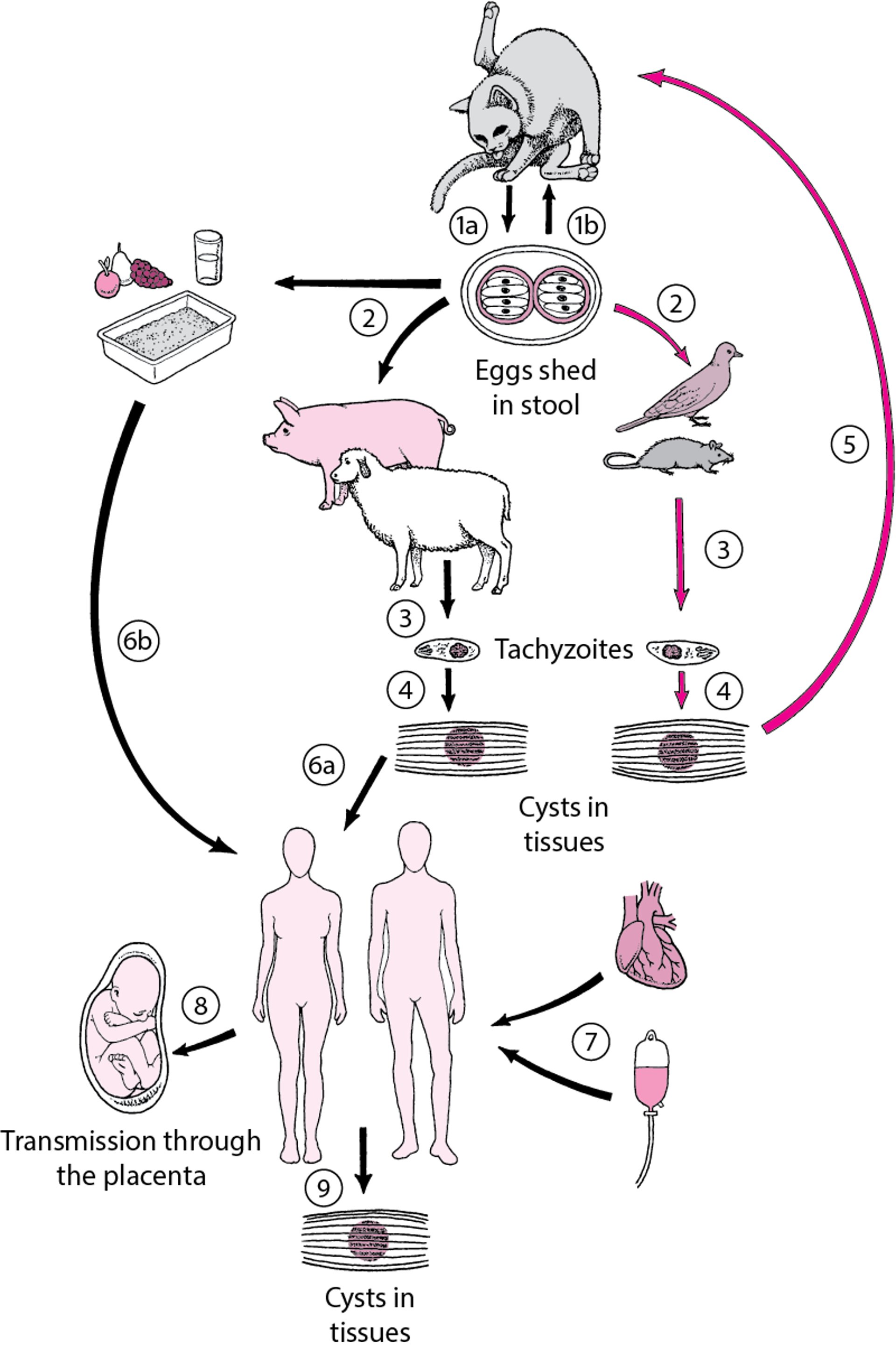
Transmission of Toxoplasmosis
People may acquire toxoplasmosis in several ways:
Eating food, water, or other materials (such as soil) that are contaminated with cat stool containing Toxoplasma eggs
Eating meat that contains Toxoplasma cysts
Spread from a newly infected mother to a fetus
Rarely, having a blood transfusion or organ transplant that contains the parasite
People may swallow Toxoplasma eggs after they touch contaminated cat litter, soil, or other objects and then touch their mouth or handle and eat food without washing their hands. People may swallow cysts when they eat raw or undercooked meat (usually pork or lamb) from infected animals.
Rarely, the parasite is transmitted through blood transfusions or by an organ transplanted from an infected person.
Toxoplasmosis during pregnancy
A woman who acquires the infection during pregnancy can transfer Toxoplasma gondii to her fetus through the placenta. Infection is more severe if the fetus is infected early in the pregnancy. The result may be a fetus that grows slowly, preterm birth, a miscarriage, stillbirth, or a baby born with birth defects. Congenital toxoplasmosis can cause problems with vision, seizures, and intellectual disabilities later in life.
A woman who was infected before the pregnancy does not pass the parasite on to her fetus unless her immune system has been weakened (for example by HIV infection), reactivating her infection.
Toxoplasmosis in people with a weakened immune system
People with a weakened immune system, primarily those who have AIDS or cancer or who take medications to suppress rejection of an organ transplant, are especially at risk of toxoplasmosis. If they have been infected in the past, developing a disorder that weakens the immune system or taking a medication that suppresses the immune system (immunosuppressants) may cause the infection to be reactivated.
A reactivated infection is most likely to occur in the brain, but it may affect the eye or spread throughout the body (disseminate).
In people with a weakened immune system, toxoplasmosis is very serious and may be fatal if untreated.
Symptoms of Toxoplasmosis
Most people with a healthy immune system have few or no toxoplasmosis symptoms and recover fully. About 10 to 20% of these people have swollen but painless lymph nodes. A few of these people also have intermittent low fevers, a vague ill feeling, muscle aches, and sometimes a sore throat. The symptoms disappear on their own, usually after several weeks.
Congenital toxoplasmosis
Children born with congenital toxoplasmosis may be severely ill and die before or shortly after birth, or they may have birth defects. Some never become ill. Others appear healthy at first but develop symptoms (such as seizures, intellectual disability, or vision problems) months or even years later.
Typical symptoms in newborns can include
Infection of the lining of the back part of the eyeball and the retina (chorioretinitis)
Enlargement of the liver and spleen
Rash
Easy bruising
Seizures
A large head caused by accumulation of fluid in the brain (hydrocephalus)
A small head (microcephaly)
Chorioretinitis can cause blurred vision, eye pain, sensitivity to light, and blindness.
Symptoms in people with a weakened immune system
Toxoplasmosis symptoms in people with a weakened immune system depend on the site of infection, as in the following:
Toxoplasmosis of the brain (encephalitis): Symptoms such as weakness on one side of the body, trouble speaking, problems with vision, headache, confusion, seizures, and coma
Toxoplasmosis that has spread throughout the body (acute disseminated toxoplasmosis): A rash, fever, chills, trouble breathing, and fatigue
In some people (usually those with a greatly weakened immune system), toxoplasmosis causes inflammation of the lungs (pneumonitis), the heart (myocarditis), or, less commonly, the liver (hepatitis). The affected organ may stop functioning adequately (called organ failure). Without treatment, these types of toxoplasmosis are usually fatal.
Diagnosis of Toxoplasmosis
Blood tests to detect antibodies against the parasite
If the brain may be affected, computed tomography or magnetic resonance imaging, followed by a spinal tap (lumbar puncture)
Tissue from the brain or other affected organ examined microscopically and tested for the parasite's DNA
The diagnosis of toxoplasmosis is usually based on blood tests that detect antibodies against the parasite. (Antibodies are proteins produced by the immune system to help defend the body against attack, including that by parasites.) The blood tests can be used to diagnose a new infection.
Doctors may do these blood tests in people who have a weakened immune system but have no symptoms of toxoplasmosis. The tests are done to look for evidence of a previous infection, which could reactivate if their immune system weakens further. However, if the person’s immune system is impaired by AIDS, the blood tests may indicate no infection when one is present (false-negative results).
Sometimes tests to check for the parasite's genetic material (DNA) are also done on the samples of blood, tissue from a biopsy, or cerebrospinal fluid (the fluid that surrounds the brain or spinal cord) obtained from a spinal tap.
If people report eye problems, doctors check the eyes for the damage typically caused by toxoplasmosis and do blood tests to check for antibodies to the parasite.
To determine whether a fetus has been infected, a doctor can take a sample of the fluid around the fetus (amniotic fluid) to be analyzed (a procedure called amniocentesis). The fluid is tested for antibodies to the parasite and for the parasite's genetic material. Because diagnosing toxoplasmosis during pregnancy or in the fetus or newborn is difficult, doctors often consult with an expert.
If toxoplasmosis of the brain is suspected, computed tomography (CT) and magnetic resonance imaging (MRI) of the brain are done, usually followed by a spinal tap to obtain a sample of cerebrospinal fluid for testing. Less commonly, a piece of infected brain tissue is removed and examined under a microscope to identify parasites and tested for the parasite's genetic material (DNA).
Treatment of Toxoplasmosis
For eye infections, medications effective against toxoplasmosis and a corticosteroid
Most infected people without symptoms and with a healthy immune system do not require treatment.
If people have a healthy immune system, they are usually treated for a few weeks.
People with AIDS or other conditions that weaken the immune system are given the same medications but are treated longer (usually for at least 6 weeks) until all signs of infection are gone. Relapses are common, and there are several options for chronic maintenance therapy, which is continued until their immune system improves.
In people with AIDS, toxoplasmosis tends to recur, so medications to control toxoplasmosis are continued indefinitely unless the immune system improves (indicated by an increase in the CD4 count to an acceptable level). Doctors make sure that the most effective antiretroviral medications are being used.
Did You Know...
|
Prevention of Toxoplasmosis
Pregnant women should avoid contact with cats. If contact is unavoidable, pregnant women should at least avoid cleaning cat litter boxes or wear gloves when doing so. Gloves should also be worn while gardening to avoid contact with soil.
Meat should be cooked thoroughly, to a temperature of 165 to 170° F (74 to 77° C), and hands should be washed thoroughly after handling raw meat, soil, or cat litter.
Potential organ donors should be tested to prevent the spread of the parasite through transplanted organs.
People with AIDS are also given antiretroviral medications, which help strengthen the immune system and reduce the risk that toxoplasmosis will be reactivated.
More Information
The following English-language resource may be useful. Please note that The Manual is not responsible for the content of this resource.
Centers for Disease Control and Prevention: Toxoplasmosis


