





Sunburn results from a brief (acute) overexposure to ultraviolet (UV) light.
Overexposure to ultraviolet light causes sunburn.
Sunburn causes painful reddened skin and sometimes blisters, fever, and chills.
People can prevent sunburn by avoiding excessive sun exposure and by using sunscreens.
Cold-water compresses, moisturizers, and nonsteroidal anti-inflammatory drugs ease pain until the sunburn heals.
(See also Overview of Sunlight and Skin Damage.)
The amount of sun exposure required to produce a sunburn varies with the amount of melanin in the skin (usually visible as the amount of pigmentation), the ability to produce more melanin, and the amount of UV light in the sunlight on the day of overexposure.
Sunburn results in painful reddened skin. Severe sunburn may cause swelling and blisters. Symptoms may begin as soon as 1 hour after exposure and typically reach their peak within 3 days (usually between 12 hours and 24 hours). Some severely sunburned people develop a fever, chills, and weakness and on rare occasions even may go into shock (characterized by very low blood pressure, fainting, and profound weakness).


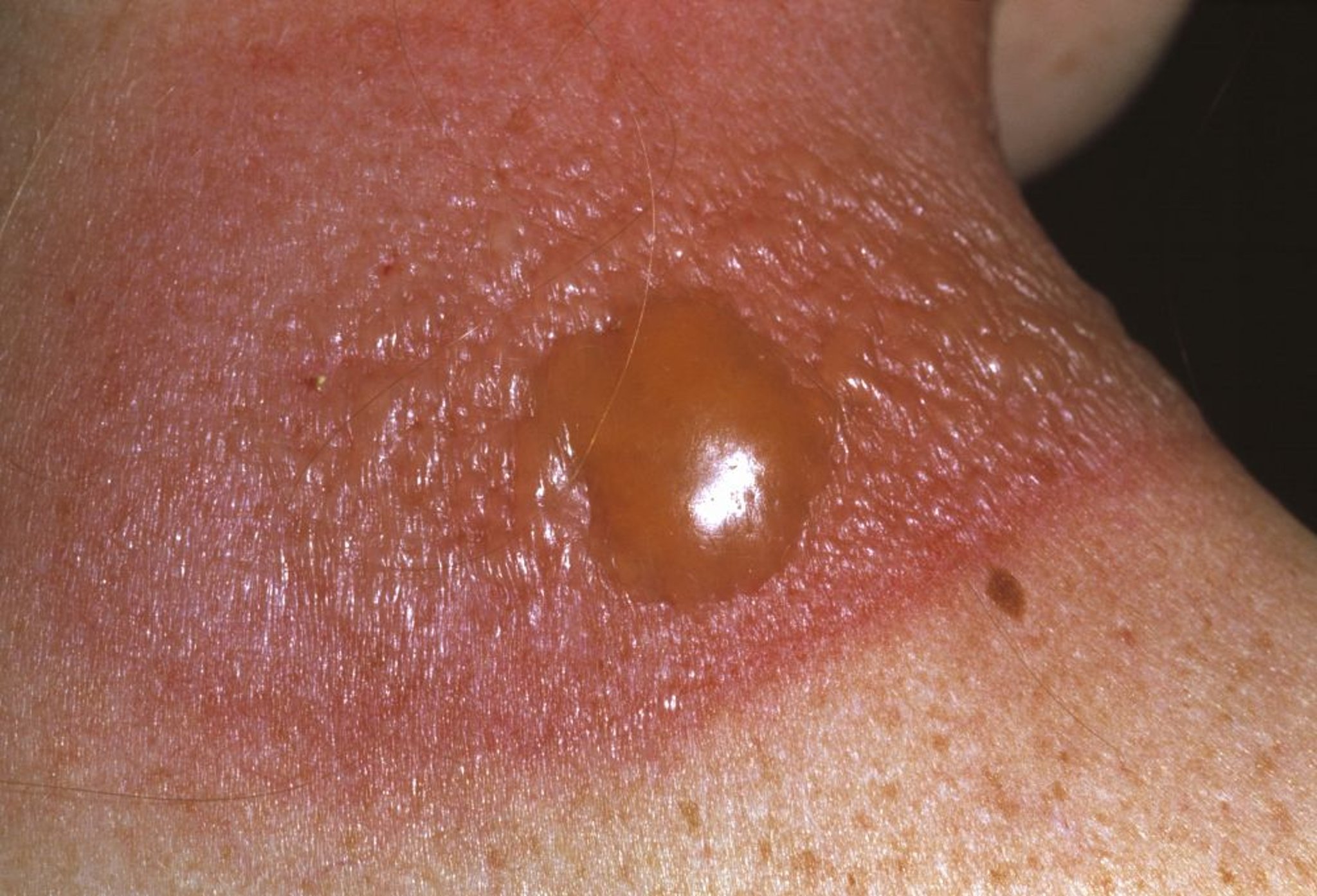
DR P. MARAZZI/SCIENCE PHOTO LIBRARY
Several days after a sunburn, people with naturally fair skin may have peeling in the burned area, usually accompanied by itching. These peeled areas are even more sensitive to sunburn for several weeks. Sunburned skin, particularly peeled sunburned skin, can become infected. Permanent brown spots called lentigines may develop. People who have had severe sunburns when young are at greater risk of skin cancer, particularly melanoma, in later years, even if they have not been exposed to much sun since that time.
Did You Know...
|
Treatment of Sunburn
Cold compresses and other soothing, cooling skin applications
Nonsteroidal anti-inflammatory drugs (NSAIDs)
Sometimes antibiotic burn creams
Cold-water compresses can soothe raw, hot areas, as can aloe vera and over-the-counter skin moisturizers; products without anesthetics or perfumes (which might irritate or sensitize the skin, causing allergic reactions) are recommended. NSAIDs taken by mouth help relieve pain and inflammation. Petrolatum-based products such as petroleum jelly should be avoided in severe sunburns. Corticosteroids applied to the skin seem to be no more effective than cool compresses.
Specific antibiotic burn creams are required only for severe blistering. Most sunburn blisters break on their own and do not need to be popped and drained. Sunburned skin rarely becomes infected, but if an infection develops, healing may be delayed. A doctor can determine the severity of an infection and prescribe antibiotics if necessary.
Sunburned skin begins healing by itself within several days, but complete healing may take weeks. After burned skin peels, the newly exposed layers are thin and initially very sensitive to sunlight and must be protected for several weeks.
Prevention of Sunburn


Avoid overexposure to sun
Wear protective clothing
Use sunscreens
Avoidance
The best—and most obvious—way to prevent sun damage is to stay out of strong, direct sunlight. Exposure to bright midday sun should be avoided, even for people with dark skin. UV rays are not as strong before 10 AM and after 4 PM. If sun exposure is unavoidable, the person should seek shade as soon as possible, cover up in UV-protective clothing, and wear sunscreen, a broad-brimmed hat, and UV-protective sunglasses.
Many materials are capable of filtering or blocking UV radiation, but many are not. Clothing, ordinary window glass, smoke, and smog filter out many of the damaging rays. However, water is not a good filter. UVA and UVB light can penetrate a foot (about 30 centimeters) of clear water. Clouds and fog are also not good filters of UV light—a person can get sunburned on a cloudy or foggy day.
Snow, water, and sand reflect sunlight, magnifying the amount of UV light that reaches the skin. People also burn more quickly at high altitudes, where the thin air allows more burning UV light to reach the skin, and low latitudes (such as at the equator).
Although sun exposure helps generate vitamin D, many experts recommend maintaining adequate vitamin D levels by consuming supplements if needed rather than by intentional overexposure to sunlight (5 to 15 minutes of sun exposure on the arms a few days a week is probably enough to maintain vitamin D levels).
Clothing
The sun's damaging effects can be further minimized by wearing protective coverings such as hats, shirts, pants, and sunglasses. Fabrics with a tight weave block the sun better than fabrics with a loose weave. Special clothing that provides high sun protection is commercially available. This type of clothing is labeled with ultraviolet protection factor (UPF) followed by a number that indicates the level of protection (similar to sunscreen labeling). Broad-brimmed hats help protect the face, ears, and neck, but people still need to apply sunscreen to these areas. People should regularly wear UV-protective, wrap-around sunglasses to help shield the eyes and eyelids.
Sunscreens
Before exposure to strong direct sunlight, a person should apply a sunscreen, which is a cream or lotion containing chemicals that protect the skin by filtering out UV light. Older sunscreens tended to filter only UVB light, but most newer sunscreens effectively filter UVA light as well.
Sunscreens are available in a wide variety of formulations, including creams, lotions, gels, foams, sprays, powders, and sticks. Self-tanning products do not provide significant protection from UV exposure.
Chemical sunscreens contain several substances that absorb UV radiation. Ingredients that absorb UVB radiation include cinnamates, salicylates, and para-aminobenzoic acid (PABA) derivatives. Benzophenones block UVA and UVB light. Avobenzone and ecamsule filter in the UVA range and may be added to provide further UVA protection.
Barrier or mineral sunscreens
All chemical sunscreen ingredients are thought to be absorbed by the body to some degree. Although most ingredients cause minimal side effects, some do have potential risks, and others are currently being studied. Traditional barrier sunscreens have relatively large mineral particles that are not absorbed by the body and are currently considered safe. Newer formulations of mineral sunscreens are made with extremely small particles (nanoparticles) that may be absorbed by the body. Although these nanoparticles are thought to be safe, they are still being studied. People concerned about the effects of absorbed nanoparticles may prefer to use so-called "non-nano" mineral sunscreens.
In the United States, the Food and Drug Administration (FDA) rates sunscreens by their sun protection factor (SPF) number—the higher the SPF number, the greater the protection. Sunscreens rated between 2 and 14 provide minimal protection, those rated between 15 and 29 provide good protection, and those rated 30 and above provide maximum protection. Products that protect against sunburn and photoaging, and also reduce the risk of skin cancer, are labeled broad spectrum and have an SPF of 15 (or higher). The SPF, however, only quantifies the protection against UVB light exposure. There is no scale for UVA light protection.
For the best protection, people should use a broad-spectrum, water-resistant sunscreen with an SPF rating of 30 or higher. One ounce (about 30 milliliters) should be used to cover the entire body surface of an average-sized person.
Sunscreens can fail if not enough of the product is applied, if the product is applied too late (sunscreens should optimally be applied 30 minutes before exposure to the sun), and if the product is not reapplied after swimming or sweating (even sunscreens labeled as water-resistant) or every 2 hours during sun exposure. Most people apply less than half the recommended amount of sunscreen.
Did You Know...
|
Sometimes sunscreens cause allergic reactions. People may react to the sunscreen after applying it or after applying it and then going in the sun (called a photoallergic reaction). Some dermatologists can do tests to diagnose such photosensitivity reactions if the reason for the reaction is unclear.
Supplements
Polypodium leucotomos (a natural tropical fern extract) and nicotinamide (a form of vitamin B3) are supplements that are taken by mouth that provide some protection against the damaging effects of sunlight. However, they are not a replacement for other methods of sun protection.


