





Aortic stenosis is a narrowing of the aortic valve opening that blocks (obstructs) blood flow from the left ventricle to the aorta.
The most common cause in people younger than 70 years is a birth defect that affects the valve.
In people over 70, the most common cause is thickening of the valve cusps (aortic sclerosis).
People may have chest tightness, feel short of breath, or faint.
Doctors usually base the diagnosis on a characteristic heart murmur heard through a stethoscope and on results of echocardiography.
People see their doctors regularly so their condition can be monitored, and people with symptoms may undergo replacement of the valve.
(See also Overview of Heart Valve Disorders and the video The Heart.)
The aortic valve is in the opening between the left ventricle and the aorta. The aortic valve opens as the left ventricle contracts to pump blood into the aorta. If a disorder causes the valve flaps to become thick and stiff, the valve opening is narrowed (stenosis). Sometimes the stiffened valve also fails to close completely and blood from the aorta leaks back through the aortic valve into the heart (aortic regurgitation) each time the left ventricle relaxes.
In aortic stenosis, the muscular wall of the left ventricle usually becomes thicker as the ventricle works harder to pump blood through the narrowed valve opening into the aorta. The thickened heart muscle requires an increasing supply of blood from the coronary arteries, and sometimes, especially during exercise, the blood supply does not meet the needs of the heart muscle. The insufficient blood supply can cause chest tightness, fainting, and sometimes sudden death. The heart muscle may also begin to weaken, leading to heart failure. The abnormal aortic valve can rarely become infected (infective endocarditis).
Causes of Aortic Stenosis
In North America and Western Europe, aortic stenosis is mainly a disease of older people—the result of scarring and calcium accumulation (calcification) in the valve cusps. In such cases, aortic stenosis becomes evident after age 60 but does not usually cause symptoms until a person is age 70 or 80 years.
Aortic stenosis may also result from rheumatic fever contracted in childhood. Rheumatic fever is the most common cause in regions where antibiotics are not widely used.
In people under 70 years, the most common cause is a birth defect, such as a valve with only two cusps instead of the usual three (bicuspid valve) or a valve with an abnormal funnel shape. The narrowed aortic valve opening may not be a problem during infancy, but problems occur as a person grows. The valve opening remains the same size, but the heart grows and enlarges further as it tries to pump increasing amounts of blood through the small valve opening. Over the years, the opening of a defective valve often becomes stiff and narrow because calcium accumulates.
Symptoms of Aortic Stenosis
People who develop aortic stenosis as a result of a birth defect may not develop symptoms until adulthood.
Chest tightness (angina) may occur during exertion. The symptoms go away with several minutes of rest. People with heart failure develop fatigue and shortness of breath during exertion.
People who have severe aortic stenosis may faint during exertion because blood pressure may fall suddenly. Fainting usually occurs without any warning symptoms (such as dizziness or light-headedness).
Diagnosis of Aortic Stenosis
Physical examination
Echocardiography
Doctors usually base the diagnosis on a characteristic heart murmur (abnormal heart sound) heard through a stethoscope and on results of echocardiography. Echocardiography is the best procedure for assessing the severity of aortic stenosis (by measuring how small the valve opening is) and the function of the left ventricle.
For people who have aortic stenosis but do not have symptoms, doctors often do a stress test. People who experience angina, shortness of breath, or faintness during the stress test are at risk of complications and may need treatment.
If the stress test is abnormal or if the person develops symptoms, cardiac catheterization is necessary to determine whether the person also has coronary artery disease. Cardiac catheterization is often done when surgery is planned to replace an aortic valve so that doctors can identify coronary artery disease that could also be treated during the heart surgery.
Treatment of Aortic Stenosis
Valve replacement
Adults who have aortic stenosis but no symptoms should see their doctor regularly and should avoid overly stressful exercise. Echocardiography is done periodically, at intervals determined by the severity of the stenosis, to monitor heart and valve function.
Before surgery, heart failure is treated with diuretics (see table Some Medications Used to Treat Heart Failure
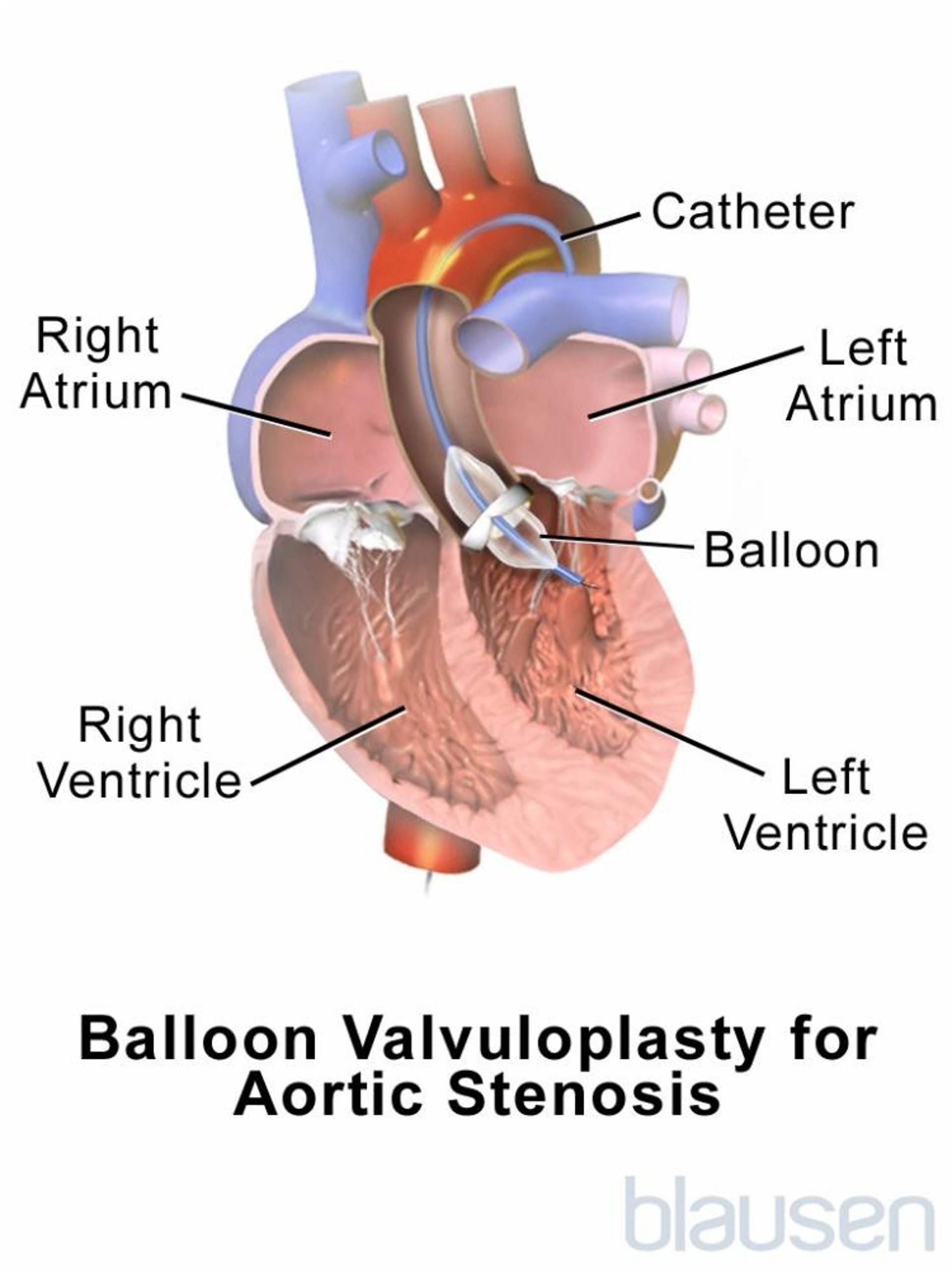
Sometimes, in children and young adults who were born with a defective valve, the valve can be stretched open using a procedure called balloon valvotomy. In this procedure, a catheter with a balloon on the tip is threaded through a vein or artery into the heart (cardiac catheterization). Once across the valve, the balloon is inflated, separating the valve cusps.
In people who have aortic stenosis that causes any symptoms (particularly shortness of breath on exertion, angina, or fainting), or if the left ventricle begins to fail, the aortic valve is replaced. Replacement of the abnormal valve is the best treatment for nearly everyone, and the prognosis after valve replacement is excellent. Aortic valve replacement was traditionally done via open-heart surgery. (See the video Aortic Valve Replacement.)

Increasingly, older people can have their valve replaced through a catheter threaded up the femoral artery in a procedure called transcatheter aortic valve implantation (TAVI). TAVI is generally better than medical therapy and similar to surgical valve replacement for these people.
People with an artificial valve must take antibiotics before a surgical, dental, or medical procedure (see table Examples of Procedures That Require Preventive Antibiotics) to reduce the risk of an infection on the valve (infective endocarditis).
Prognosis for Aortic Stenosis
Aortic stenosis progresses faster as severity increases, but the rate of progression varies, so affected people, particularly sedentary older adults, need to be checked regularly. Blood flow may become significantly compromised without triggering symptoms.
Once symptoms develop, prompt valve replacement is needed to relieve symptoms and improve survival.
In people with severe aortic stenosis, death may occur suddenly, so doctors advise these people to limit physical exertion.
More Information
The following English-language resource may be useful. Please note that THE MANUAL is not responsible for the content of this resource.
American Heart Association: Heart Valve Disease: Provides comprehensive information on diagnosis and treatment of diseases of the heart valves


