





Ganglia are swellings that occur over joints or on coverings of tendons in the hands and wrists and that contain a jellylike fluid.
It is not known why ganglia develop.
Ganglia usually do not cause symptoms.
Doctors base the diagnosis on an examination.
If ganglia do cause symptoms, the fluid is withdrawn using a needle or the ganglion is surgically removed.
(See also Overview of Hand Disorders.)
Ganglia typically spontaneously occur in people between the ages of 20 and 50. Women are affected 3 times more often than men. Ganglia usually develop on the back of the wrist. Ganglia also develop on the front of the wrist, in the palm at the base of the finger, and on the back of the finger, a few millimeters behind the cuticle (where they are also called mucous cysts).

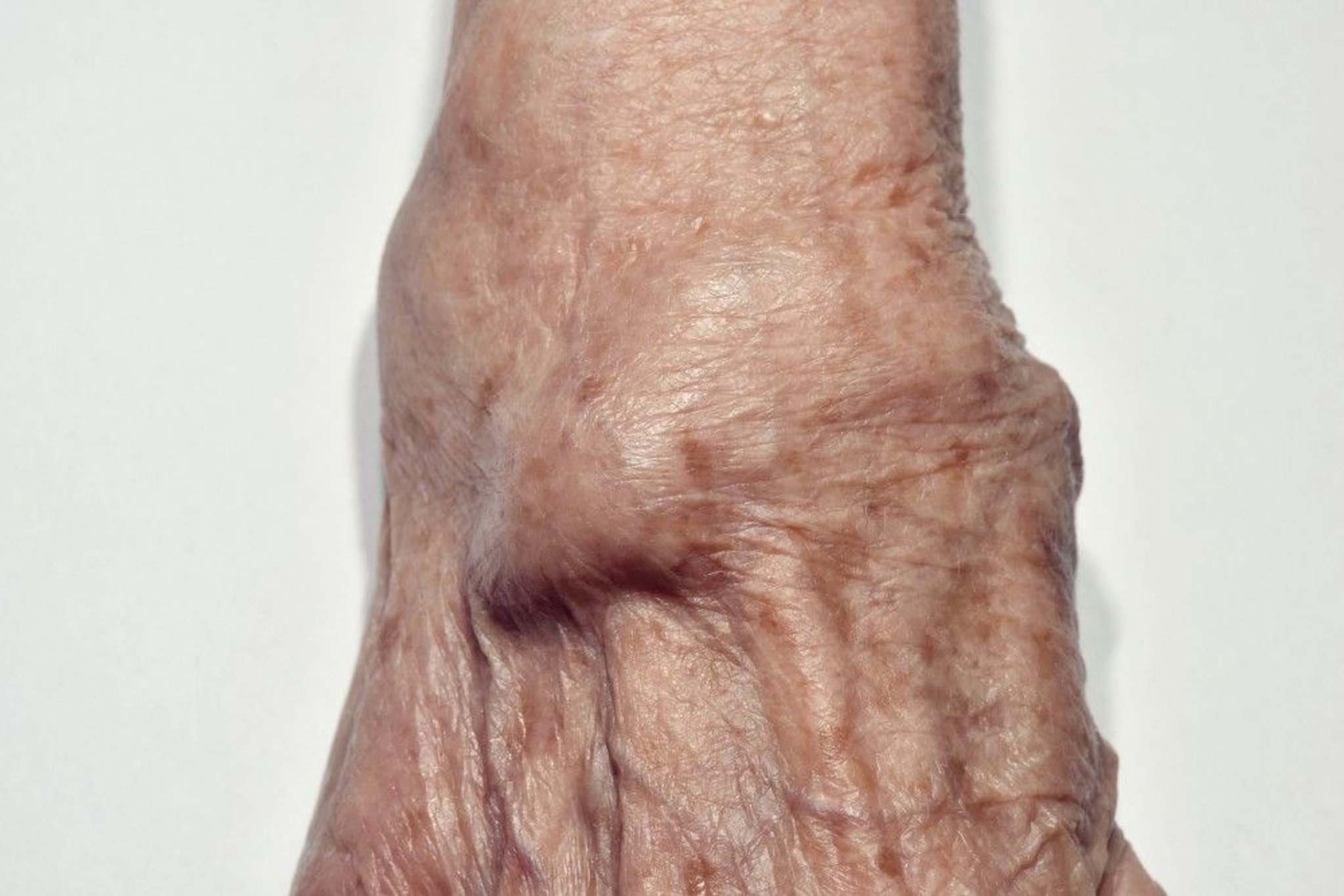
DR P. MARAZZI/SCIENCE PHOTO LIBRARY
Why ganglia develop on the wrist is not known, although they may be related to a previous injury. Ganglia on the back of a finger usually are related to arthritis of the last joint of the finger. However, in most cases, having a ganglion cyst does not mean that arthritis will develop.
Did You Know...
|
Symptoms of Ganglia
Ganglia are firm, smooth, and round or oval swellings that arise under the skin surface. They contain a clear, jellylike, and usually sticky fluid. They are usually painless but occasionally cause discomfort.
Diagnosis of Ganglia
A doctor can readily make the diagnosis of ganglia by examining the hand.
Treatment of Ganglia
Removal of the fluid using a needle
Surgical removal
Most ganglia disappear without treatment, so treatment may not be necessary. However, if ganglia are unsightly, cause discomfort, or continue to increase in size, the jellylike fluid inside them can be removed by a doctor using a needle and a syringe (called aspiration). Aspiration is effective in about 50% of people. Sometimes a corticosteroid is injected afterward to further ease any discomfort.
People should not remove a ganglion by placing their hand on a firm surface (such as a table) and hitting the ganglion with a large book or other hard object. This method may cause injury and is unreliable.
In about 40 to 70% of people, surgical removal is necessary. After surgical removal, ganglia return in about 5 to 15% of people.


