





In people with a bunion, the joint at the base of the big toe appears to stick out (becomes prominent).
Abnormalities in joint position or motion can distort and enlarge or seem to enlarge the joint that connects the big toe with the foot.
Pain and swelling can affect the inner part of the joint or the entire joint.
The diagnosis is based on symptoms and an examination, and sometimes fluid in the joint is tested.
Changing shoes or using toe spacers, pads, or orthotic devices placed in the shoe that help redistribute and relieve pressure from affected joint, or a combination of such measures usually helps.
For some people with pain and difficulty walking, surgery may be considered.
(See also Overview of Foot Problems.)
A bunion occurs when the big toe and/or the bone to which it connects is out of position.
Hallux Valgus With a Bunion
A hallux valgus is when the base of the big toe abnormally points outward away from the foot and the tip of the big toe tilts in toward the second toe. A bunion is the enlargement at the base of the big toe caused by the hallux valgus deformity. A bursa (a fluid-filled sac) may develop over the joint and may become painful. |

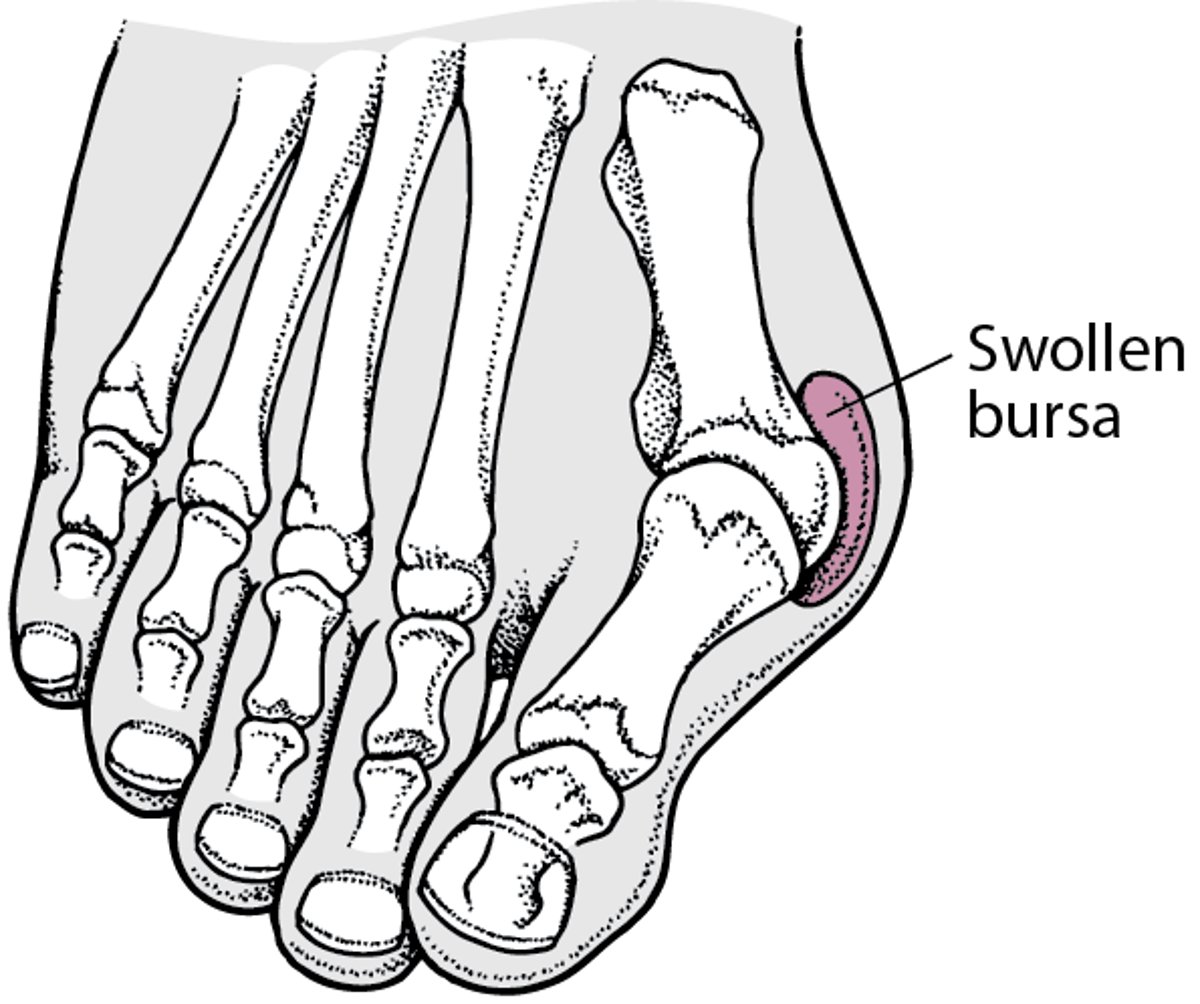
When the base of the big toe abnormally points outward and the tip of the big toe points inward (toward the second toe), the condition is called hallux valgus. Hallux valgus causes a bunion.
Factors that contribute to bunion formation may include excessive rolling inward (pronation) of the foot, wearing tight-fitting and pointed-toe shoes, and occasionally injury. Osteoarthritis may develop, and bone spurs may form. Osteoarthritis causes joint cartilage damage, limiting the foot’s range of motion. The joint may swell, and a bursa (a fluid-filled sac) often develops and becomes painful. Tight-fitting shoes can worsen symptoms. Occasionally, gout can cause sudden attacks in which the bunion becomes red, painful, and swollen.
Symptoms of a Bunion
The first symptom of a bunion may be pain at the joint when wearing shoes that are too narrow and/or tight. Later symptoms may include increasing enlargement; a painful, warm, red swelling where the joint bulges out (bursitis); and swelling and pain all around the joint. Joint motion is usually limited.
Diagnosis of a Bunion
A doctor's examination
Sometimes tests of joint fluid
Doctors easily base the diagnosis of a bunion on symptoms and examination findings.
X-rays are not needed to diagnose a bunion, but x-rays may be done to help determine the extent of joint damage.
Sometimes, if the joint is very painful, swollen, and red, doctors may withdraw and analyze joint fluid (joint aspiration) from the toe joint to detect infectious arthritis or gout. If multiple joints are affected, tests may be done to diagnose diseases that cause swelling and pain in multiple joints.
Treatment of a Bunion
Wide toe box, bunion pads, toe spacers, and orthoses
Sometimes, surgery to treat complications
Mild discomfort caused by a bunion may be significantly lessened by wearing shoes with a wide toe box. If not, bunion pads can shield the painful area. Toe spacers can also be tried. Orthoses (devices placed in the shoe) can also help redistribute and relieve pressure from the affected joint.

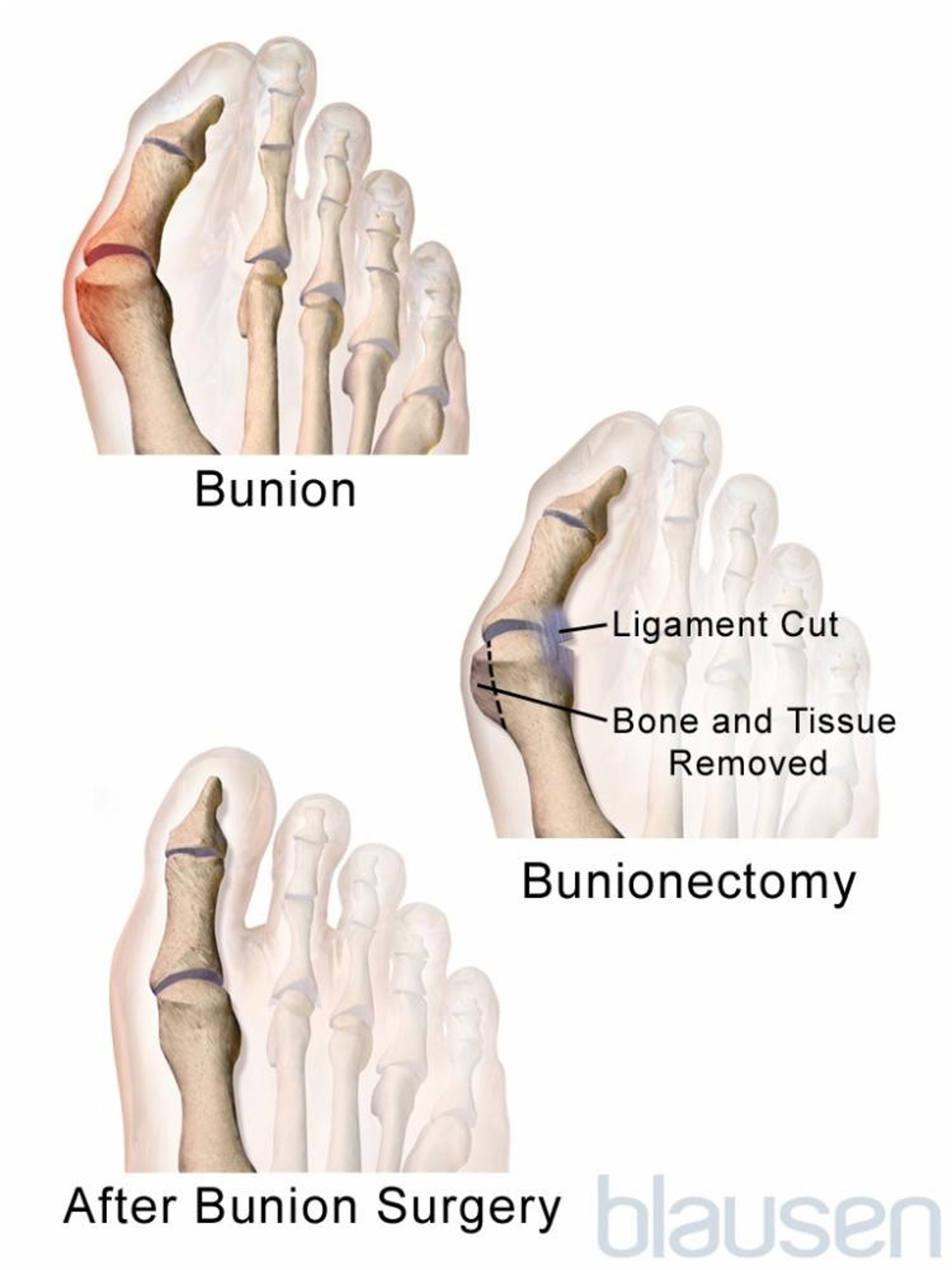
If these measures are ineffective or if the person is unwilling to wear large, wide shoes and orthoses, surgery (bunionectomy) is considered.
Sometimes taking nonsteroidal anti-inflammatory drugs (NSAIDs) or injecting a corticosteroid with or without a pain blocker (an anesthetic) can help relieve pain and swelling.
Sometimes the fluid in a bursa is removed using a needle (aspiration).
Sometimes, surgery to release scar tissue and improve alignment is necessary.


