





Progressive supranuclear palsy is characterized by slow movements, muscle stiffness (rigidity), problems moving the eyes, and a tendency to fall backward.
Progressive supranuclear palsy progresses faster and results in more severe muscle rigidity and disability than Parkinson disease.
The diagnosis is based on symptoms, a doctor's evaluation, and magnetic resonance imaging.
No effective treatment exists, but medications used to treat Parkinson disease sometimes provide temporary relief.
(See also Overview of Movement Disorders.)
Progressive supranuclear palsy, which is much rarer than Parkinson disease, affects many parts of the brain, particularly the basal ganglia and the brain stem. The basal ganglia help initiate and smooth out intended (voluntary) movements, suppress unintended (involuntary) movements, and coordinate changes in posture. The brain stem regulates critical body functions, such as breathing, heart rate, and swallowing, and helps adjust posture. Brain cells in these areas degenerate, but why they do is usually unknown.
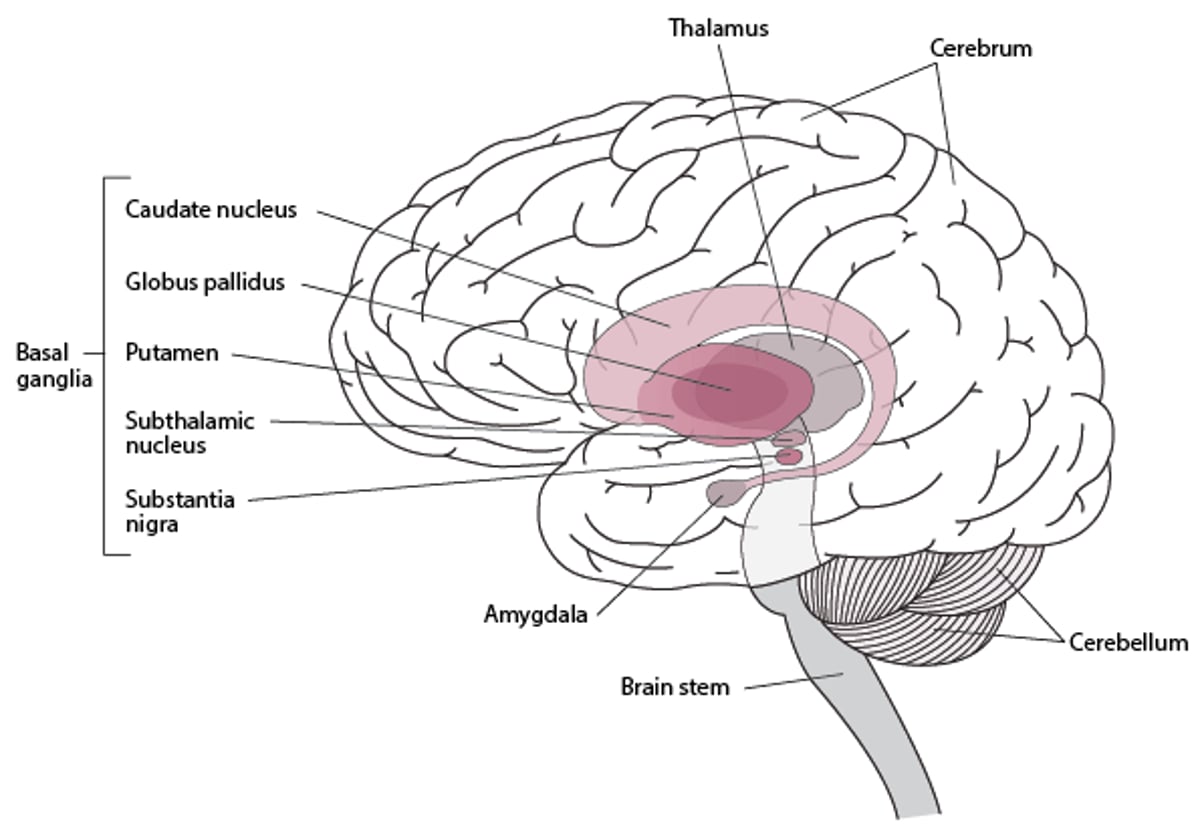
Locating the Basal Ganglia
The basal ganglia are collections of nerve cells located deep within the brain. They include the following:
The basal ganglia help initiate and smooth out muscle movements, suppress involuntary movements, and coordinate changes in posture. |

Symptoms of PSP
Symptoms of progressive supranuclear palsy usually begin after age 60 but may begin as early as age 40.
The first symptoms are usually difficulty looking down without bending the neck and difficulty going up and down stairs. The trunk becomes stiff, As a result. walking becomes more difficult and the risk of falling increases.
As the disorder progresses, intentionally looking up or down becomes increasingly difficult, as does trying to follow a moving object with the eyes. Eventually, looking side to side also becomes difficult. The eyes appear to be frozen in their sockets. The upper eyelids may pull back, producing a look of astonishment.
Muscles become rigid, and movements are slow. Walking is unsteady, with a tendency to fall backward. Speaking and swallowing are difficult.
Other symptoms include insomnia, agitation, irritability, apathy, and rapid changes in emotion.
In the late stages, depression and dementia are common. Compared with Parkinson disease, progressive supranuclear palsy progresses faster, causes falls earlier, responds less well to treatment, and results in severe muscle rigidity and disability, usually within 5 years. Usually, death, often due to aspiration (inhaling mouth secretions and/or food they eat or liquids they drink), occurs within 10 years after symptoms begin.
Diagnosis of PSP
A doctor's evaluation
Usually magnetic resonance imaging
The diagnosis of progressive supranuclear palsy is based on symptoms and a doctor's evaluation.
The following test helps doctors diagnose this disorder: People with progressive supranuclear palsy have trouble voluntarily moving their eyes, especially up or down but eventually also side to side. However, when a doctor asks them to look straight ahead at an object, then turns their head for them in one direction, their eyes move normally and involuntarily in the opposite direction to enable them to keep looking at the object. This test can detect the loss of voluntary eye movements but the preservation of involuntary eye movements that is characteristic of progressive supranuclear palsy and confirms the diagnosis.
Magnetic resonance imaging (MRI) is usually done to check for other disorders that may be causing the symptoms. In people with advanced progressive supranuclear palsy, MRI shows that the upper part of the brain stem (the midbrain) has shrunk and is smaller than normal.
Treatment of PSP
Sometimes medications used to treat Parkinson disease
Physical and occupational therapy
There is no cure for progressive supranuclear palsy.
Sometimes the medications used to treat Parkinson disease
Physical and occupational therapists can provide exercises to help keep joints limber and help people function better. They can also recommend strategies and safety measures to reduce the risk of falls.
Because progressive supranuclear palsy is fatal, people with this disorder should prepare advance directives, indicating what kind of medical care they want at the end of life.


