





Growths can originate in any type of tissue in and around the mouth, including connective tissues, bone, muscle, and nerve. Growths most commonly form on the
Lips
Sides of the tongue
Floor of the mouth
Back portion of the roof of the mouth (soft palate)
Some growths cause pain or irritation.
Causes of Mouth Growths
Mouth growths can be
Noncancerous (benign)
Precancerous (dysplastic)
Cancerous (malignant)
Most mouth growths are noncancerous.
Noncancerous mouth growths
A variety of noncancerous growths may occur in and around the mouth. A persistent lump or raised area on the gums (gingiva) should be evaluated by a dentist. Such a lump may be caused by a gum or tooth abscess or by irritation. But, because any unusual growths in or around the mouth can be cancer, the growths should be checked by a doctor or dentist without delay.
Noncancerous growths due to irritation are relatively common and, if necessary, can be removed by surgery. In 10 to 40% of people, noncancerous growths on the gums reappear because the irritant remains. Occasionally such irritation, particularly if it persists over a long period of time, can lead to precancerous changes.
Ordinary warts (verrucae vulgaris) can infect the mouth if a person sucks or chews one that is growing on a finger. A different type of wart also caused by the human papillomavirus—a genital wart—may be transmitted to the mouth through oral sex. Among the several methods used to remove warts (see Warts: Treatment), surgical removal is the preferred method for mouth warts.
Thrush is a yeast infection of moist areas of the skin and other moist areas (such as the mouth and vagina). In the mouth it often appears as whitish, cheeselike patches. Thrush sticks tightly to the mucous membranes and when wiped away, leaves a red patch. Thrush is most common among people with diabetes or a suppressed immune system and in those who are taking antibiotics.
A torus is a slow-growing, rounded projection of bone that forms in the middle of the roof of the mouth (torus palatinus) or on the lower jaw by the side of the tongue (torus mandibularis). This hard growth is both common and harmless. Even a large growth can be left alone unless it gets scraped during eating or the person needs a denture that covers the area. Multiple bony growths, particularly along the angle of the lower jaw, may indicate Gardner syndrome, a hereditary disorder of the digestive tract where the person has numerous polyps in the colon that often become cancerous.
Keratoacanthomas are growths that form on the lips and other sun-exposed areas, such as the face, forearms, and hands. A keratoacanthoma usually reaches its full size of ½ to 1 inch (about 1 to 3 centimeters) or more in diameter within 1 or 2 months, then begins to shrink after another few months and may eventually disappear without treatment. Once, all keratoacanthomas were considered to be noncancerous, but some experts now consider those that do not diminish in size to be slow-growing cancerous tumors and recommend that they be removed.
Cysts (hollow, fluid-filled swellings) of many types cause jaw pain and swelling. Often they are next to an impacted wisdom tooth and can destroy considerable areas of the jawbone as they expand. Certain types of cysts are more likely to recur after surgical removal. Various types of cysts may develop in the floor of the mouth. Often, cysts are surgically removed because they make swallowing uncomfortable or because they are unattractive. By far the most common cyst occurs in the lip and is called a mucocele or mucus retention cyst. It is usually the result of accidentally biting the (lower) lip and occurs when saliva draining into the mouth from a minor salivary gland is blocked. Most mucoceles disappear in a week or two but can be surgically removed if annoying.
Odontomas are overgrowths of tooth-forming cells that look like either small, misshapen extra teeth or a large mass of tooth material. In children, they may get in the way of normal teeth coming in. In adults, they may push teeth out of alignment. If odontomas grow large, they may cause the upper or lower jaw to become enlarged as well. They are usually removed surgically.
Most (75 to 80%) salivary gland tumors are noncancerous, slow-growing, and painless. They usually occur as a single, soft, movable lump beneath normal-looking skin or under the lining (mucosa) of the inside of the mouth. Occasionally, when hollow and fluid-filled, they are firm. The most common type (called a mixed tumor or pleomorphic adenoma) occurs mainly in women older than 40. This type can become cancerous and is removed surgically. Unless completely removed, this type of tumor is likely to grow back. Other types of noncancerous tumors are also removed surgically but are much less likely to become cancerous or to grow back once removed.
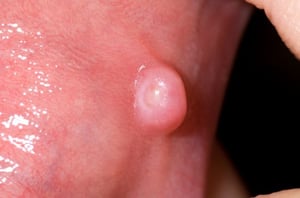
DR P. MARAZZIN/SCIENCE PHOTO LIBRARY
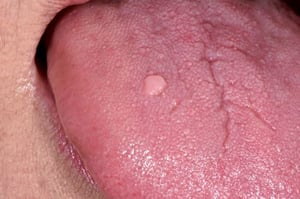
DR P. MARAZZI/SCIENCE PHOTO LIBRARY
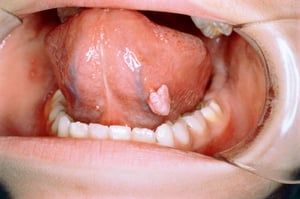
CLINICA CLAROS/SCIENCE PHOTO LIBBRARY
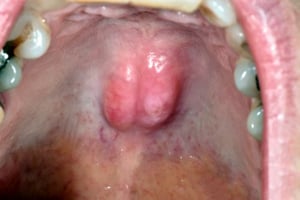
DR P. MARAZZI/SCIENCE PHOTO LIBRARY


DR P. MARAZZIN/SCIENCE PHOTO LIBRARY


DR P. MARAZZI/SCIENCE PHOTO LIBRARY


CLINICA CLAROS/SCIENCE PHOTO LIBBRARY


DR P. MARAZZI/SCIENCE PHOTO LIBRARY
Precancerous changes in the mouth
White, red, or mixed white-red areas that are not easily wiped away, persist for more than 2 weeks, and are not definable as some other condition may be precancerous. The same risk factors are involved in precancerous changes as in cancerous growths, and precancerous changes may become cancerous if not removed.
Leukoplakia is a flat white spot that may develop when the moist lining of the mouth (oral mucosa) is irritated for a long period. The irritated spot appears white because it has a thickened layer of keratin—the same material that covers the skin and normally is less abundant in the lining of the mouth.

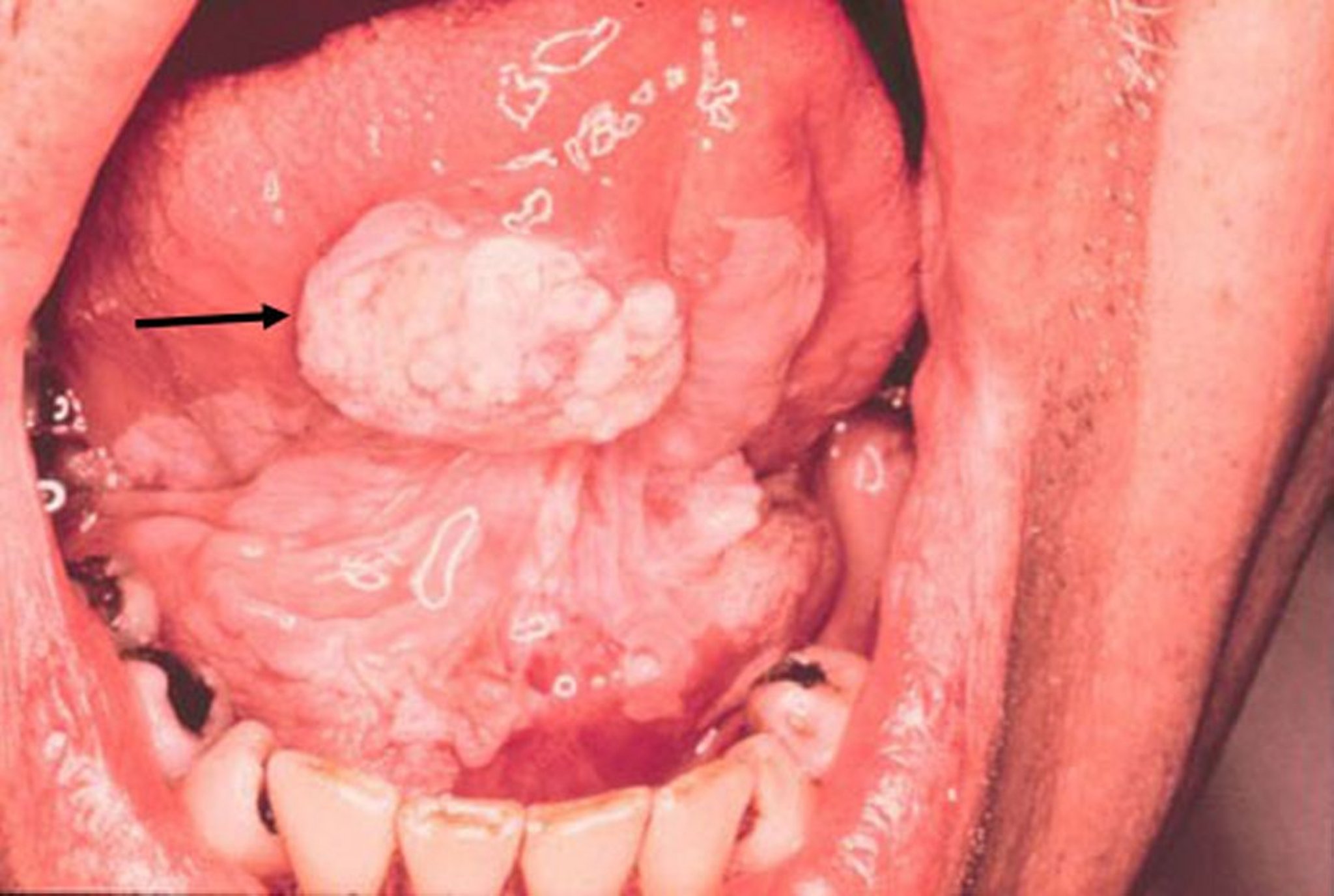
Photo provided by Jonathan A. Ship, DMD.
Erythroplakia is a red and flat or worn-away area that results when the lining of the mouth thins. The area appears red because the underlying capillaries are more visible. Erythroplakia is a much more ominous predictor of oral cancer than leukoplakia.

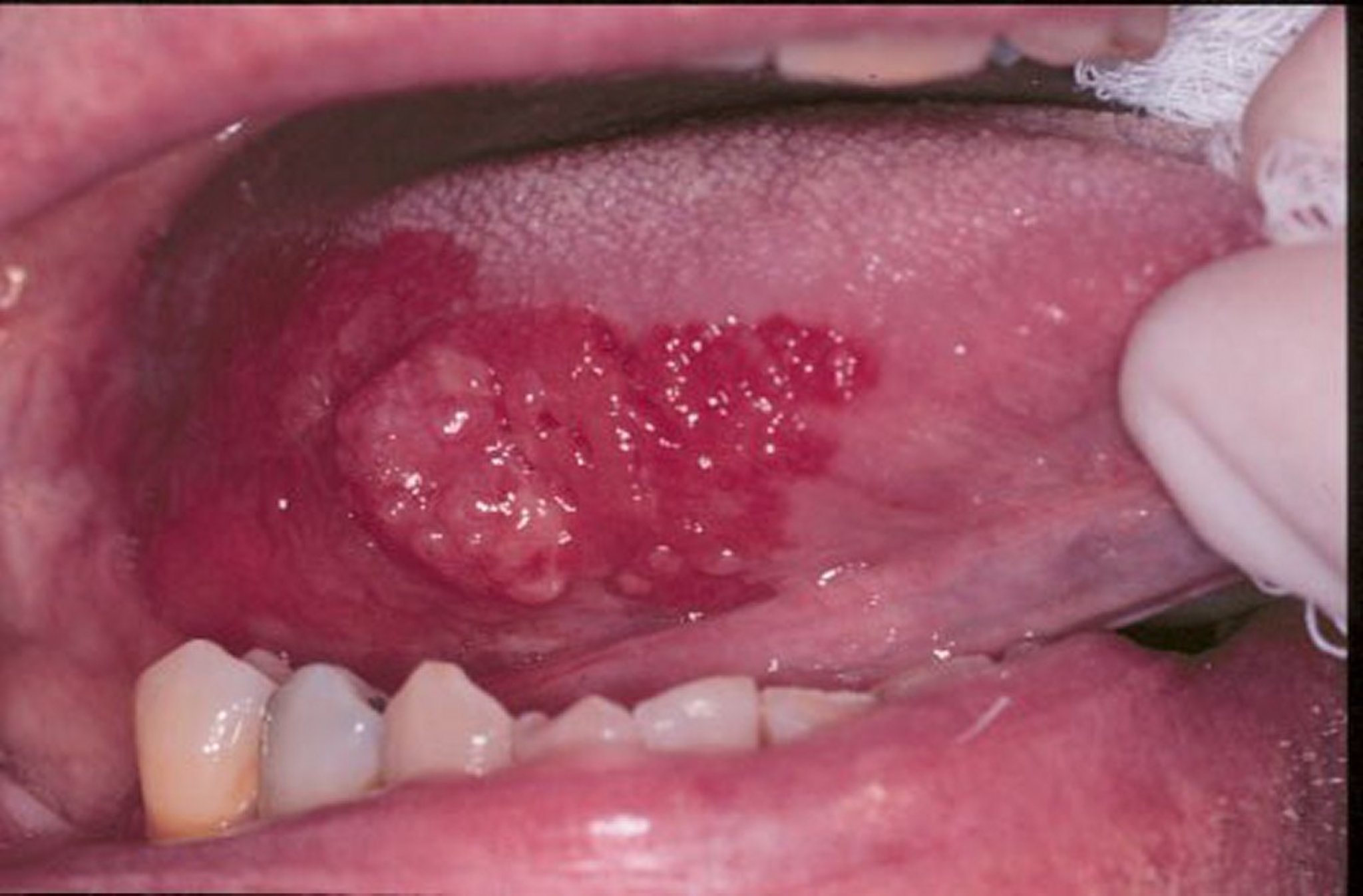
Image provided by Jonathan A. Ship, DMD.
Mixed white-red areas contain both leukoplakia and erythroplakia and also may become cancer over time.
Oral cancer
People who use tobacco, alcohol, or both are at much greater risk of oral cancer. For those who use chewing tobacco and snuff, the insides of the cheeks and lips are common sites of oral cancer. In other people, the most common sites for oral cancer include the sides of the tongue, the floor of the mouth, and the throat. Cancers caused by oral infection with human papillomavirus (HPV), especially type 16, usually occur at the back of the throat, base of tongue, and tonsils. HPV infection is now a more common cause of cancers at these sites than tobacco. Rarely, cancers found in the mouth region have spread there from other parts of the body, such as the lungs, breast, or prostate.
Oral cancer can have many different appearances but typically resembles precancerous lesions (for example, white, red, or mixed white-red areas that are not easily wiped away).
Evaluation of Mouth Growths
The following information can help people decide when a doctor's evaluation is needed and help them know what to expect during the evaluation.
Warning signs
Certain symptoms and characteristics are cause for concern. They include
Weight loss
Firm lump in the neck
A sore throat that will not go away
Difficulty swallowing
When to see a doctor
People with a mouth growth that does not go away in a week or two should see their doctor or dentist when convenient. Warning signs suggest a higher risk of cancer, and people with warning signs (particularly those who use tobacco) should not put off being evaluated.
Because oral cancer often causes no symptoms early on, it is important for people to have a yearly examination of the mouth. Such an examination can be done during an annual dental check-up.
What the doctor does
Doctors first ask questions about the person's symptoms and medical history. Doctors then do a physical examination. What they find during the history and physical examination can help suggest a cause of the mouth growth.
Doctors ask people about how long the growth has been present, whether it is painful, and whether there was any injury to the area (for example, biting a cheek or scraping by a sharp tooth edge or dental restoration). Other things they ask about include
The amount and duration of use of alcohol and tobacco
Risk factors for thrush (caused by the fungus Candida albicans), including use of antibiotics and a history of diabetes or HIV infection
Whether the person has lost weight or been feeling generally ill
How frequently the person has oral sex and the number of sexual contacts with whom they engage in oral sex
The physical examination focuses on the mouth and neck. Doctors look carefully at all areas of the mouth and throat, including under the tongue. They feel the sides of the neck for swollen glands (lymph nodes), which indicate possible cancer or chronic infection.
Testing
If a growth has the appearance of thrush, doctors examine scrapings under a microscope. For other growths that have lasted longer than a few weeks, most doctors recommend removing all or part of the growth for examination in a laboratory (biopsy). Biopsy is often necessary to make sure a growth is noncancerous.
Treatment of Mouth Growths
Treatment depends on the cause
Treatment differs depending on the cause, cosmetic effects or other symptoms, and possibility of cancerous transformation of the growth.
Key Points
Most mouth growths are noncancerous.
Warts, yeast infections, and repeated trauma (such as biting or rubbing against a sharp tooth edge) are common causes of noncancerous growths.
Use of alcohol and tobacco and oral human papillomavirus (HPV) infection are risk factors for oral cancer.
Because cancerous growths are difficult to recognize by their appearance, doctors frequently recommend a biopsy.
More Information
The following English-language resource may be useful. Please note that THE MANUAL is not responsible for the content of this resource.
MouthHealthy.org: Provides information on oral health, including nutrition and guidance on selecting products that carry the American Dental Association's seal of approval. There is also advice on finding a dentist and how and when to see one.


