





An abdominal wall hernia is an opening or area of weakness in the abdominal wall through which abdominal contents can protrude.
An abdominal wall hernia causes a noticeable bulge but little discomfort.
The diagnosis is made by physical examination and sometimes ultrasonography.
Treatment involves surgery to repair the hernia.
(See also Overview of Gastrointestinal Emergencies.)
Abdominal hernias are very common, particularly among men. There are about 700,000 hernia operations each year in the United States. Hernias are usually named for the area in which they occur.


The abdominal wall is thick and tough in most places, so hernias usually occur in an area of weakness where a previous opening has closed. Heavy lifting or straining may make a hernia more obvious but does not cause a hernia to form.
Groin hernias
Groin hernias include
Inguinal hernias
Femoral hernias
Inguinal hernias appear in the crease of the groin or in the scrotum. They are more common among men. There are two types, direct and indirect, depending on exactly where the hernia occurs. Inguinal hernias also occur in children.


A femoral hernia may develop just below the crease of the groin in the middle of the thigh where the femoral artery and vein enter the leg. This type of hernia is more common among women.
Abdominal wall hernias
Abdominal wall hernias (also called ventral hernias) include
Umbilical hernias
Epigastric hernias
Incisional hernias
Umbilical hernias occur around the navel (umbilicus). Many babies have a small umbilical hernia because the opening for the umbilical cord blood vessels did not close completely. In younger children, doctors sometimes monitor umbilical hernias to see whether they close on their own.

Some adults have an umbilical hernia because of obesity, pregnancy, or excess fluid in the abdomen (ascites).
Epigastric hernias form through natural small defects in the midline of the upper abdominal wall (above the umbilicus).
Incisional hernias sometimes form through a surgical incision in the abdominal wall. This type of hernia may develop many years after surgery.

Incarceration and strangulation
Sometimes, a loop of intestine or a piece of fat becomes stuck in the hernia, a condition called incarceration. An incarcerated hernia can block (obstruct) the intestine.
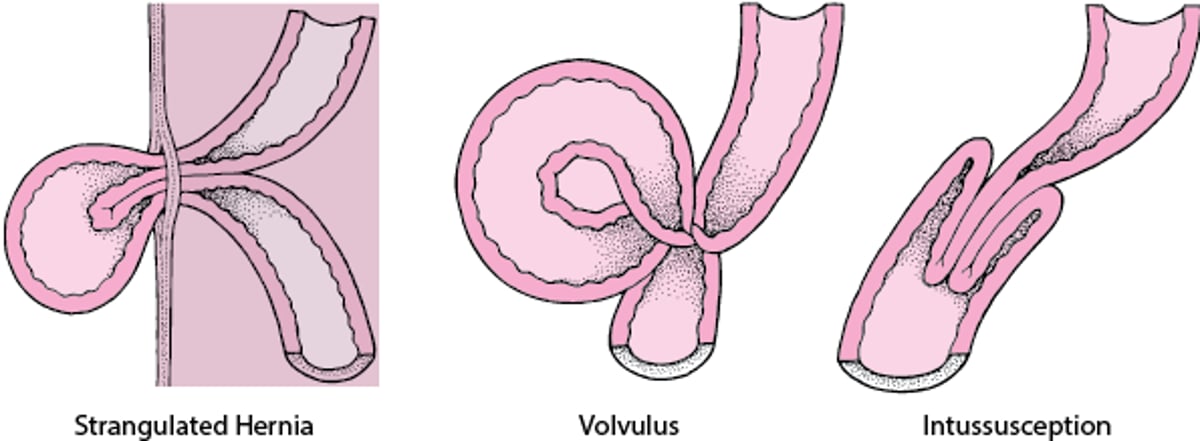
Rarely, the hernia traps the intestine so tightly that it cuts off the blood supply, a condition called strangulation. With strangulation, the trapped piece of intestine can develop gangrene in as few as 6 hours. With gangrene, the intestinal wall dies, usually causing rupture, which leads to peritonitis (inflammation and usually infection of the abdominal cavity), shock, and, if untreated, death.
What Causes Intestinal Strangulation?
Intestinal strangulation (cutting off of the blood supply to the intestine) usually results from one of three causes: strangulated hernia, volvulus, or intussusception. |

Sports hernias
A sports hernia is not a true hernia because there is no opening or weakness in the abdominal wall. There is also no protrusion of abdominal contents. Instead, the disorder involves a tear of one or more muscles, tendons, or ligaments in the lower abdomen or groin, particularly where they attach to the pubic bone. The term sports hernia may have come about because the pain occurs in the same area as an inguinal hernia.
Did You Know...
|
Symptoms of Abdominal Wall Hernias
Most people usually notice only a bulge at the site of the hernia. Sometimes the hernia appears only with lifting, coughing, or straining. There is usually little or no discomfort, and the bulge can be pushed back in (reduced) by the person or a doctor.
An incarcerated hernia is usually more painful, and the bulge cannot be reduced.
A strangulated hernia causes steady, gradually increasing pain, typically with nausea and vomiting, cannot be reduced, and is tender when touched.
Diagnosis of Abdominal Wall Hernias
A doctor's examination
Sometimes ultrasonography
Doctors base the diagnosis of hernias mainly on an examination. Lumps in the groin that resemble hernias may be swollen lymph nodes or undescended testes. A swelling in the scrotum may be a varicocele (a condition in which the veins that carry blood from a testis widen), a spermatocele (a cyst in a sac that develops next to the coiled tube where sperm are stored until they mature [epididymis]), or a tumor in a testis.
Sometimes the doctor does ultrasonography to help make the diagnosis.
Treatment of Abdominal Wall Hernias
Surgical repair
Umbilical hernias in infants rarely strangulate and are not treated. Most go away without treatment within several years. Very large umbilical hernias may be repaired after the infant is 2 years old.
Umbilical hernias in adults cause cosmetic concerns and can be repaired at a time that is convenient for the person (called elective surgery). Although umbilical hernias in adults do not usually strangulate and incarcerate, these complications can occur.
Because other types of hernias are more likely to strangulate, doctors usually repair them surgically when they are diagnosed. If the hernia is incarcerated or strangulated, surgery is done immediately. Otherwise, elective surgery is done. Surgical repair is aimed at closing or covering the opening so the abdominal contents cannot slide back out. Surgery usually relieves the symptoms of a hernia, depending on its size and the amount of discomfort it caused.
Holding the hernia in with tape or bandages or by other means sometimes makes the person more comfortable but does not lower the risk of strangulation or allow the opening to close. Therefore, these are not recommended treatments.


