





Cirrhosis is the widespread distortion of the liver's internal structure that occurs when a large amount of normal liver tissue is permanently replaced with nonfunctioning scar tissue. The scar tissue develops when the liver is damaged repeatedly or continuously. Cirrhosis was once considered irreversible, but it now appears to be reversible in some cases.
Chronic excessive use of alcohol, chronic viral hepatitis, and metabolic dysfunction–related steatohepatitis (MASH) formerly known as nonalcoholic steatohepatitis (NASH) (fatty liver not due to alcohol use) are the most common causes of cirrhosis.
Symptoms, when they occur, include poor appetite, weight loss, fatigue, and a general feeling of illness.
Many serious complications, such as accumulation of fluid within the abdomen (ascites), bleeding in the digestive tract, and deterioration in brain function, can occur.
The diagnosis is based on symptoms and results of a physical examination, blood tests, imaging studies, and sometimes a biopsy.
Doctors treat complications, but the damage due to cirrhosis is usually permanent.
People who have cirrhosis are at risk of liver cancer, so ultrasonography and, if needed, magnetic resonance imaging (MRI) or computed tomography (CT), and blood tests are done regularly to check for cancer.
Cirrhosis is a common cause of death worldwide and was the 16th leading cause of death worldwide in 2019.
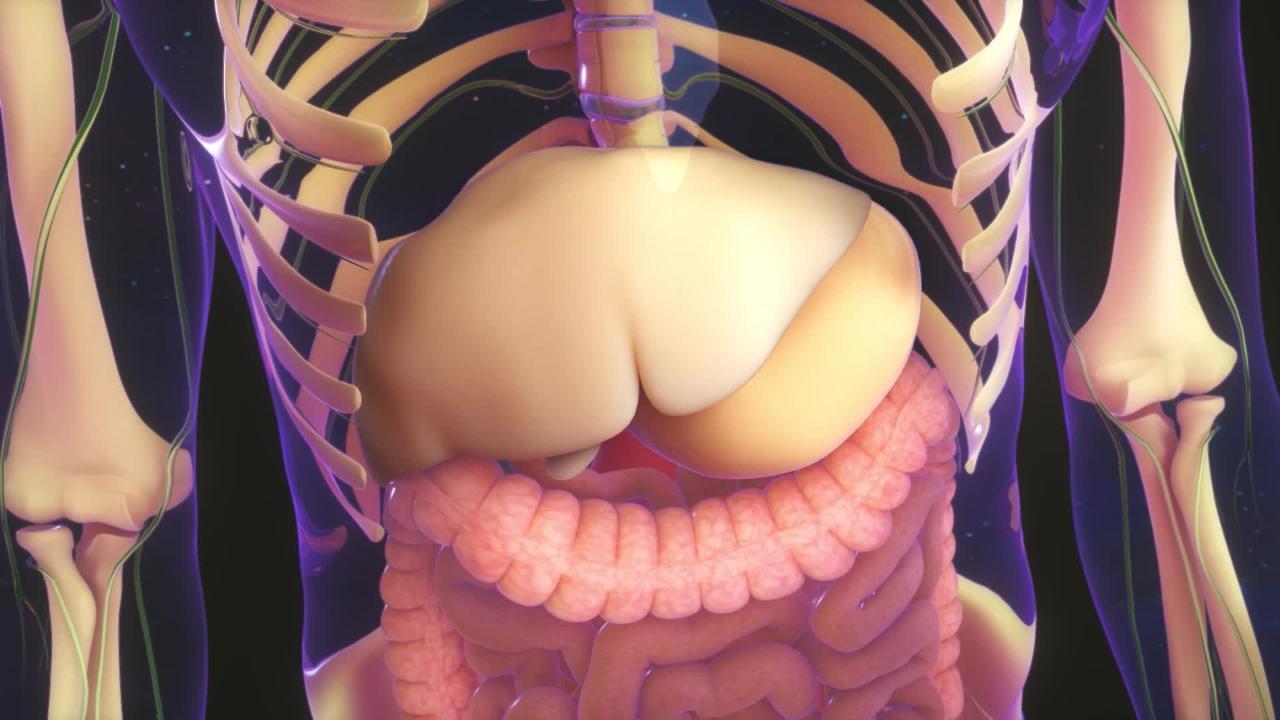
Various disorders, medications, or toxins can damage the liver. If damage is sudden (acute) and limited, the liver commonly repairs itself by making new liver cells and attaching them to the web of connective tissue (internal structure) that is left when liver cells die. Repair and full recovery can occur if people can survive long enough. However, with repeated damage, the liver's attempts to replace and repair damaged tissue lead to scarring (fibrosis of the liver). The scar tissue performs no function. When fibrosis is widespread and severe, the scar tissue forms bands throughout the liver, destroying the liver’s internal structure and impairing the liver’s ability to regenerate itself and to function. Such severe scarring is called cirrhosis.
Because liver function is impaired, the liver is less able to
Break down and remove medications, toxins, and waste products made in the body
Process bile
Produce proteins that help blood clot (clotting factors)
Produce albumin (a protein that helps keep fluid from leaking out of blood vessels)
The liver processes many medications, toxins, and body waste products. It breaks them down into substances that are less harmful and/or easier to remove from the body. The liver removes the substances by excreting them in bile, a greenish yellow digestive fluid produced by cells in the liver. When the liver is less able to process these substances, they accumulate in the bloodstream. As a result, the effects of many drugs and toxins, including sometimes serious side effects, are increased. Such side effects may develop even when people are taking a dose that they previously took with no ill effects. Medications may need to be stopped or used at lower doses and more cautiously. Some examples include opioids and some medications used to treat anxiety or insomnia.
Bilirubin is an important body waste product that the liver processes and removes. If the liver cannot process bilirubin quickly enough, it builds up in the blood and is deposited in the skin. The result is jaundice (a yellow coloring of the eyes and skin).
Within the liver, the bile moves into small channels (bile ducts) that join to form larger ducts. These large ducts eventually leave the liver and connect to the gallbladder (which stores bile) or to the small intestine. Bile helps make fats easier to absorb in the intestine and carries toxins and waste products into the intestine so that they can be excreted in stool. When scar tissue blocks bile flow through the bile ducts, fats, including fat-soluble vitamins (A, D, E, and K), are not absorbed as well. In addition, fewer toxins and waste products are eliminated from the body.
Normally, a large part of bile (bile salts) is reabsorbed into the bloodstream from the intestine and circulated back to the liver. The liver extracts the bile salts and reuses them. However, in cirrhosis, the liver cannot extract bile salts normally. As a result, the liver cannot produce as much bile, further interfering with digestion and elimination of toxins and waste products and the absorption of fats and fat-soluble vitamins.
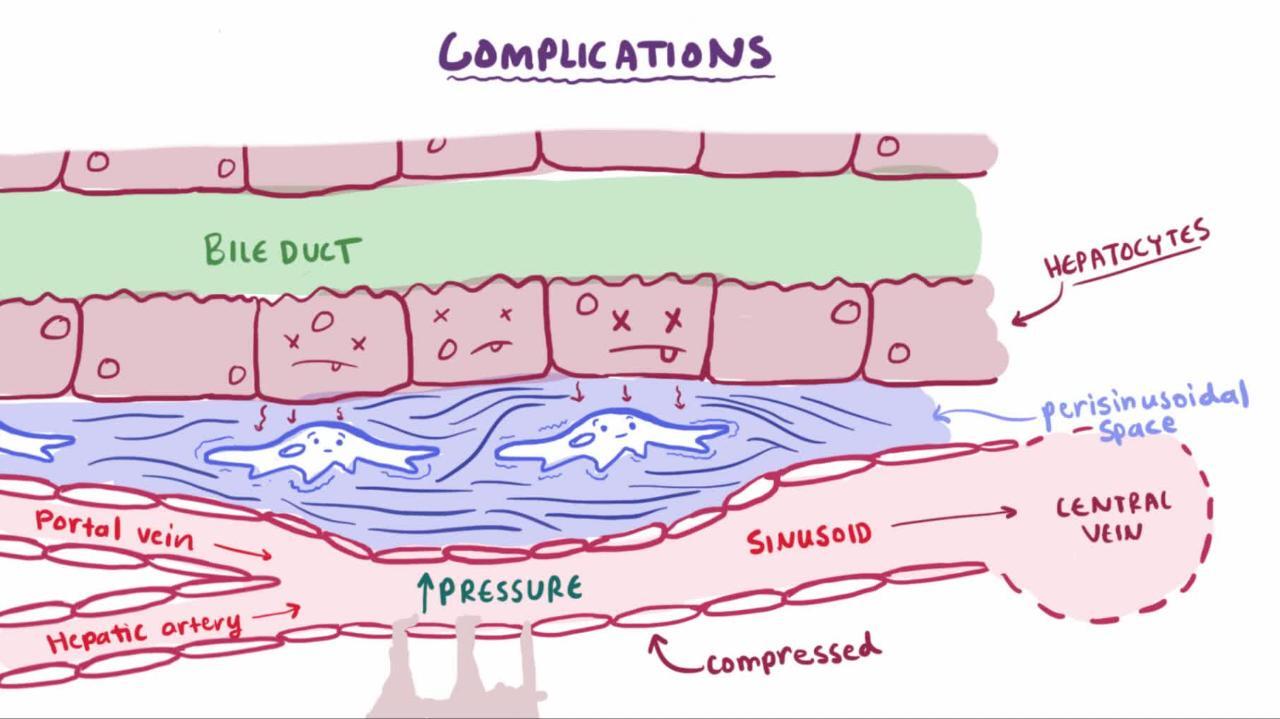
In addition to interfering with liver function, scar tissue also can block blood flow into the liver from the portal vein (which carries blood from the intestine to the liver). The blockage results in high blood pressure in the portal vein (portal hypertension). Portal hypertension leads to high blood pressure in the veins connected to the portal vein, including veins in the stomach, esophagus, spleen and rectum.

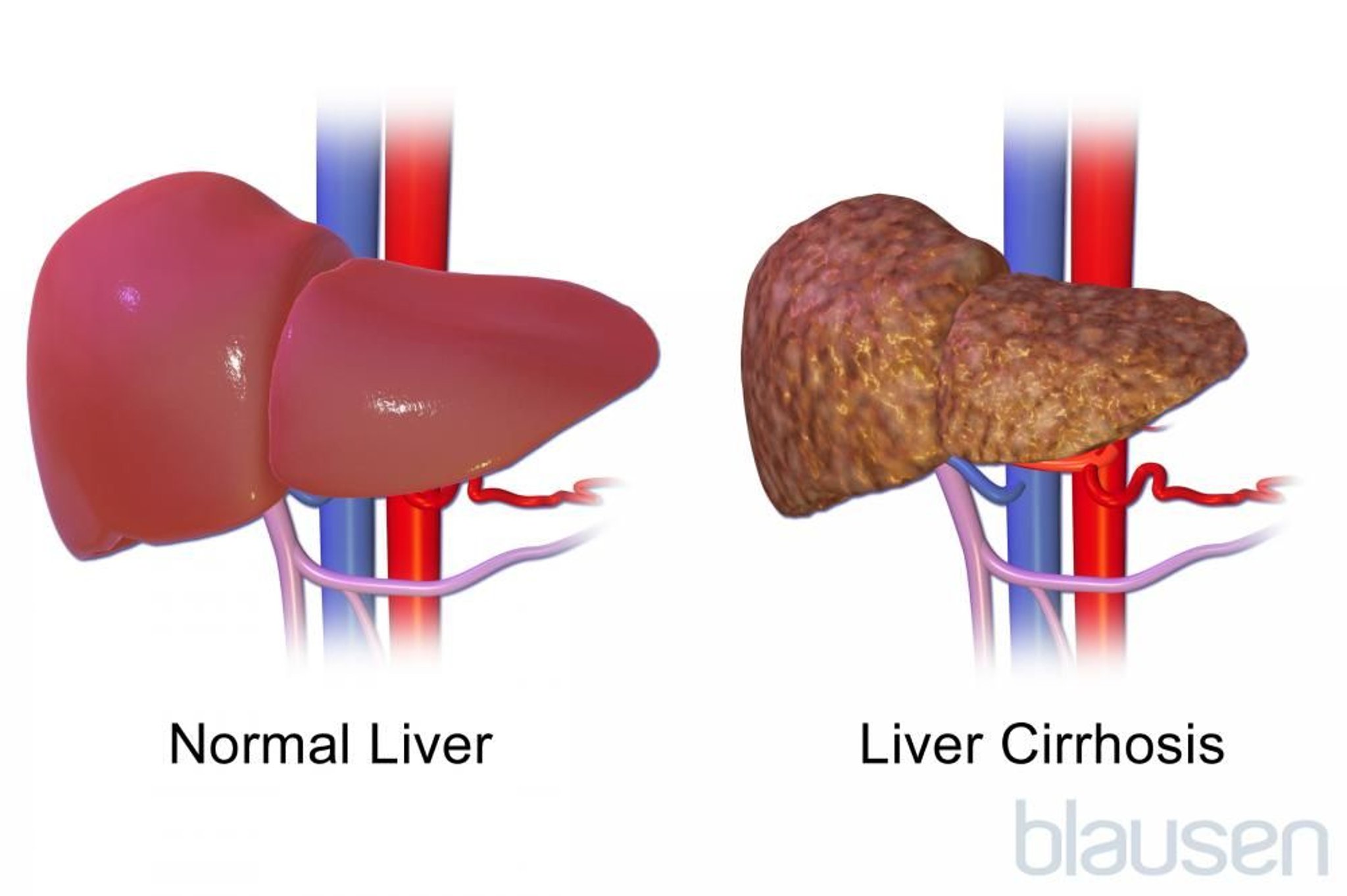
As scarring progresses, the liver shrinks and becomes stiffer.
Did You Know...
|
Causes of Cirrhosis
In the United States and other developed countries, the most common causes of cirrhosis are
Chronic excessive use of alcohol (drinking too much alcohol for a long time)
Chronic hepatitis C (hepatitis C that has lasted at least 6 months)
Fatty liver not due to alcohol use: metabolic dysfunction–associated steatohepatitis (MASH) formerly known as nonalcoholic steatohepatitis (NASH)
Metabolic dysfunction–associated steatohepatitis (MASH) usually occurs in people who are overweight, have diabetes or prediabetes, and/or high cholesterol.
Any disorder, drug, or toxin that causes fibrosis (see table Some Conditions and Drugs That Can Cause Fibrosis of the Liver) can cause cirrhosis. Some specific causes include certain hereditary metabolic disorders, such as iron overload (hemochromatosis), copper overload (Wilson disease), and alpha-1 antitrypsin deficiency, and disorders that damage the bile ducts, such as primary biliary cholangitis (PBC) and primary sclerosing cholangitis (PSC).
In many parts of Asia and Africa, cirrhosis often results from
Symptoms of Cirrhosis
Many people with cirrhosis have no symptoms and appear to be well for years. About one third never develop symptoms.
Others feel tired and generally unwell, lose their appetite, and lose weight:
Their fingertips may enlarge (called clubbing).
Jaundice can develop, making the skin and whites of the eyes look yellow and the urine look dark like cola.
When fats and fat-soluble vitamins are poorly absorbed, stools may be light-colored, soft, bulky, oily-looking, and unusually foul-smelling (called steatorrhea).
Many people are undernourished and lose weight because they have lost their appetite and because fats and vitamins are poorly absorbed. People may have a reddish purple rash of tiny dots or larger splotches, caused by bleeding from small blood vessels in the skin.
If the liver function has been impaired for a long time, people may itch all over.
Other symptoms may develop if cirrhosis is caused by chronic excessive alcohol use or if people have a chronic liver disorder:
Muscles waste away (atrophy).
The palms become red (called palmar erythema).
The tendons of the hand shrink, causing the fingers to curl up (called Dupuytren contracture).
Small spiderlike blood vessels (spider angiomas) appear in the skin.
Salivary glands in the cheeks enlarge.
The nerves outside the brain and spinal cord (peripheral nerves) malfunction (called peripheral neuropathy).
Men may have enlarged breasts (gynecomastia) and shrunken testes (testicular atrophy) because the damaged liver cannot break down estrogens (female hormones) as it usually does. Hair in the armpits decreases.
Complications of cirrhosis
Advanced cirrhosis can cause additional problems.
Portal hypertension
Portal hypertension (high blood pressure in the portal vein) is a serious complication. When it causes blood to back up in the veins connected to it, these veins may enlarge and twist (called varicose veins). Varicose veins may develop at the lower end of the esophagus (esophageal varices), in the stomach (gastric varices), or in the rectum (rectal varices). Varicose veins are fragile and prone to bleeding. People may vomit large amounts of blood if esophageal or gastric varices bleed (see Gastrointestinal Bleeding). If bleeding is slow and continues for a long time, it may cause anemia. If bleeding is rapid and more severe, it may result in shock and death.
Portopulmonary hypertension
Portal hypertension can cause high blood pressure in the arteries of the lungs (called portopulmonary hypertension). This problem can cause symptoms of heart failure, such as difficulty breathing, particularly when lying down, and fatigue.
Ascites
Portal hypertension plus impaired liver function may lead to accumulation of fluid within the abdomen (ascites). As a result, the abdomen swells and may feel tight. Also, the fluid in the abdomen may become infected (called spontaneous bacterial peritonitis).
Poor absorption of fats and vitamins
Over time, poor absorption of fats, particularly fat-soluble vitamins, can lead to several problems. For example, when vitamin D is poorly absorbed, osteoporosis can develop. When vitamin K (which helps blood clot) is poorly absorbed, people may bleed more easily.
Bleeding irregularities
Cirrhosis causes other problems that can interfere with how blood clots (disordered blood clotting). Some problems make people more likely to bleed. For example, the spleen may enlarge. The enlarged spleen may trap blood cells and platelets. Thus, fewer platelets (which help blood clot) are in the bloodstream. Also, the damaged liver is less able to produce the proteins that help blood clot (clotting factors).
However, some liver problems make blood more likely to clot. For example, the damaged liver is less able to produce the substances that prevent blood from clotting too much. Thus, blood clots may form, especially in blood vessels entering the liver (portal vein or splenic vein).
Increased risk of infection
The number of white blood cells may be reduced (called leukopenia) because the enlarged spleen traps them. When the number of white blood cells is low and the liver's synthesis of proteins that fight infections decreases, the risk of infections increases.
Kidney failure
Liver failure can eventually lead to kidney failure—a condition called hepatorenal syndrome. In this syndrome, less urine is produced and excreted from the body, resulting in the buildup of toxic substances in the blood. Eventually, people with hepatorenal syndrome have difficulty breathing. This kidney problem can become severe enough to require dialysis.
Deterioration of brain function
Liver failure can also cause brain function to deteriorate (called hepatic encephalopathy) because the damaged liver can no longer remove toxic substances from the blood. These toxic substances then travel through the bloodstream and affect the brain.
Liver cancer
Liver cancer (hepatocellular carcinoma, or hepatoma) can develop in people with cirrhosis. Liver cancer monitoring, also called surveillance (periodic assessment), is required once cirrhosis is developed, because early detection of liver cancer makes curative treatment possible.
Diagnosis of Cirrhosis
Blood tests, including liver tests
Sometimes imaging tests (for example, ultrasound)
Sometimes liver biopsy
Doctors usually suspect cirrhosis based on the person's symptoms, results of the physical examination, and a history of risk factors for cirrhosis such as chronic excessive alcohol use. Often during the physical examination, a doctor notices problems that typically result from cirrhosis, such as an enlarged spleen, a swollen abdomen (indicating ascites), jaundice, or a rash indicating bleeding in the skin. Doctors typically then do tests to look for other disorders that can cause similar symptoms.
Laboratory tests
Blood tests to evaluate the liver are done. Results are often normal because these tests are relatively insensitive and the liver can function for a long time despite damage. The liver can carry out essential functions even when its function is reduced by 80%. A complete blood count (CBC) is done to check for anemia, low platelet count, and other blood abnormalities. Blood tests are done to check for hepatitis and often other possible causes.
Liver imaging tests
Imaging tests can identify advanced cirrhosis but often does not identify early cirrhosis.
Ultrasonography, computed tomography (CT), or magnetic resonance imaging (MRI) can show whether the liver has shrunk or its structure is abnormal, suggesting cirrhosis. These tests can detect portal hypertension and ascites.
Specialized imaging tests (transient elastography, magnetic resonance elastography, and acoustic radiation force impulse imaging) help detect early cirrhosis.
Liver biopsy
If the diagnosis is still uncertain, a liver biopsy (removal of a tissue sample for examination under a microscope) can be done to confirm it. Biopsy and sometimes blood tests can also help doctors determine the cause of cirrhosis.
Monitoring
If cirrhosis is confirmed, ultrasonography with or without a blood test that could indicate a liver tumor (alpha fetoprotein) are done every 6 months to check for liver cancer. If ultrasonography detects abnormalities that suggest cancer, doctors do magnetic resonance imaging (MRI) or CT after injecting a contrast agent.
When cirrhosis is confirmed, endoscopy of the upper digestive tract (inserting a flexible viewing tube) may be needed to check for varices, particularly when there are signs of portal hypertension in blood and imaging tests and the patient is not a candidate for medication to decrease portal hypertension. This endoscopy test is repeated every 2 to 3 years. It is done more often if varices are detected.
Blood tests that assess the liver are done regularly.
Treatment of Cirrhosis
There is no cure for cirrhosis. The liver is almost always damaged permanently and is unlikely to be normal again.
Treatment includes
Correcting or treating the cause, such as chronic excessive alcohol use, use of a drug, exposure to a toxin, hemochromatosis, or chronic hepatitis
Treating complications as they develop
Sometimes transplanting a liver
The best approach is to stop cirrhosis in its earliest stages by correcting or treating the cause. Treating the cause usually prevents any further damage and sometimes causes the person's condition to improve.
Treating causes
People are given the hepatitis A and B vaccines if they have not had them before. These vaccines are given to protect the liver from further damage due to these viruses, damage that could add to their cirrhosis.
To prevent cirrhosis from progressing, people should stop drinking alcohol completely, even if alcohol is not the main cause of their liver problem (see Alcohol/Treatment). Drinking even moderate amounts of alcohol can be very harmful to the liver once cirrhosis is present. Withdrawal symptoms, if they occur, are treated.
People must inform their doctor of all the drugs they are taking, including over-the-counter drugs, herbal products, and dietary supplements, because the damaged liver may not be able to process (metabolize) them. If people need to take drugs that are metabolized by the liver, much smaller doses are used to avoid further damage to the liver. Also, people may be taking a drug that can damage the liver and thus contribute to cirrhosis. Such drugs are stopped whenever possible, and another drug is substituted if needed.
For hemochromatosis, bloodletting (phlebotomy) is the best treatment. For Wilson disease, a medication to remove copper from the body is used.
For fatty liver disease called metabolic dysfunction–associated steatohepatitis (MASH), weight loss is the treatment and diabetes and high cholesterol should be controlled tightly.
Chronic viral hepatitis is treated with antiviral drugs and autoimmune liver diseases are treated with corticosteroids or other drugs that affect the immune system.
Generally, people with advanced cirrhosis need a liver transplant, but transplantation is used sometimes to treat certain causes of liver disease even before the liver becomes cirrhotic.
Treating complications
For complications, treatment includes
For accumulation of fluid within the abdomen (when cirrhosis is advanced): Restriction of sodium in the diet because excess sodium can contribute to fluid accumulation. Drugs can help eliminate excess fluid by increasing the amount of urine produced.
For vitamin deficiencies: Supplemental vitamins
For hepatic encephalopathy: Medications to help bind toxins in the bowel (in the stool) and antibiotics to reduce the number of bacteria in the gastrointestinal tract that produce these toxins
For bleeding from the digestive tract varices: Beta-blockers to lower blood pressure in the liver's blood vessels and/or application of elastic bands to tie off the bleeding blood vessels (called endoscopic banding, or ligation)
To place the bands, doctors use a viewing tube (endoscope) inserted through the mouth. If beta-blockers or band ligation cannot be used or is unsuccessful, doctors may use one of the following procedures:
Endoscopic cyanoacrylate injection: Doctors pass an endoscope through the mouth and into the digestive tract. Working through the endoscope, they inject cyanoacrylate (a gluelike substance) into the bleeding vein. The cyanoacrylate closes the blood vessel, and bleeding stops.
Balloon-occluded retrograde transvenous obliteration: After injecting a local anesthetic, doctors make a small incision in the skin over a large vein, typically in the neck or groin. Then they insert a thin, flexible tube (catheter) with a deflated balloon at its tip into the vein and thread the tube to the site of the bleeding. The balloon is inflated to block blood flow. Then a substance that causes scar tissue to form is injected in or near the vein to block it and stop the bleeding.
Transjugular intrahepatic portosystemic shunting (TIPS): Doctors insert a catheter into a vein in the neck and, using x-rays to guide them, thread the catheter to veins in the liver. The catheter is used to create a passage (shunt) that connects the portal vein (or one of its branches) directly with one of the hepatic veins, which carry blood from the liver to the body's largest vein, which returns blood to the heart. Thus, most of the blood that normally goes to the liver is rerouted to bypass the liver. This procedure lowers blood pressure in the portal vein because pressure is lower in the hepatic veins. By reducing this pressure, TIPS helps reduce bleeding from the veins in the digestive tract and accumulation of fluid within the abdomen.
Liver transplantation
For suitable candidates, liver transplantation may be done. If transplantation is successful, the transplanted liver typically functions normally, and the symptoms of cirrhosis and liver failure should disappear. Liver transplantation can be lifesaving for people with advanced cirrhosis or liver cancer. Liver transplantation is usually done based on how likely people are to die if they do not receive a liver transplant.
Prognosis for Cirrhosis
Cirrhosis is almost always permanent and can be progressive unless the cause of cirrhosis is treated. How quickly it will progress is often hard to predict. The outlook for people with cirrhosis depends on the cause, severity, presence of other symptoms and disorders, and effectiveness of treatment.
Stopping all consumption of alcohol prevents further scarring in the liver. If people continue to drink alcohol—even small amounts—cirrhosis progresses, causing serious complications.
Once a major complication (such as vomiting of blood, accumulation of fluid within the abdomen, or deterioration in brain function) occurs, the outlook is grim.


