





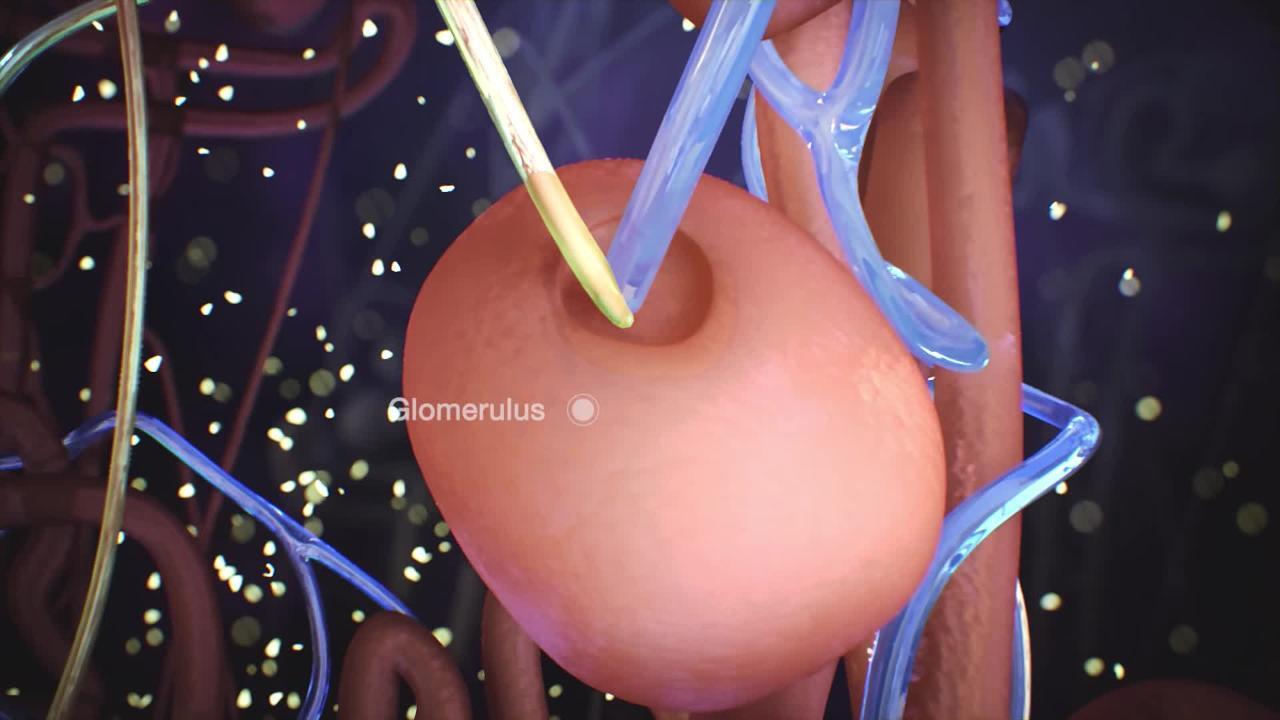
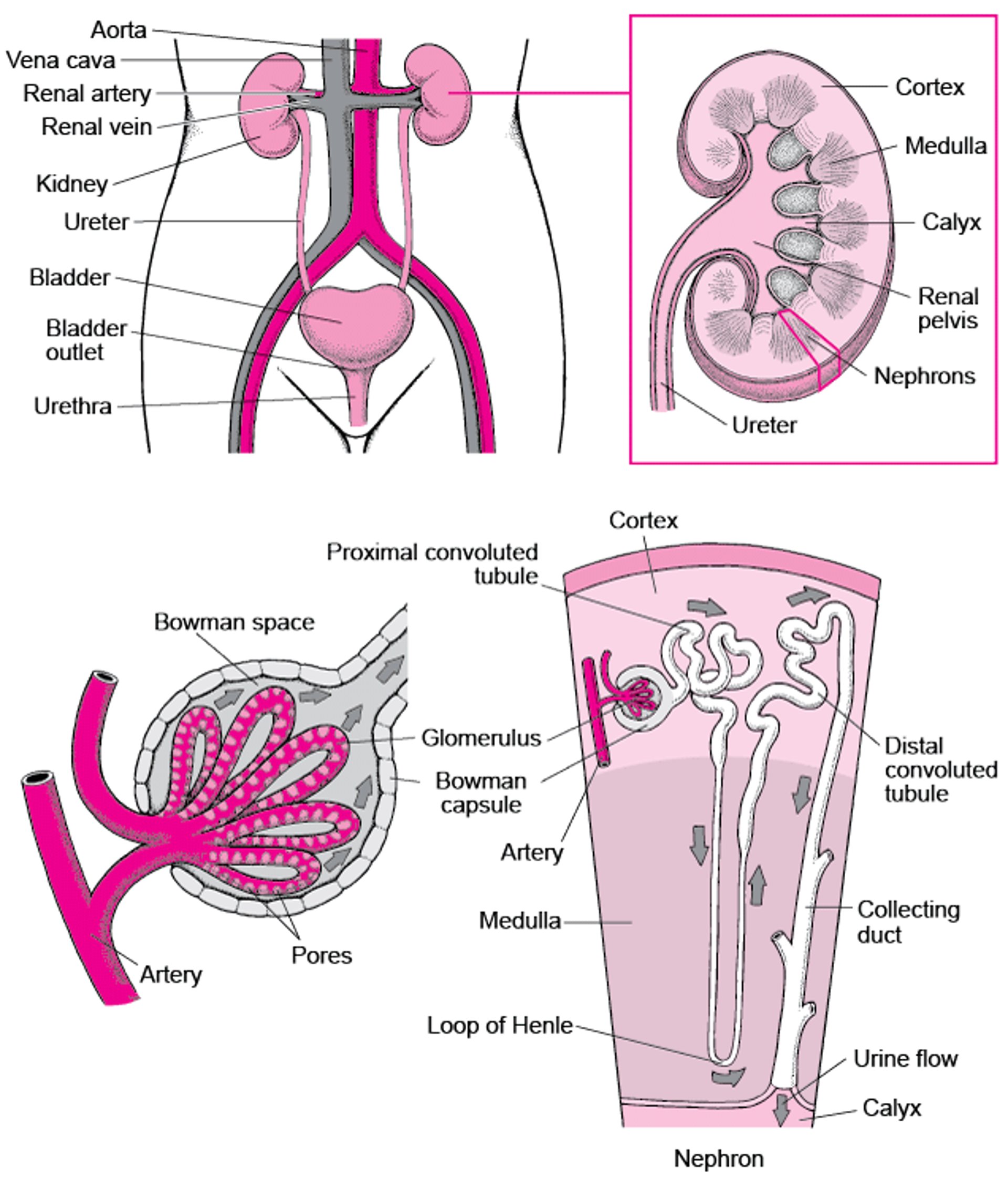
Each kidney contains about 1 million filtering units (glomeruli). The glomeruli are made up of many microscopic clusters of tiny blood vessels (capillaries) with small pores. These blood vessels are designed to leak fluid from the bloodstream into a system of miniature tubules. The tubules secrete and reabsorb chemicals and substances from the fluid to cause it to become urine. The urine then drains from the tubules into larger and larger tubes until it leaves the kidney. Normally this filtering system permits fluid and small molecules (but almost no protein or blood cells—Asymptomatic Proteinuria and Hematuria Syndrome) to leak into the tubules.
Diseases that affect the kidneys can be divided into 3 categories based on the way they affect different parts of the kidneys:
Glomerulonephritis (or nephritic syndrome) is inflammation of the glomeruli, which causes blood cells and protein to escape from the glomerular capillaries into the urine and is sometimes hereditary (it is then called hereditary nephritis, or Alport syndrome).
Nephrotic syndrome occurs when damage to the capillaries of the glomeruli causes proteins to leak into the urine.
Tubulointerstitial nephritis is inflammation of the tubules and/or the tissues surrounding the tubules (interstitium).
Some disorders have features of both glomerulonephritis and nephrotic syndrome.
A separate disorder, called reflux nephropathy due to reflux of urine from the bladder up to the kidneys, increases the risk of urinary tract infection and can cause inflammation and scarring of the kidneys.
Viewing the Urinary Tract

Glomerulonephritis, nephrotic syndrome, and tubulointerstitial nephritis are not specific disorders but rather categories of disorders. Many specific disorders fall within each category, and many specific conditions may cause disorders in each category. For example, membranoproliferative glomerulonephritis is inflammation of kidney filtering cells caused by an immune response. The immune response might be caused by any of several autoimmune disorders, such as systemic lupus erythematosus (lupus), or by an infection or even cancer.
In glomerulonephritis, inflammation is often the result of an abnormal immune reaction. Such a reaction can occur in 2 ways:
Antibodies (proteins made by the body to attack specific molecules called antigens) may attach directly to cells of the kidneys or molecules trapped in them, causing inflammation.
Antibodies attach to antigens outside the kidneys, and these antigen-antibody (or immune) complexes are carried to the kidneys by the bloodstream and get trapped in the glomeruli, causing inflammation.
If enough glomeruli are damaged, kidney function is decreased. As a result, urine production falls and waste products build up in the blood. Also, when damage is severe, inflammatory cells and injured glomerular cells accumulate, compressing the capillaries within the glomeruli and interfering with filtration. Scarring may develop, which also impairs kidney function and reduces urine production. In some cases, tiny blood clots (microthrombi) may form in the small blood vessels, further decreasing kidney function. Rarely, glomerulonephritis can result from a hereditary condition. In other cases, glomerulonephritis is caused by inflammation of the blood vessels (vasculitis).
Nephrotic syndrome causes large amounts of protein to leak from blood into the urine. This leakage can be caused by damage to the glomeruli by inflammatory or noninflammatory processes. In inflammatory processes, red blood cells appear in the urine. Nephrotic syndrome caused by inflammation, therefore, has characteristics similar to those of glomerulonephritis. With noninflammatory processes, no red blood cells appear in the urine. Some forms of nephrotic syndrome can be severe. The glomeruli become scarred, and kidney failure (loss of most kidney function) develops. In less severe forms of nephrotic syndrome, kidney function decreases very little.
Tubulointerstitial nephritis often is caused by a toxic or allergic reaction to a medication. White blood cells or scar tissue appears in the affected kidney. Infection of the kidneys (pyelonephritis) can also cause tubulointerstitial nephritis. When inflammation damages the tubules and surrounding tissues, the kidneys may become unable to carry out their normal functions, such as concentrating urine, resulting in urine that is too dilute. The kidneys may also become unable to eliminate (excrete) waste products from the body or balance the excretion of acid, sodium, and other electrolytes, such as potassium. If the damage is severe and affects both kidneys, the result is kidney failure.
More Information
The following English-language resources may be useful. Please note that THE MANUAL is not responsible for the content of these resources.
American Kidney Fund: Comprehensive information on kidney diseases, from prevention through living with a kidney transplant, and access to needs-based financial assistance
National Institute of Diabetes and Digestive and Kidney diseases (NIDDKD): General information on kidney diseases, including research discoveries, statistics, and community health and outreach programs


