





Hereditary hemorrhagic telangiectasia is a hereditary disorder in which blood vessels are malformed, making them fragile and prone to bleeding.
Dilated blood vessels (telangiectasia) are present on the skin and the lining of the mouth, nose, and digestive tract.
When blood vessels break, people develop active bleeding from these vessels, especially those within the nose.
Usually the appearance of the dilated blood vessels on the lips and tongue give doctors enough information to make a diagnosis.
Doctors stop the episode of bleeding and may give iron supplements or blood transfusions if the bleeding has caused anemia.
Blood vessels under the skin may break and bleed, causing small, red-to-violet discolorations, especially on the face, lips, lining of the mouth and nose, and tips of the fingers and toes. Severe nosebleeds may also occur. Small blood vessels in the digestive and urinary tracts, as well as in the brain, liver, lungs, and spinal cord, may also be affected, causing bleeding in these sites. If bleeding episodes occur frequently, many people develop a low level of iron in their blood (iron deficiency anemia).
Hereditary hemorrhagic telangiectasia is a genetic disorder, which means people pass on the mutated genes to their children. Some of the genes have been identified.
Symptoms of HHT
Many people with hereditary hemorrhagic telangiectasia have abnormal connections between an artery and a vein (arteriovenous malformations [AVM]). These abnormal connections can shunt blood away from some tissues, leaving them deprived of oxygen. For example, AVMs that develop in the brain or spinal cord may cause seizures, stroke, or paralysis, and those that occur in the liver may cause liver failure. Shunting of blood and anemia due to bleeding can cause the heart to work harder, leading to heart failure. If an AVM is in a lung, blood passes through the lungs without receiving enough oxygen and the person may be short of breath, feel tired, or have skin that appears bluish. An AVM in the lung also may allow small clots to go to the brain, resulting in a stroke or transient ischemic attack.
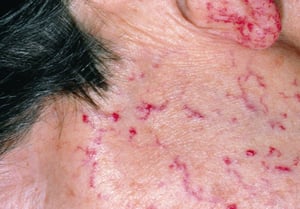
DR P. MARAZZI/SCIENCE PHOTO LIBRARY
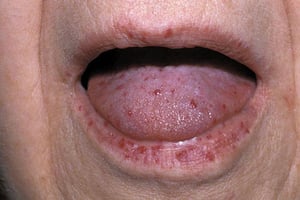
By permission of the publisher. From Deitcher S. In Atlas of Clinical Hematology. Edited by JO Armitage. Philadelphia, Current Medicine, 2004.

DR P. MARAZZI/SCIENCE PHOTO LIBRARY


DR P. MARAZZI/SCIENCE PHOTO LIBRARY


By permission of the publisher. From Deitcher S. In Atlas of Clinical Hematology. Edited by JO Armitage. Philadelphia, Current Medicine, 2004.


DR P. MARAZZI/SCIENCE PHOTO LIBRARY
Diagnosis of HHT
A doctor's evaluation
Imaging tests
Sometimes genetic testing
Doctors usually make the diagnosis of hereditary hemorrhagic telangiectasia after considering the person's family history, seeing evidence of bleeding in a person who has typical dilated blood vessels on the face, around the mouth, and on the fingers, palms, and toes, and noting a history of nosebleeds.
Doctors often do blood tests to look for iron deficiency anemia once they suspect the diagnosis.
Once doctors diagnose hereditary hemorrhagic telangiectasia, they do imaging tests to check the brain, lungs, liver, and intestine for the presence of AVMs.
Screening
When family members of a person with AVMs reach puberty, doctors screen them for hereditary hemorrhagic telangiectasia. Screening usually consists of blood tests to check for anemia and imaging of the lungs, liver, and brain. Because some of the gene mutations that are associated with hereditary hemorrhagic telangiectasia have been identified, screening may also involve genetic testing. Screening tests are usually repeated at the end of adolescence and every 5 to 10 years thereafter.
Treatment of HHT
Stopping bleeding
Iron supplements
Sometimes blood transfusions
Treatment of hereditary hemorrhagic telangiectasia is aimed at stopping or preventing bleeding. Treatment may involve applying pressure, using a topical medication that narrows blood vessels (astringent), or using a laser beam to destroy the leaking blood vessel in the nose or digestive tract. Severe bleeding may require more invasive techniques, including surgery.
AVMs in the lungs, and sometimes in the liver, can be treated using a thin flexible tube (catheter) to insert a small device that blocks the affected blood vessel. In this procedure, doctors insert a catheter through one of the person's arteries and into the artery leading to the AVM. The doctor then passes a small coil or a plug through the catheter to stop the blood flow through the AVM.
Bleeding almost always recurs, resulting in iron deficiency anemia. People with hereditary hemorrhagic telangiectasia often need oral or intravenous iron supplements. People may also need repeated blood transfusions
More Information
The following English-language resource may be useful. Please note that THE MANUAL is not responsible for the content of this resource.
CureHHT: General information on hereditary hemorrhagic telangiectasia, including research and support resources


