





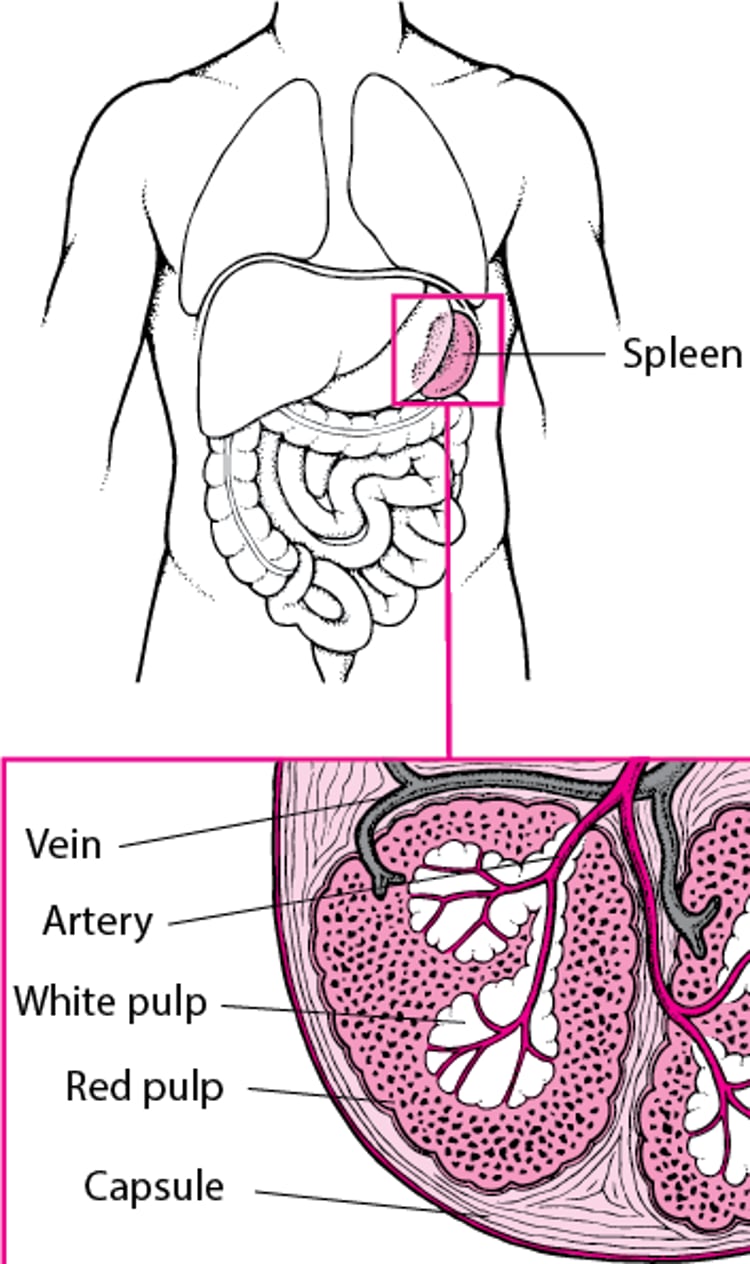
The spleen, a spongy, soft organ about as big as a person’s fist, is located in the upper left part of the abdomen, just under the rib cage. The splenic artery brings blood to the spleen from the heart. Blood leaves the spleen through the splenic vein, which drains into a larger vein (the portal vein) that carries the blood to the liver. The spleen has a covering of fibrous tissue (the splenic capsule) that supports its blood vessels and lymphatic vessels.
The spleen is made up of two basic types of tissue, each with different functions:
White pulp
Red pulp
The white pulp is part of the infection-fighting system (immune system). It produces white blood cells called lymphocytes, which in turn produce antibodies (specialized proteins that protect against invasion by foreign substances).
The red pulp filters the blood, removing unwanted material. The red pulp contains other white blood cells called phagocytes that ingest microorganisms, such as bacteria, fungi, and viruses. It also monitors red blood cells, destroying those that are abnormal or too old or damaged to function properly. In addition, the red pulp serves as a reservoir for different elements of the blood, especially white blood cells and platelets (cell-like particles involved in clotting). However, releasing these elements is a minor function of the red pulp.
Viewing the Spleen

Asplenia
People can live without a spleen (a condition called asplenia).
Asplenia is loss of splenic function due to
Absence of the spleen at birth
A disease that affects the function of the spleen (functional asplenia)
Surgical removal of the spleen (splenectomy)
Absence of the spleen at birth is a rare disorder. Infants with this disorder often also have a heart defect.
People with functional asplenia have a spleen that does not function properly. Functional asplenia can be due to a variety of diseases. Common causes include sickle cell disease, celiac disease, and alcohol-related liver disease. Functional asplenia can also occur after injury to the arteries or veins of the spleen.
Splenectomy is surgical removal of the spleen. It can be done in otherwise healthy people after a spleen injury (such as after a motor vehicle accident) or in people with diseases that cause the spleen to enlarge.
When the spleen is removed or does not function, the body loses some of its ability to produce protective antibodies and to remove unwanted microorganisms from the blood. As a result, the body’s ability to fight infections is impaired. However, other organs (primarily the liver) compensate for the loss by increasing their infection-fighting ability and by monitoring for and removing red blood cells that are abnormal, too old, or damaged.
People who do not have a spleen are at particularly high risk of infections because of the spleen’s role in fighting certain kinds of bacteria, such as Streptococcus pneumoniae, Neisseria meningitidis, and Haemophilus influenzae. Because of this risk, people receive vaccinations to help protect them from infection with these organisms. People should also be sure they receive the influenza vaccine every year and the COVID-19 vaccine. Some people take daily antibiotics to prevent infections, particularly when they have another disorder (such as sickle cell disease or cancer) that increases the risk of developing infections or have regular contact with children.


