





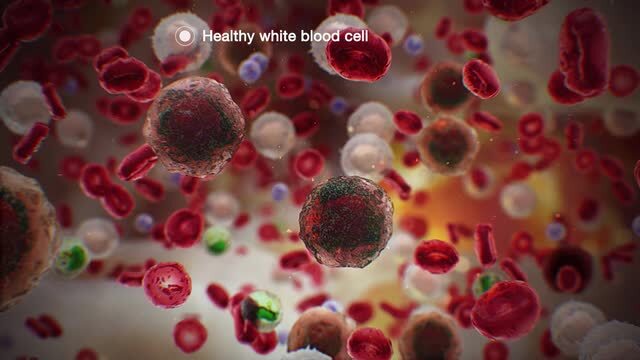
A cancer is an abnormal growth of cells (usually derived from a single abnormal cell). The cells have lost normal control mechanisms and thus are able to multiply continuously, invade nearby tissues, migrate to distant parts of the body, and promote the growth of new blood vessels from which the cells derive nutrients. Cancerous (malignant) cells can develop from any tissue within the body.
As cancerous cells grow and multiply, they form a mass of cancerous tissue—called a tumor—that invades and destroys normal adjacent tissues. The term tumor refers to an abnormal growth or mass. Tumors can be cancerous or noncancerous. Cancerous cells from the primary (initial) site can spread throughout the body (metastasize).
Types of Cancer
Cancerous tissues (malignancies) can be divided into those of the blood and blood-forming tissues (leukemias and lymphomas) and “solid” tumors (a solid mass of cells). Cancerous solid tumors can be categorized as carcinomas or sarcomas. Specific cancers can be further categorized by the organ in which they first develop and the type of cell in which they arise—for example, squamous cell carcinoma of the skin.
Leukemias and lymphomas are cancers of the blood and blood-forming tissues and cells of the immune system. Leukemias arise from blood-forming cells and crowd out the production of normal blood cells in the bone marrow. Cancer cells from lymphomas expand lymph nodes, producing large masses in the armpit, groin, abdomen, or chest.
Carcinomas are cancers of cells that line the skin, lungs, digestive tract, and internal organs. Examples of carcinomas are cancer of the skin, lungs, colon, stomach, breasts, prostate, and thyroid gland. Typically, carcinomas occur more often in older than in younger people.
Sarcomas are cancers of mesodermal cells. Mesodermal cells normally form muscles, blood vessels, bone, and connective tissue. Examples of sarcomas are leiomyosarcoma (cancer of smooth muscle that is found in the wall of digestive organs) and osteosarcoma (bone cancer). Typically, sarcomas occur more often in younger than in older people.
Cancer Terminology
The following terms are often used in discussing cancer:
Aggressiveness: The degree to which (or speed at which) a tumor grows and spreads
Benign: Noncancerous. Benign tumors do not invade nearby tissues or spread to distant sites through the bloodstream or lymphatic system (metastasize). However, a benign tumor may still grow in place and cause problems by pressing on nearby tissues.
Carcinogen: An agent that causes cancer
Carcinoma-in-situ: Cancerous cells that are still contained within the tissue where they have started to grow and that have not yet invaded surrounding normal tissue or spread to other parts of the body.
Cure: Complete elimination of the cancer with the result that the specific cancer will not grow back
Differentiation: The extent to which the cancer cells have matured, ceased to multiply, and taken on normal cellular functions so that they no longer look like rapidly multiplying and primitive cells
Grade: The degree of abnormality of the appearance of cancer cells on microscopic examination—more abnormal appearing cells are more aggressive
Invasion: The capacity of a cancer to grow into and destroy surrounding tissue
Malignant: Cancerous cells that can invade adjacent tissue and can also spread to other parts of the body
Malignant transformation: The complex process by which cancerous cells develop from healthy cells
Metastasis: Cancerous cells that have spread to a completely new location
Neoplasm: General term for a tumor, whether cancerous or noncancerous
Recurrence (relapse): Cancerous cells return after treatment, either in the primary location or as metastases (spread)
Remission: Absence of all evidence of a cancer after treatment although there may still be cancer in the body
Stage: The extent to which cancer has spread
Survival rate: The percentage of people who survive for a given period of time after treatment (for example, the 5-year survival rate is the percentage of people who survive 5 years)
Tumor: An abnormal growth or mass
Did You Know...
|


