





Bacteria are microscopic, single-celled organisms. They are among the earliest known life forms on earth. There are thousands of different kinds of bacteria, and they live in every conceivable environment all over the world. They live in soil, seawater, and deep within the earth’s crust. Some bacteria have been reported even to live in radioactive waste. Many bacteria live on and in the bodies of people and animals—on the skin and in the airways, mouth, and digestive, reproductive, and urinary tracts—without causing any harm. Such bacteria are called resident flora, or the microbiome. There are at least as many bacteria in our resident flora as there are cells in the body. Many resident flora are actually helpful to people—for example, by helping them digest food or by preventing the growth of other, more dangerous bacteria.
Only a few kinds of bacteria cause disease. They are called pathogens. Sometimes, under certain conditions, the resident bacterial flora can act as pathogens and cause disease. Bacteria can cause disease by producing harmful substances (toxins), invading tissues, or doing both. Some bacteria can trigger inflammation that may affect the heart, lungs, nervous system, kidneys, or gastrointestinal tract. Some bacteria (such as Helicobacter pylori) increase the risk of cancer.
Certain bacteria have the potential to be used as biological weapons. These bacteria include those that cause anthrax, botulism, plague, and tularemia.
Classification of Bacteria
Bacteria can be classified in several ways:
Scientific names: Bacteria, like other living things, are classified by genus (based on having one or several similar characteristics) and, within the genus, by species. Their scientific name is genus followed by species (for example, Clostridium botulinum). Within a species, there may be different types, called strains. Strains differ in genetic makeup and chemical components. Sometimes certain drugs and vaccines are effective only against certain strains.
Staining: Bacteria may be classified by the color they turn after certain chemicals (stains) are applied to them. Gram staining is a commonly used staining process. Some bacteria stain blue. They are called gram-positive. Others stain red. They are called gram-negative. Gram-positive and gram-negative bacteria stain differently because their cell walls are different. They also cause different types of infections, and different types of antibiotics are effective against them. There are many other stains besides Gram stain.
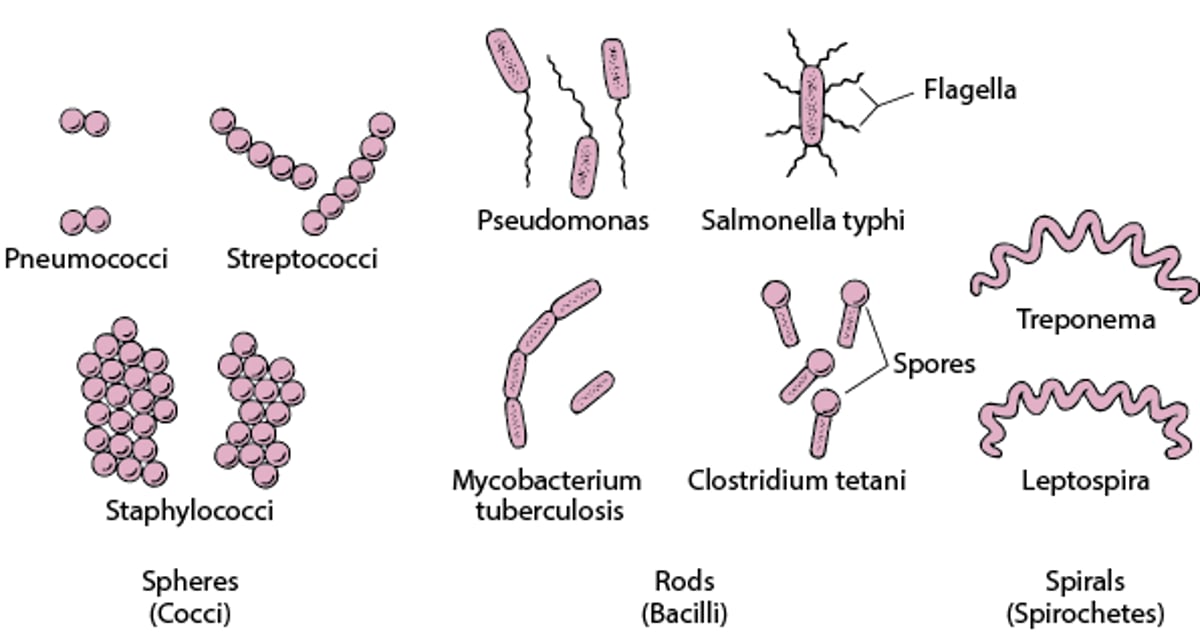
Shapes: All bacteria may be classified as one of three basic shapes: spheres (cocci), rods (bacilli), and spirals or helixes (spirochetes).
Need for oxygen: Bacteria are also classified by whether they need oxygen to live and grow. Those that need oxygen are called aerobes. Those that do not need oxygen and have trouble living or growing when oxygen is present are called anaerobes. Some bacteria, called facultative bacteria, can live and grow with or without oxygen.
Genetic make-up: Specialized tests can determine differences in the genetic make-up (genotype) of bacteria.
How Bacteria Shape Up

Bacterial Infections
Doctors classify bacterial infections based on the various ways they classify the bacteria. For example, infections may be classified as caused by gram-negative or by gram-positive bacteria. This distinction is important because treatment of the two types may require different types of antibiotics.
Gram-negative infections include the following:
Gram-positive infections include the following:
Some infections are classified by the bacteria's shape. For example, infections caused by spirochetes (spiral-shaped bacteria) are classified as spirochete infections.
Spirochete infections include the following:
Other infections may be classified by whether the bacteria that cause them require oxygen or thrive in an oxygen-free environment. Bacteria that require oxygen to live and grow are called aerobes. Bacteria that do not require oxygen to live and grow are called anaerobes.
Anaerobic infections include the following:
Many different antibiotics are available to treat bacterial infections. However, bacterial resistance to antibiotics is a great concern.
Bacterial Defenses
Bacteria have many ways of defending themselves.
Biofilm
Some bacteria secrete a substance that helps them attach to other bacteria, cells, or objects. This substance combines with the bacteria to form a sticky layer called biofilm. For example, certain bacteria form a biofilm on teeth (called dental plaque). The biofilm traps food particles, which the bacteria process and use, and in this process, they probably cause tooth decay. Biofilms also help protect bacteria from antibiotics by making them difficult to kill, such as the bacteria that cause prosthetic joint infections.
Capsules
Some bacteria are enclosed in a protective capsule. This capsule helps prevent white blood cells, which fight infection, from ingesting the bacteria. Such bacteria are described as encapsulated.
Outer membrane
Under the capsule, gram-negative bacteria have an outer membrane that protects them against certain antibiotics. When disrupted, this membrane releases toxic substances called endotoxins. Endotoxins contribute to the severity of symptoms during infections with gram-negative bacteria.
Spores
Some bacteria produce spores, which are an inactive (dormant) form. Spores can enable bacteria to survive when environmental conditions are difficult (such as being too dry or lacking in nutrients). When conditions are favorable, each spore germinates into an active bacterium.
Flagella
Flagella are long, thin filaments that protrude from the cell surface and enable bacteria to move. Bacteria without flagella cannot move on their own.
Antibiotic resistance
Some bacteria are naturally resistant to certain antibiotics.
Other bacteria develop resistance to drugs because they acquire genes from other bacteria that have become resistant or because their genes mutate. For example, soon after the drug penicillin was introduced in the mid-1940s, a few individual Staphylococcus aureus bacteria acquired genes that made penicillin ineffective against them. The strains that possessed these special genes had a survival advantage when penicillin was commonly used to treat infections. Strains of Staphylococcus aureus that lacked these new genes were killed by penicillin, allowing the remaining penicillin-resistant bacteria to reproduce and over time become more common.
Chemists then altered the penicillin molecule, making a different but similar drug, methicillin, which could kill the penicillin-resistant bacteria. Soon after methicillin was introduced, strains of Staphylococcus aureus developed genes that made them resistant to methicillin and related drugs. These strains are called methicillin-resistant Staphylococcus aureus (MRSA).
The genes that encode for drug resistance can be passed to following generations of bacteria or sometimes even to other species of bacteria.
The more often antibiotics are used, the more likely resistant bacteria are to develop. Therefore, experts recommend that doctors use antibiotics only when necessary and for the shortest amount of time possible. In particular, doctors should prescribe antibiotics only for infections caused by bacteria, not for those caused by viruses such as a cold or the flu. Giving antibiotics to people who probably do not have a bacterial infection, such as those who have cough and cold symptoms, does not make people better but does help create resistant bacteria. Because antibiotics have been so widely used (and misused), many bacteria are resistant to certain antibiotics.
Resistant bacteria can spread from person to person. Because international travel is so common, resistant bacteria can spread to many parts of the world in a short time. Spread of these bacteria in hospitals is a particular concern. Resistant bacteria are common in hospitals because antibiotics are so often necessary and because hospital personnel and visitors may spread the bacteria if they do not strictly follow appropriate sanitary procedures. Also, many hospitalized patients have a weakened immune system, making them more susceptible to infection.
Resistant bacteria can also spread to people from animals. Resistant bacteria are common among farm animals because antibiotics are often routinely given to healthy animals to prevent infections that can impair growth or cause illness. Many countries have banned the use of antibiotics in animals to reduce the risk of the following:
Consuming resistant bacteria in animal food products
Being infected with resistant bacteria through contact with animals
Being exposed to antibiotics in animal food products


