





Hookworm infection is a roundworm infection of the intestines that can cause an itchy rash, respiratory and gastrointestinal problems, and eventually iron deficiency anemia due to ongoing loss of blood.
People can become infected when walking barefoot because hookworm larvae live in the soil and can penetrate the skin.
At first, people may have an itchy rash where the larvae penetrate the skin, then fever, coughing, and wheezing or abdominal pain, loss of appetite, and diarrhea.
Severe, chronic infections can cause loss of blood and anemia that is sometimes severe enough to cause fatigue and occasionally heart failure and widespread swelling.
Doctors diagnose the infection by identifying hookworm eggs in a stool sample.
(See also Overview of Parasitic Infections.)
Worldwide, between 576 and 740 million people are infected with hookworms, which are intestinal roundworms. The infection is most common in tropical areas where sanitation is poor. Hookworms thrive in warm, moist places.
Two species of hookworm cause infection in people:
Ancylostoma duodenale
Necator americanus
Both species are present in moist, hot areas of Africa, Asia, and the Americas. Ancylostoma duodenale is present in the Middle East, North Africa, and southern Europe. Necator americanus is present mainly in the Americas and Australia. It once was common in the southern part of the United States and is still present in areas in that region where there is unsanitary disposal of human waste. Hookworm remains endemic on islands of the Caribbean and in Central and South America. Finally, Ancylostoma ceylanicum, a hookworm of dogs, cats, and hamsters present in parts of Asia and some South Pacific islands, can complete its life cycle in humans and on occasion causes hookworm disease.

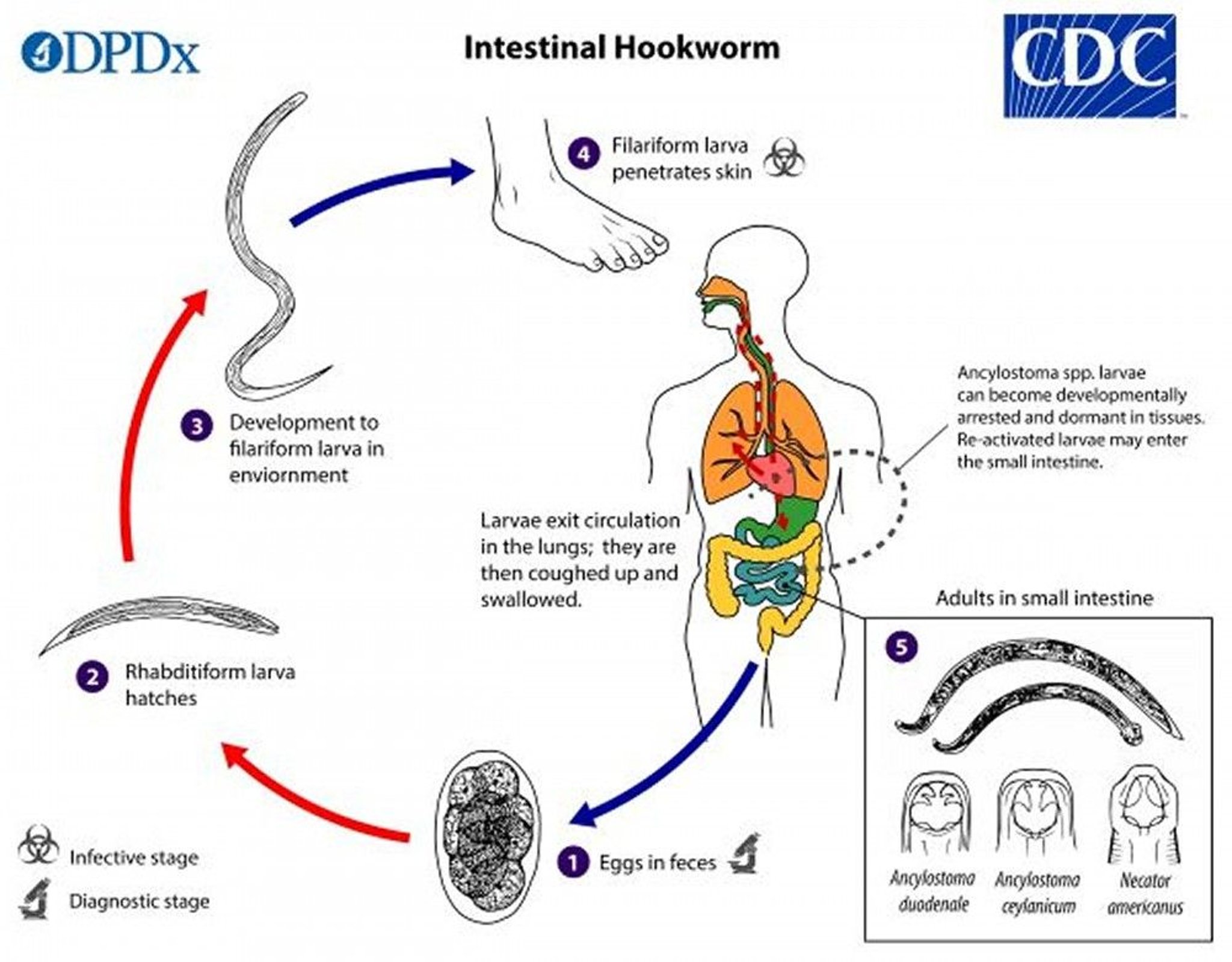
Image from the Centers for Disease Control and Prevention, Global Health, Division of Parasitic Diseases and Malaria.
Hookworm eggs are passed in stool and hatch in the soil after 1 to 2 days if they are deposited in a warm, moist place on loose soil. Larvae emerge and live in the soil. The larvae can survive 3 to 4 weeks in the environment if conditions are favorable. After 5 to 10 days of development, larvae are able to cause infection and can penetrate the skin. A person can become infected by walking barefoot or sitting in contaminated soil. Larvae of Ancylostoma duodenale can also cause infection when people consume food that contains the larvae.
Once larvae enter the body, they move through the bloodstream to the lungs. The larvae pass into the air spaces of the lungs and move up the respiratory tract. They are coughed up into the throat and swallowed. About a week after penetrating the skin, they reach the intestine. Once inside the intestine, the larvae develop into adults. They attach themselves by their mouth to the lining of the upper small intestine, where they feed on blood and produce substances that keep blood from clotting. As a result, blood is lost, and anemia may develop.
Adult worms may live 2 or more years.
Other hookworm infections
Other hookworm species usually cause infections only in cats, dogs, or other animals. However, people are occasionally infected. In people, these hookworms cannot mature and reproduce. However, after larvae of some Ancylostoma species penetrate the skin, they wander in the skin, causing an itchy rash called cutaneous larva migrans.
Rarely, larvae of an animal hookworm, Ancylostoma caninum, travel to the intestine. In such cases, people may have no symptoms or may have abdominal pain. The number of eosinophils (a type of white blood cell) may increase in the intestine and blood, as occurs in some worm infections. This condition is known as eosinophilic enteritis. These infections do not cause blood loss and anemia in people.
Symptoms of Hookworm Infection
Many people with hookworm infection do not have symptoms. However at the start of a hookworm infection, an itchy, red, raised rash (ground itch) may develop where the larvae penetrate the skin. The movement of the larvae through the lungs can cause fever, coughing, and wheezing.
When adult worms first attach in the intestine, they can cause pain in the upper abdomen, loss of appetite, diarrhea, and weight loss. Over time, severe infections cause anemia as blood is lost, and people become iron deficient. Anemia causes fatigue. In children, continuing blood loss can lead to severe anemia and may cause heart failure and widespread tissue swelling. In pregnant women with severe anemia, the fetus may not grow normally.
Diagnosis of Hookworm Infection
Examination of a stool sample
Blood tests to check for anemia and iron deficiency
Hookworm infection is diagnosed by identifying hookworm eggs in a sample of stool. Stool should be examined within several hours after defecation.
Eosinophilia is often present in people infected with hookworms. Eosinophilia is a higher than normal number of eosinophils, which are a type of disease-fighting white blood cell that play an important role in the body's response to allergic reactions, asthma, and infection with parasitic worms (helminths). During the 5 to 9 weeks between penetration of larvae and appearance of eggs in the stool, eosinophilia may be the only laboratory abnormality. Hookworm infection is an important diagnostic consideration in people who have a blood count done that shows eosinophilia, especially if they are immigrants or travelers returning from endemic regions where sanitation is poor.
Blood tests for anemia and iron deficiency are also done.
Cutaneous larva migrans is diagnosed based on the appearance and location of the moving, linear rash in people who have been exposed to the hookworms that infect cats and dogs.
Prevention of Hookworm Infection
Hookworm infection prevention involves the following:
Using sanitary toilet facilities
Preventing the skin from directly contacting the soil (for example, by wearing shoes and using a tarp or other barrier when seated on the ground)
Treating dogs and cats for hookworm to prevent them from spreading animal hookworms to people
In areas where human hookworm infection is common, public health officials sometimes periodically treat people who are likely to be infected with hookworms and other roundworms that are spread through contaminated soil (such as Ascaris and whipworm
Treatment of Hookworm Infection
For iron deficiency anemia, iron supplements
Iron supplements are given to people with iron deficiency anemia.


