





Onchocerciasis is infection with the roundworm Onchocerca volvulus. It causes itching, a rash, sometimes with scarring, as well as eye symptoms that may lead to blindness.
The infection is spread through the bite of female blackflies, which breed in streams.
The infection may cause only intense itching but sometimes causes a rash, swollen lymph nodes, impaired vision, or complete blindness.
Usually, doctors diagnose the infection by identifying an immature form of the worm in a skin sample.
(See also Overview of Parasitic Infections and Filarial Worm Infections Overview.)
Worldwide, about 21 million people have onchocerciasis. About 14.6 million have skin disease, and 1.15 million have vision problems or blindness. Onchocerciasis is the second leading cause of infectious blindness worldwide, after trachoma.
Onchocerciasis is most common in tropical and southern (sub-Saharan) areas of Africa. It occasionally occurs in Yemen and in a small transmission zone in South America along the border of Venezuela and Brazil. Colombia, Ecuador, Mexico, and Guatemala have been declared free of onchocerciasis by the World Health Organization (WHO). People who live or work near rapidly flowing streams or rivers are the most likely to be infected. In addition to residents, longterm travelers in these regions, such as missionaries, volunteers, or field researchers, are at risk.
Did You Know...
|
Transmission of onchocerciasis
Onchocerciasis is spread though the bite of female blackflies that breed in swiftly flowing streams (hence, the term river blindness).
The cycle of infection begins when a blackfly bites an infected person and the fly is infected with immature forms of the worm called microfilariae. The microfilariae develop into larvae in the fly. When the fly bites another person, larvae are passed into that person’s skin. The larvae move under the skin and form lumps (nodules), where they develop into adult worms in 12 to 18 months. Adult female worms may live up to 15 years in these nodules. After mating, mature female worms produce eggs, which develop into microfilariae that leave the worm. A worm may produce 1,000 microfilariae each day. Thousands of microfilariae move through the tissues of the skin and eyes and are responsible for the disease.
Usually, many bites are necessary before the infection causes symptoms. Thus, the infection is much less likely to develop in visitors to affected areas.

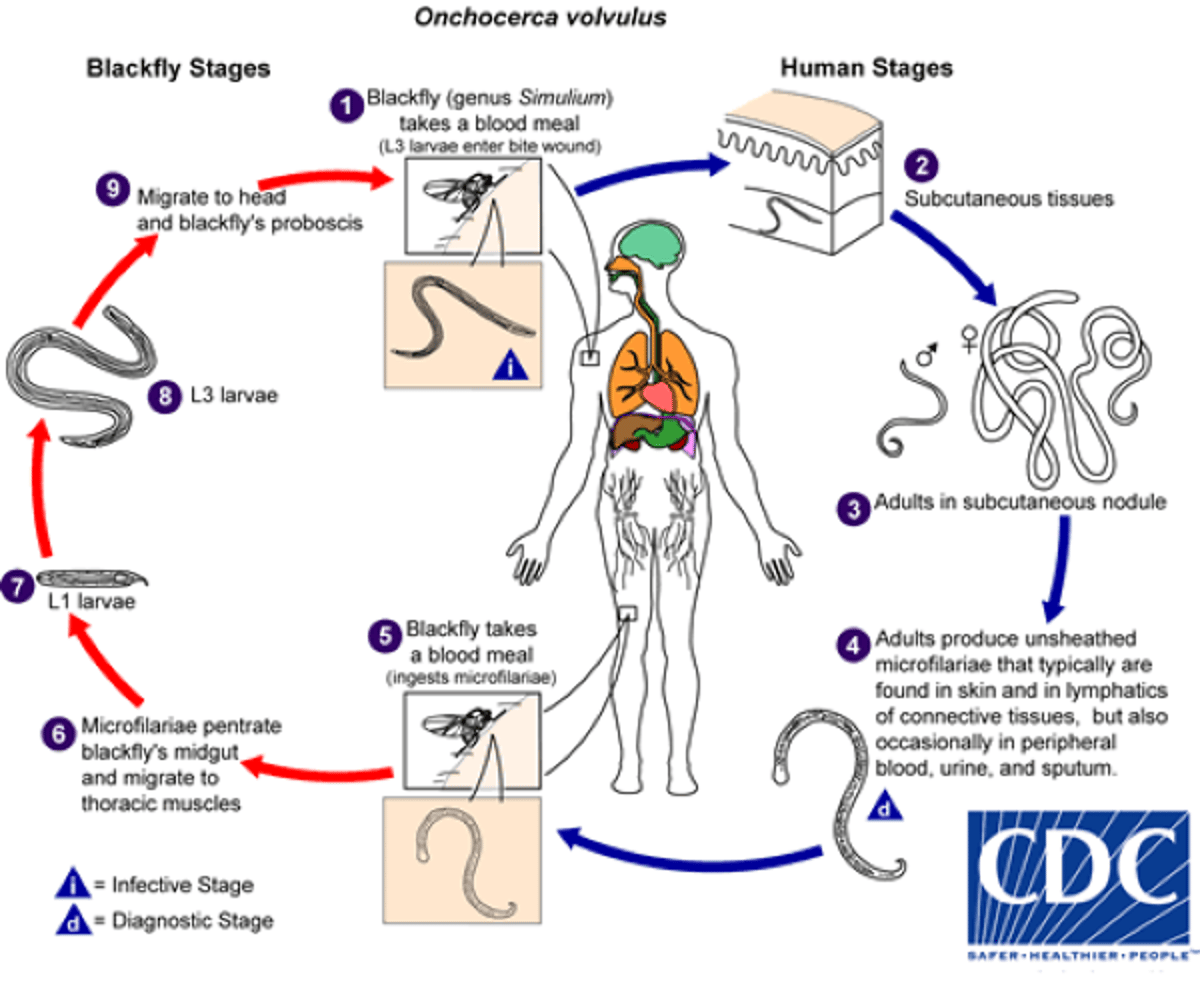
Image from the Centers for Disease Control and Prevention, Global Health, Division of Parasitic Diseases and Malaria.
Because the infection is transmitted near rivers, many people avoid those areas. Not being able to live or to work near a river affects their ability to raise crops. Thus, onchocerciasis can contribute to food shortages in some areas.
Symptoms of Onchocerciasis
Onchocerciasis symptoms occur when the microfilariae die. Their death can cause intense itching, which may be the only symptom. A rash with redness may develop. Over time, the skin may thicken, roughen, and wrinkle. It may lose its elasticity and pigment in patchy spots. In severe cases, people may develop long folds of skin that hang down over their lower abdomen and upper thighs ("hanging groin"). Lymph nodes, including those in the genital area, may become inflamed and swollen. Lumps (nodules) containing adult worms form and may be seen or felt under the skin. Usually, these lumps do not cause symptoms.
Effects on vision range from mild impairment (blurring) to complete blindness. The eye may become inflamed and appear red. Exposure to bright light may cause pain. Without treatment, the cornea may become completely opaque and may scar—the cause of blindness. Other structures in the eye, including the iris, pupil, and retina, may be affected. The optic nerve may become inflamed and degenerate.
If people become blind, they may become unable to work and provide for their family, and their life span may be decreased.

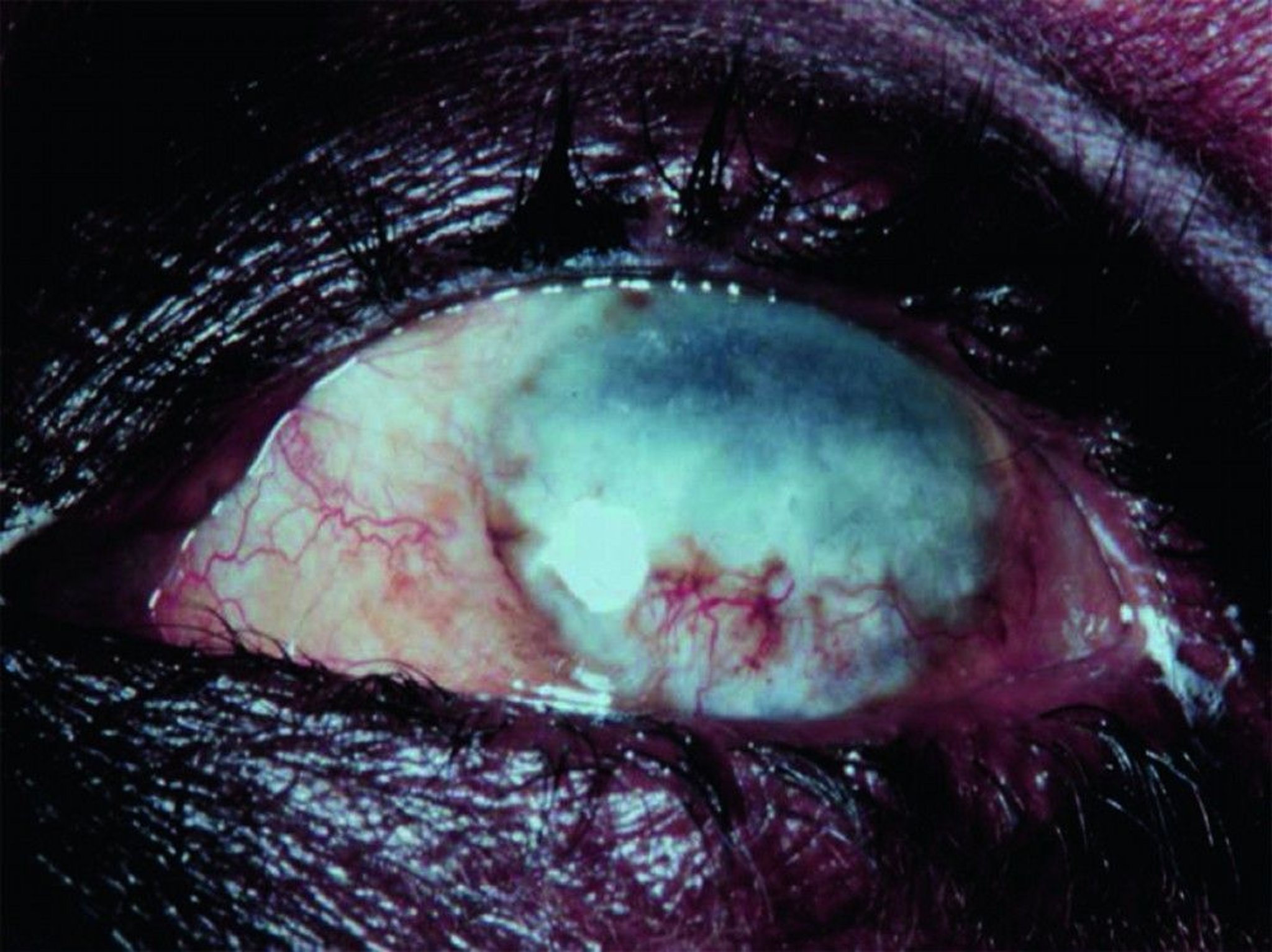
© Springer Science+Business Media
Diagnosis of Onchocerciasis
Examination of a sample of skin
Usually to diagnose onchocerciasis, a sample of skin is removed and examined for microfilariae. Doctors may use a slit lamp to look for microfilariae in the eye.
Blood tests to check for evidence of the infection may be done, but these tests are not always reliable or available.
Nodules can be removed and checked for adult worms, but this procedure is rarely necessary.
Prevention of Onchocerciasis
The following may help reduce the chances of being bitten by a blackfly and thus reduce the risk of onchocerciasis:
Avoiding fly-infested areas
Wearing protective clothing
Liberally using insect repellents
Treatment of Onchocerciasis
Ivermectin kills microfilariae, reducing the number of microfilariae in the skin and eyes. It reduces production of microfilariae by adult worms for several months. It does not kill adult worms, but repeated doses decrease their fertility. If people with onchocerciasis live in areas of Africa where Loa loa is transmitted, doctors check them for loiasis before giving them ivermectin because ivermectin can cause serious brain inflammation (encephalitis) in people with loiasis.
Doxycycline kills bacteria that live inside the worms and that are essential to the worms' survival. As a result, many of the adult female worms die, and others produce fewer or no microfilariae. Side effects are usually mild.
In the past, nodules were surgically removed, but this treatment has been replaced by ivermectin.


