





Toxocariasis is infection caused by larvae of the roundworms Toxocara canis or Toxocara cati, which are parasites of animals.
Young children can acquire the infection when they eat soil contaminated with animal stool (feces) that contain the roundworm eggs.
The infection may cause fever, cough or wheezing, and an enlarged liver, and in some people, it may cause vision problems.
Doctors confirm the diagnosis by identifying antibodies to the roundworm in a sample of blood.
Regularly deworming dogs and cats can help prevent the infection.
Treatment is usually unnecessary but may include antiparasitic drugs and corticosteroids.
(See also Overview of Parasitic Infections.)
Toxocariasis occurs mainly in young children, who acquire Toxocara eggs by ingesting soil contaminated by the feces of dogs, cats, or other animals that carry the parasite. Sandboxes, where dogs and cats often defecate, pose a particular hazard for exposure to the eggs. Children frequently transfer the eggs from their hands to their mouth and may eat the contaminated sand. Occasionally, adults ingest eggs picked up from contaminated soil, other surfaces, or hands and become infected. Adults and children who have a craving for nonfoods, such as soil or clay (a condition called pica), are at particular risk.
After the eggs are swallowed, larvae hatch in the intestine. The larvae penetrate the intestinal wall and spread through the bloodstream. Almost any tissue of the body may be affected, but the liver and lungs are most commonly involved. The larvae can remain alive for many months, causing damage by moving through tissues and stimulating inflammation.
The larvae do not mature to adulthood in people, but they can remain alive in the body for many months. The larvae require another host for maturation: dogs, cats, or other animals.
Toxocara eggs may be ingested by other mammals, such as rabbits or sheep. In these animals, the eggs hatch into larvae, which penetrate the wall of the intestine and travel to various tissues where they form cysts. Rarely, people are infected by eating raw or undercooked meat from these animals.

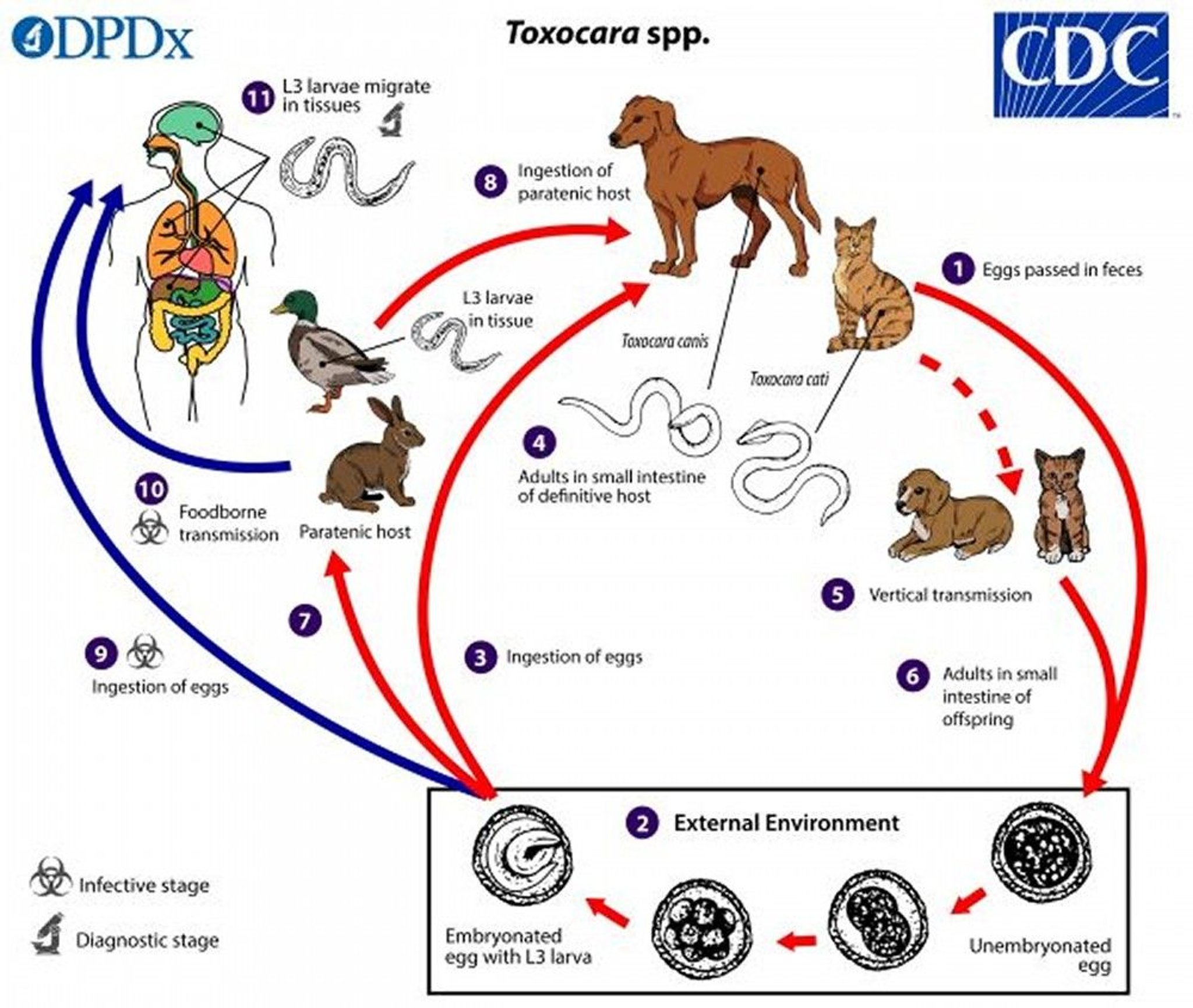
Image from the Centers for Disease Control and Prevention, Global Health, Division of Parasitic Diseases and Malaria.
Symptoms of Toxocariasis
Toxocariasis symptoms may start within several weeks after eggs are ingested. They vary depending on the organ affected. Fever, cough or wheezing, and liver enlargement are the most common. Some people have a rash, spleen enlargement, or recurring pneumonia. They may lose their appetite.
When larvae infect the eye (usually only one eye), they typically cause no symptoms or very mild symptoms. However, the eyes may become inflamed, and vision may be impaired or lost.
Diagnosis of Toxocariasis
Blood tests to detect antibodies to the parasite
A doctor may suspect toxocariasis in a person who has an enlarged liver, inflammation of the lungs, a fever, and high levels of eosinophils (a type of white blood cell). The diagnosis of toxocariasis is confirmed by identifying Toxocara antibodies in the blood. (Antibodies are proteins produced by the immune system to help defend the body against attack, including that by parasites.)
Rarely, a sample of liver or other tissue is obtained and examined (biopsied) for evidence of larvae or inflammation resulting from their presence.
Prevention of Toxocariasis
Prevention involves deworming dogs and cats regularly. Covering sandboxes when not in use prevents animals from defecating in them.
Children should be discouraged from eating nonfoods, such as soil and clay, as should adults who have such cravings.
Treatment of Toxocariasis
Sometimes, laser photocoagulation or surgery when an eye is infected
Occasionally, laser photocoagulation (application of an intense beam of light) is used to kill larvae in the eyes. Sometimes, doctors use cold probes (cryosurgery) or surgery.


