





Trichinosis is infection caused by the roundworm Trichinella spiralis or another Trichinella species. Symptoms include diarrhea, abdominal cramps, muscle pain, and fever.
People acquire the infection by eating raw or undercooked contaminated meat.
At first, people have nausea, diarrhea, abdominal cramps, followed later by muscle pain, weakness, fever, headache, and sometimes inflammation of other organs.
Several weeks after the initial infection, a blood test to detect antibodies to Trichinella can confirm the diagnosis.
Thoroughly cooking meats can kill Trichinella larvae, and freezing pork (but not meat from wild animals) usually kills the larvae.
(See also Overview of Parasitic Infections.)
Trichinella larvae live in the muscle tissue of animals, typically pigs, wild boars, foxes, bears, walruses, and many other carnivores. Occasionally, muscle tissue of horses that are fed meat supplements contain these larvae.
People develop trichinosis if they eat uncooked, undercooked, or underprocessed meat from an animal that carries the parasite. In most people, infections result from eating pork, particularly in regions where pigs are fed uncooked meat scraps and garbage, or from eating meat from wild boar, bear, or walrus.
An estimated 10,000 cases of trichinosis occur worldwide each year. Fewer than 20 cases are reported each year in the United States.
When a person eats meat containing live Trichinella cysts, the cyst wall is digested, releasing larvae that quickly mature to adulthood and mate in the intestine. After the male worms mate, they die and thus play no further role in infection. The females burrow into the intestinal wall and, after several days, begin to produce larvae.
Production of larvae continues for about 4 to 6 weeks. Then, the female worm dies or is excreted from the body. The larvae are carried through the body through the lymphatic vessels and bloodstream. The larvae penetrate muscles, causing inflammation. In 1 to 2 months, they form cysts that can live for years in the body. Eventually, dead larvae are absorbed or become hard (calcified).

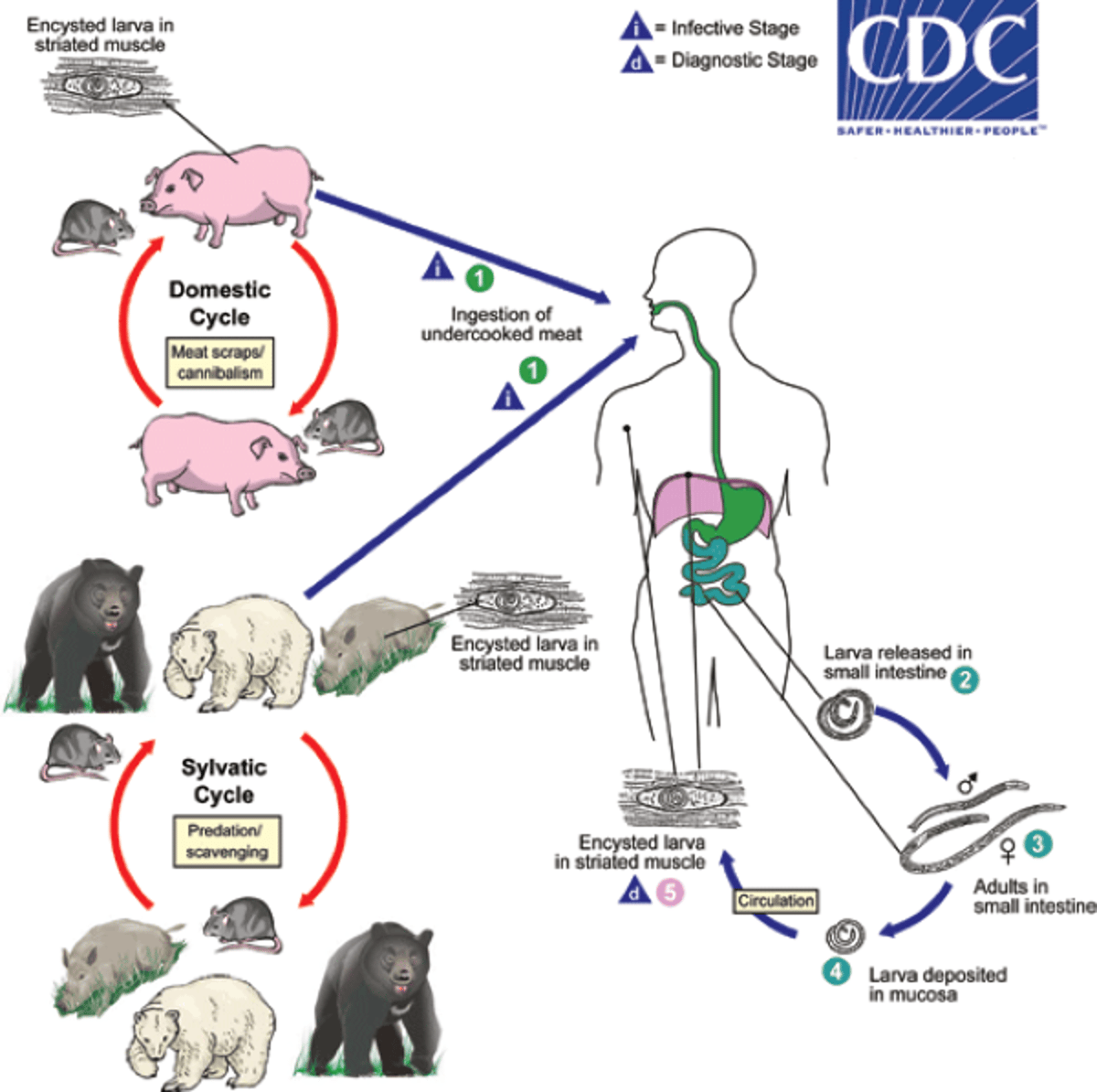
Image from the Centers for Disease Control and Prevention, Global Health, Division of Parasitic Diseases and Malaria.
Certain muscles, such as those in the tongue, around the eyes, and between the ribs, are most often infected. Larvae rarely form cysts in heart muscle, but in about one fourth of people with trichinosis, an electrocardiogram (ECG) shows evidence of inflammation in the heart.
Symptoms of Trichinosis
Trichinosis symptoms vary, depending on the stage of infection, number of invading larvae, tissues invaded, and general physical condition of the person. Many people have no symptoms.
Symptoms of trichinosis occur in two stages.
Stage 1: Intestinal infection develops 1 to 2 days after eating contaminated meat. Symptoms include nausea, diarrhea, abdominal cramps, and a slight fever.
Stage 2: Symptoms from the larval invasion of muscles usually start after about 7 to 15 days. Symptoms include muscle pain and tenderness, weakness, fever, headache, and swelling of the face, particularly around the eyes. The pain is often most pronounced in the muscles used to breathe, speak, chew, and swallow. A rash that does not itch may develop. In some people, the whites of the eyes become red, and their eyes hurt and become sensitive to bright light.
If many larvae are present, the heart, brain, and lungs may become inflamed. Heart failure, abnormal heart rhythms, seizures, and severe breathing problems may result. Death can occur but is rare.
Without treatment, most trichinosis symptoms disappear by the third month of infection, although vague muscle pain and fatigue can persist longer.
Diagnosis of Trichinosis
Blood tests to detect antibodies to the parasite
Trichinosis cannot be diagnosed by microscopic examination of the stool. Blood tests for antibodies to Trichinella spiralis are fairly reliable, but they are not positive until 3 to 5 weeks after symptoms start. If the results are negative, a doctor usually bases an initial diagnosis of trichinosis on symptoms and the presence of elevated levels of eosinophils (a type of white blood cell) in a blood sample. The antibody test is repeated at weekly intervals for several weeks to confirm the diagnosis.
A biopsy of muscle tissue (in which a sample of tissue is removed and examined under a microscope), done after the second week of infection, may reveal larvae or cysts but is seldom necessary.
Prevention of Trichinosis
Trichinosis is prevented by thoroughly cooking meats, especially pork and pork products, to a temperature higher than 160° F (71° C), until they are brown throughout. Alternatively, larvae can be killed in domestic pork that is less than 6 inches (15 centimeters) thick by freezing the pork at -15° F (-5° C) for 20 days. Freezing is not recommended for meat from wild animals because they may be infected with Trichinella species that are not killed by low temperatures.
Smoking, salting, or microwave cooking does not reliably kill the larvae.
Meat grinders and other items used to prepare raw meat should be thoroughly cleaned. Washing the hands with soap and water is also important.
Also, pigs should not be fed uncooked meat.
Treatment of Trichinosis
For muscle pain, analgesics
For severe infections, corticosteroids
Analgesics (such as nonsteroidal anti-inflammatory drugs, or NSAIDs) help relieve muscle pain.
Most people with trichinosis recover fully.


