





Shingles is a painful skin rash caused by a viral infection that results from reactivation of the varicella-zoster virus, the virus that causes chickenpox.
What causes the virus to reactivate is usually unknown, but sometimes reactivation occurs when a disorder or medication weakens the immune system.
Shingles causes a painful rash of fluid-filled blisters and sometimes results in chronic pain in the affected area.
Doctors diagnose shingles when typical blisters appear on a strip of skin.
Antiviral medications, if started before blisters appear, can help relieve symptoms and help them resolve sooner, but pain relievers, including opioids, are often needed.
For people aged 50 and over, the shingles vaccine can help prevent shingles.
Chickenpox and shingles are caused by the varicella-zoster virus:
Chickenpox is the initial infection.
Shingles is a reactivation of the virus, usually years later.
The varicella-zoster virus is a member of the herpesvirus family (herpesvirus type 3). So shingles is sometimes called herpes zoster.
During chickenpox, the virus infects collections of nerve cells (ganglia) of the spinal or cranial nerves. The virus remains in the ganglia in an inactive (dormant or latent) state. The virus may never cause symptoms again, or it may reactivate many years later. When it reactivates, the virus travels down the nerve fibers to the skin, where it creates painful sores resembling those of chickenpox. This outbreak of sores (shingles) almost always appears on a strip of the skin over the infected nerve fibers and only on one side of the body. This strip of skin, the area supplied by nerve fibers from a single spinal nerve region, is called a dermatome. Sores may also appear on the dermatomes next to the affected dermatome.
Unlike herpes simplex virus infections, which can recur many times, there is usually only one outbreak of shingles in a person's lifetime. Fewer than 6% of people have more than one outbreak.
Did You Know...
|
Shingles may develop at any age but is most common after age 50. The chance of developing shingles increases as people age.
Most often, the reason for reactivation is unknown. However, reactivation sometimes occurs when the immune system is weakened by another disorder, such as AIDS, or by use of medications that suppress the immune system (for example to prevent rejection of a transplanted organ). The occurrence of shingles does not usually mean that the person has another serious disease.
Symptoms and Complications of Shingles
During the 2 or 3 days before shingles develops, most people have pain, a tingling sensation, or itching in a strip of skin (a dermatome) on one side of the body. Clusters of small, fluid-filled blisters surrounded by a small red area then develop on the strip of skin. Typically, the blisters occur only on the limited area of skin supplied by the infected nerve fibers. Most often, blisters appear on the trunk, usually on only one side. However, a few blisters may also appear elsewhere on the body. Typically, blisters continue to form for about 3 to 5 days. The affected area is usually sensitive to any stimulus, including light touch, and may be very painful.

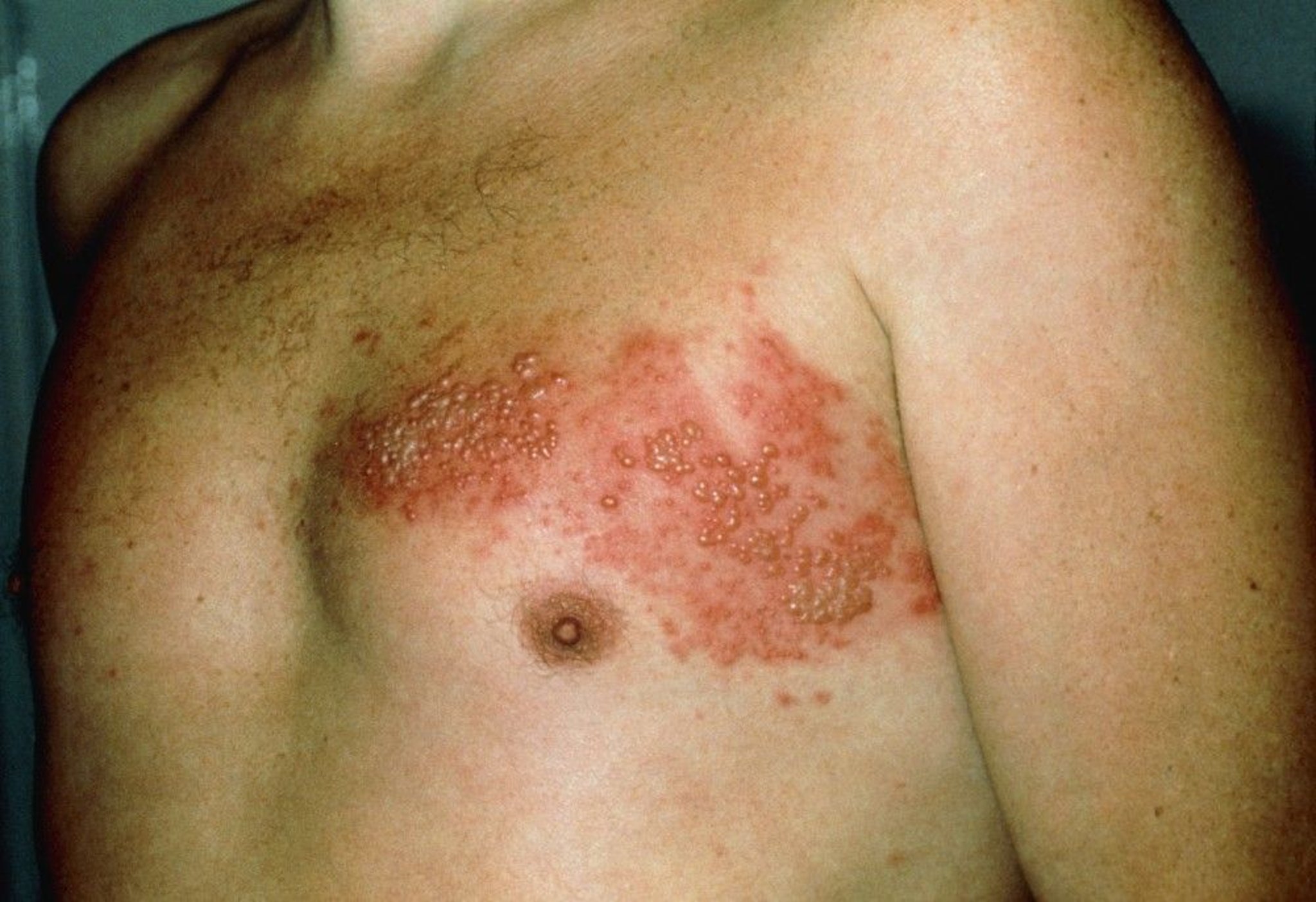
BIOPHOTO ASSOCIATES/SCIENCE PHOTO LIBRARY
Shingles symptoms are usually less severe in children than in adults.
The blisters begin to dry and form a scab about 5 days after they appear. Until scabs appear, the blisters are contagious and contain varicella-zoster virus, which, if spread to susceptible people, can cause chickenpox. Having many blisters outside the affected dermatome or having blisters that persist for more than 2 weeks usually indicates that the immune system is not functioning normally.
Rarely, the affected skin becomes infected by bacteria. Scratching the blisters increases this risk. Bacterial infections increase the risk of scarring.
If shingles affects the nerve that leads to the eye, the eye may be infected. Eye infection is more common when sores occur on the forehead, near the eye, and especially on the tip of the nose. This infection (called herpes zoster ophthalmicus) can be serious. Even with treatment, vision may be affected.
The nerve that leads to the ear may also be affected. This infection (called herpes zoster oticus, or Ramsay Hunt syndrome) can cause blisters in the ear canal, pain, partial paralysis of the face, hearing loss, ringing in the ears (tinnitus), and sometimes vertigo.
Scarring or hyperpigmentation of the skin may occur, but most people recover without lasting effects. A few people, more commonly older adults, continue to have chronic pain in the area (postherpetic neuralgia).
Postherpetic neuralgia develops in about 10% of people who have had shingles. It is more common among older adults. In postherpetic neuralgia, people who have had shingles continue to have pain long after the rash has gone away. The pain occurs in areas of skin supplied by nerves infected with herpes zoster. Postherpetic neuralgia can be very severe and even incapacitating.
Diagnosis of Shingles
A doctor's evaluation
Rarely analysis or biopsy of a sample taken from the blisters
People who suspect they have shingles should see a doctor right away because to be effective, treatment must be started early. Doctors ask them to precisely describe the location of the pain. Pain in a vague band on one side of the body suggests shingles. If characteristic blisters appear in the typical pattern (on a strip of skin representing a dermatome), the diagnosis is clear.
Rarely, doctors take a sample from the blisters to be analyzed or do a skin biopsy to confirm the diagnosis.
Treatment of Shingles
Antiviral medications
Pain relievers
Shingles treatments include several antiviral medicationsSome Antiviral Medications for Herpesvirus Infections
The medications should be started as soon as shingles is suspected, before blisters appear if possible. Antivirals are likely not to be effective if started more than 3 days after blisters appear. These medications do not cure the disease, but they can help relieve shingles symptoms and shorten their duration.
If an eye or ear is involved, the appropriate specialist (ophthalmologist or otolaryngologist) should be consulted.
Wet compresses are soothing, but pain-relieving medications
To prevent bacterial infections from developing, people with shingles should keep the affected skin clean and dry and should not scratch the blisters.
Prevention of Shingles
Preventing chickenpox by vaccinating children and adults who do not have immunity with the varicella vaccine is recommended.
There are two shingles vaccines: a newer recombinant vaccine and an older, weakened live-virus vaccine. The older, live-virus vaccine is no longer available in the United States, but it remains available in many other nations. The newer recombinant vaccine contains only pieces of a virus. The recombinant vaccine is preferred and is recommended for healthy people aged 50 or over, regardless of whether they recall having had chickenpox or shingles and regardless of whether they have been vaccinated with the older shingles vaccine. The recombinant vaccine is also recommended for adults 19 years and older who are or will be immunodeficient or immunosuppressed because of disease or therapy.
The recombinant herpes zoster vaccine is given in two doses, injected into a muscle. The doses are given 2 to 6 months apart and at least 2 months after the older (weakened live-virus) vaccine for people who have had that vaccine.
The recombinant vaccine significantly reduces the chance of getting shingles and postherpetic neuralgia.
When shingles occurs, taking antiviral medications may reduce the risk of developing postherpetic neuralgia.


