





Rosacea is a persistent skin disorder that causes redness, tiny pimples, and noticeable blood vessels, usually on the central area of the face.
The cause is unknown.
Typical symptoms include redness, small visible blood vessels, and sometimes small pimples that appear on the cheeks and nose.
The diagnosis is based on the typical appearance of the rash and on the person's age when symptoms first appear.
Worsening of rosacea may be prevented by avoiding certain foods, alcohol, hot beverages, and exposure to sunlight, extremes of temperature, wind, and cosmetics.
Treatment includes antibiotics applied to the skin or, for some people, taken by mouth.
Rosacea typically affects people aged 30 to 50. The disorder is most common among people of Irish and Northern European descent who have fair complexions, but it does affect and is probably under-recognized in darker-skinned people. Although usually easy for doctors to recognize, rosacea sometimes looks like acne and certain other skin disorders. It is often called adult acne.
The cause of rosacea is not known, but some people may be prone to developing this disorder.
Spicy foods, alcohol, or hot beverages may trigger flare-ups. Other triggers may include sunlight, sunscreen, emotional stress, cold or hot weather, exercise, wind, cosmetics, and hot baths.
Symptoms of Rosacea
Rosacea affects only the face and scalp. It has 4 phases:
Pre-rosacea phase (phase 1): The skin over the cheeks and nose becomes flushed, but for longer periods of time than normal, and may sting.
Vascular phase (phase 2): The skin appears red and swollen, with small blood vessels visible just below the surface (called telangiectasia).
Inflammatory phase (phase 3): Often small pimples develop, sometimes with some pus (called pustules).
Late phase (phase 4): In some people, the skin around the nose occasionally thickens, making it look red and bulbous (called rhinophyma).
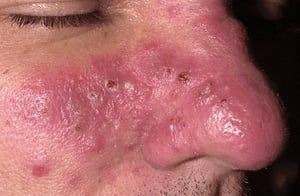
Image provided by Thomas Habif, MD.
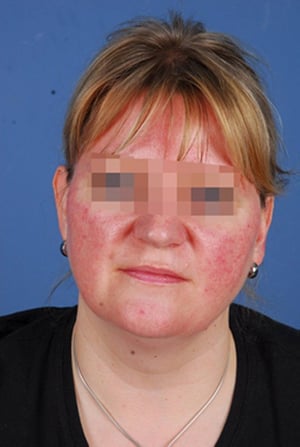
© Springer Science+Business Media
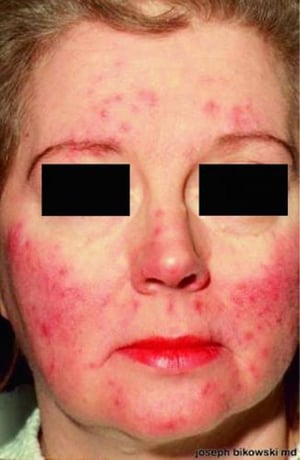
© Springer Science+Business Media
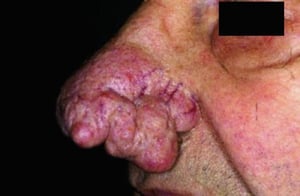
© Springer Science+Business Media


Image provided by Thomas Habif, MD.


© Springer Science+Business Media


© Springer Science+Business Media

© Springer Science+Business Media
Rosacea that affects the eyes (called ocular rosacea) often accompanies rosacea that affects the face. Symptoms of ocular rosacea may include inflammation of the eyelids, conjunctiva, iris, sclera, cornea, or a combination that causes itching, a feeling as though something is in the eye (foreign body sensation), redness, and swelling of the eye.


Diagnosis of Rosacea
A doctor's examination
Doctors base the diagnosis of rosacea on the typical appearance of the rash. There are no specific tests. The person's age when the symptoms first appear and a lack of blackheads and whiteheads help distinguish rosacea from acne.
Treatment of Rosacea
Avoidance of triggers
For telangiectasia, lasers and electrocautery
For rhinophyma, dermabrasion, lasers, and/or removal of excess tissue
The first treatment of rosacea is avoiding triggers. Treatment is aimed at controlling symptoms because there is no cure for rosacea.
Treatment of telangiectasia includes laser treatment and electrocautery (an electrical current applied to the skin removes the telangiectasia).
Severe rhinophyma is unlikely to improve completely with medications. Therefore, a person with this disorder may need dermabrasion (a procedure in which the skin surface is rubbed with an abrasive metal instrument to remove the top layer), laser treatment, and/or surgery to remove the excess tissue.


