





Scabies is a parasitic skin infestation caused by mites.
Scabies usually spreads from person to person through physical contact.
People with scabies have severe itching, even though there are typically few mites on the body.
Doctors diagnose scabies by examining the itchy areas and sometimes by looking at skin scrapings under a microscope.
Parasites are organisms that live on or inside another organism (the host) and depend on the host for nutrition to live. The mites that cause scabies are parasites because they live by feeding on a person's blood.
Scabies is caused by the mite Sarcoptes scabiei. Infestations occur worldwide. The female mite bites and tunnels into the topmost layer of the skin and deposits her eggs in burrows. Young mites (larvae) then hatch in a few days. The infestation causes intense itching, probably due to an allergic reaction to the mites. (See also Mite Bites.)
The infestation spreads easily from person to person through physical contact, often spreading through an entire household. Human mites can live on fomites, which are physical objects such as towels, bedding, and clothing, from which they can infect people. However, once away from the human body, mites do not live very long. Animal mites may be spread to humans and cause itching, but they do not live very long or require treatment. Mites that cause scabies are usually destroyed by normal laundering (machine washing in hot water followed by drying in a hot dryer or ironing) or dry cleaning. The main risk factor is crowded conditions (as in schools, shelters, barracks, and some households). Scabies is not related to poor hygiene.
Symptoms of Scabies Infestation
The hallmark of scabies is intense itching, which is usually worse at night. The burrows of the mites are often visible as very thin lines up to a ½ inch (about 1 centimeter) long, sometimes with a tiny bump—the mite—at one end. Often, scratching of the itchy burrows results in a bacterial infection of the skin (so-called secondary infection). Sometimes, only tiny bumps are seen, many of which are scratched open because of the itching.
The bumps can be anywhere on the body, including the breasts and penis. The bumps do not appear on the face in adults. The bumps first appear on the webs between the fingers, wrists, inner elbows, underarms, along the belt line, or buttocks. Over time, the burrows may become difficult to see because they are obscured by inflammation induced by scratching. People in warm climates develop small red bumps with few burrows.
In people with dark skin, scabies can cause solid raised areas. In infants, the palms, soles, face, and scalp may be affected, especially behind the ears. In older adults, scabies can cause intense itching but very mild skin symptoms, which makes it a challenge for doctors to diagnose.
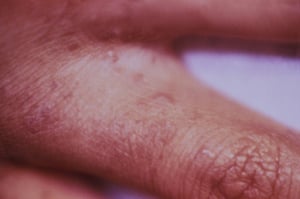
Image courtesy of the Public Health Image Library of the Centers for Disease Control and Prevention.
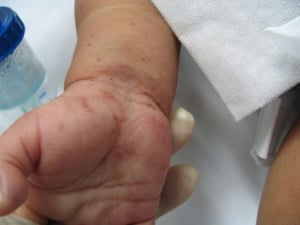
Photo courtesy of Karen McKoy, MD.

© Springer Science+Business Media


Image courtesy of the Public Health Image Library of the Centers for Disease Control and Prevention.


Photo courtesy of Karen McKoy, MD.


© Springer Science+Business Media
People who may develop a severe infestation (called crusted scabies or Norwegian scabies) include
Those with a weakened immune system (caused by human immunodeficiency virus [HIV] infection, blood cancer, or chronic use of corticosteroids or other drugs that suppress the immune system)
Those with severe physical disabilities or intellectual disability
Aboriginal Australians
Severe infestations cause large areas of thickened, crusted skin (particularly on the palms and soles in adults and on the scalp in children) that do not itch.


Scabies incognito is a different form of scabies that develops in people who use topical corticosteroids for extended periods of time. It is sometimes hard to recognize because it looks different from the usual forms of scabies, and the mites may be very difficult to find.
Diagnosis of Scabies Infestation
A doctor's evaluation
Burrow scrapings
Usually, itching and the appearance of bumps and burrows are all that are needed to make a diagnosis of scabies. Sometimes doctors use a lens to magnify the skin and make the burrows visible. However, doctors often confirm the presence of mites, eggs, or mite feces by taking a scraping from the bumps or burrows and looking at it under a microscope.
Treatment of Scabies Infestation
For older children and adults,
For infants and young children,permethrin
For adults and children 4 years of age and older,
Even after successful treatment that kills the mites, itching and bumps may persist for up to 3 weeks because of a continued allergic reaction to the mite bodies, which remain in the skin for a while. The itching can be treated with mild corticosteroid cream, antihistamines taken by mouth, or both. Occasionally, the skin irritation and deep scratches lead to a bacterial infection, which may require antibiotics given by mouth.
Family members and people who have had close physical contact, such as sexual contact, with a person with scabies should be treated as well. Clothing, towels, and bedding used during the preceding few days should be washed in hot water and dried in a hot dryer, dry cleaned, or put in a closed plastic bag for at least 3 days.


