





The terms deformities and dystrophies are often used interchangeably, sometimes even by doctors. However, their meanings are slightly different.
Deformities: Changes in nail shape
Dystrophies: Changes in nail texture, color, or both
Doctors more commonly use the term dystrophy than deformity. (See also Overview of Nail Disorders.)
About 50% of nail dystrophies are caused by a fungal infection (onychomycosis) . The remainder result from various causes, including nail injuries, birth deformities of the nails, psoriasis, lichen planus, and occasionally tumors (cancerous and noncancerous). Drugs, infections, and diseases can cause discoloration of the nails (chromonychia). For example, infection with Pseudomonas bacteria can cause a greenish discoloration ( see Green Nail Syndrome).
The doctor can often make the diagnosis of nail dystrophies caused by a fungus by examining the nails. However, to confirm the diagnosis, the doctor may need to take fungal scrapings and do a culture (the process of growing the organisms in a laboratory) or do a polymerase chain reaction (PCR) analysis to look for genetic material from a fungus.
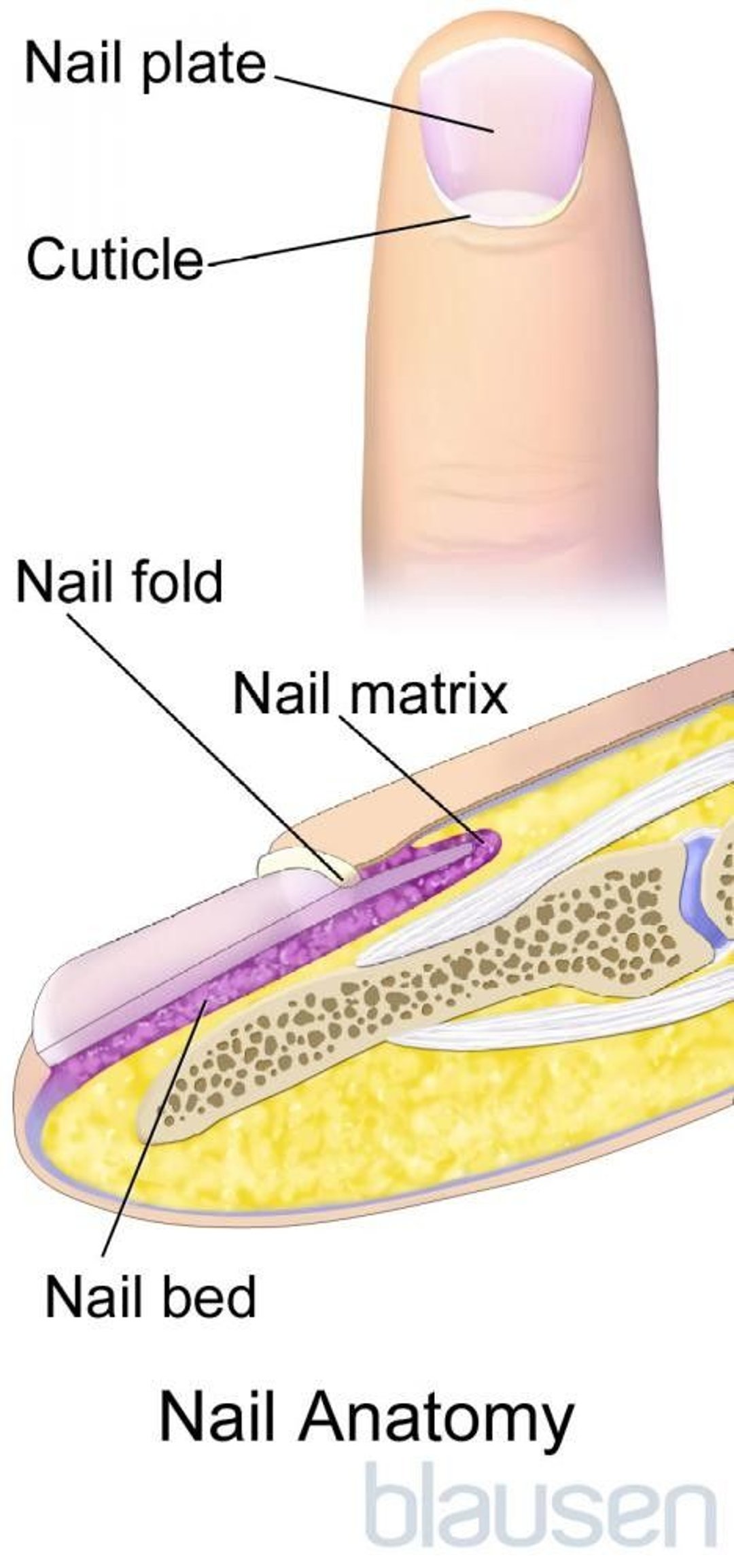
To diagnose nail dystrophies that are not caused by a fungus, doctors may do a biopsy of the nail plate (the hard part of the nail) or nail matrix (located at the base of the nail and where nail growth originates).
If the nail’s appearance does not improve with treatment of the underlying disorder, manicurists may be able to hide deformities and some dystrophies with appropriate trimming and polishes.

Birth deformities of the nail
Some babies are born without nails (anonychia). In nail-patella syndrome, thumbnails are missing or are small with pitting and ridges. Darier disease causes red and white streaks on the nails and V-shaped notches to form on the tips of the nails. In pachyonychia congenita, nail beds (the parts of the nail unit that attach the nail to the finger) are thickened and discolored and are curved from side to side, forming a pincer nail deformity.


Nail deformities and dystrophies associated with systemic diseases
Sometimes, diseases that involve other organs (systemic diseases) can cause changes in the nails as well, including the following:
Iron deficiency may cause spoon-shaped nails (koilonychia). This deformity is particularly characteristic of Plummer-Vinson syndrome.
Kidney failure may cause the bottom half of the nails to turn white and the top half of the nails to turn pink or appear pigmented (half-and-half nails or Lindsay nails). This dystrophy can also occur in healthy people.
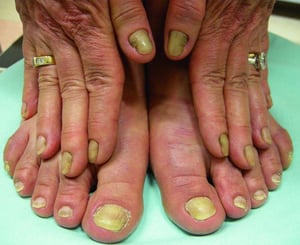
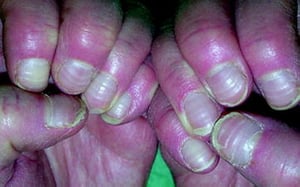
Some lung diseases, often accompanied by lymphedema (an accumulation of lymphatic fluid in tissues), may cause yellow nail syndrome, in which nails become thick, overcurved, and yellow or yellow-green in color.
Beau lines are horizontal grooves in the nail that occur when there is temporary slowing of growth of the nail. Sometimes the grooves can go all the way through the nail, leading to complete loss of the nail. They can occur after an infection, injury, systemic illness, or chemotherapy.
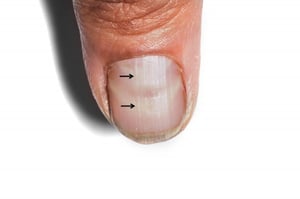
White horizontal lines across part of the nail (leukonychia) may appear after an injury. However, lines that run horizontally all of the way across the nail (Mees lines) may be associated with more serious health problems, including cancer or heart failure, chemotherapy, or exposure to certain toxins, such as arsenic, thallium, or other heavy metals. The nails can grow out normally if exposure to these toxins or chemotherapy is stopped.
DR P. MARAZZI/SCIENCE PHOTO LIBRARY
© Springer Science+Business Media
© Springer Science+Business Media
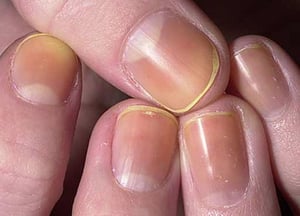
Image provided by Thomas Habif, MD.
© Springer Science+Business Media
© Springer Science+Business Media
SCIENCE PHOTO LIBRARY


DR P. MARAZZI/SCIENCE PHOTO LIBRARY


© Springer Science+Business Media


© Springer Science+Business Media


Image provided by Thomas Habif, MD.


© Springer Science+Business Media


© Springer Science+Business Media


SCIENCE PHOTO LIBRARY
Deformities and dystrophies associated with skin diseases
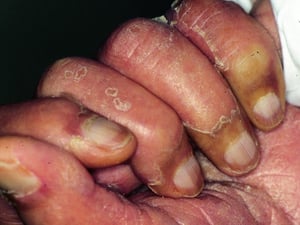
In psoriasis, nails may have irregular pits (tiny depressions in the surface of the nail), oil spots (yellow-brown spots under the nail), separation of the nail plate from its bed (onycholysis), and thickening and crumbling of the nail plate.
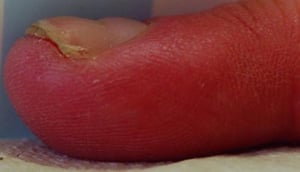
Lichen planus of the nail matrix causes scarring with early nail ridging and splitting, later leading to scarring and pterygium formation. Pterygium of the nail, which is caused by lichen planus, is scarring from the base of the nail outward in a V formation, which leads to loss of the nail.
People with alopecia areata, a disorder in which round, irregular patches of hair are suddenly lost, may have nail pits that form a geometric pattern.
People who have alopecia areata, lichen planus, atopic dermatitis, or psoriasis may develop trachyonychia (rough, opaque nails that have ridges and a sandpaper-like appearance). Trachyonychia most frequently occurs in children.
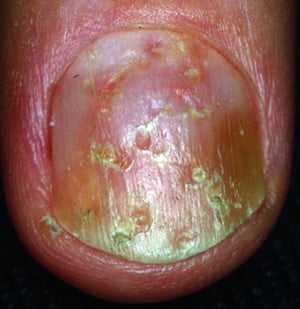
© Springer Science+Business Media
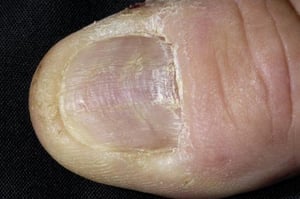
DR P. MARAZZI/SCIENCE PHOTO LIBRARY
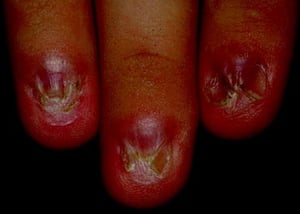
© Springer Science+Business Media
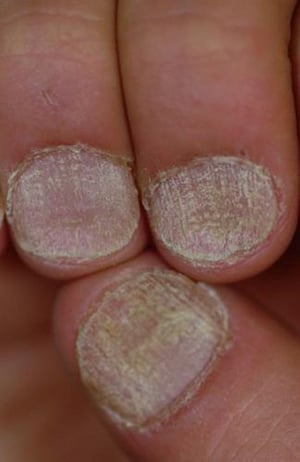
© Springer Science+Business Media


© Springer Science+Business Media


DR P. MARAZZI/SCIENCE PHOTO LIBRARY


© Springer Science+Business Media


© Springer Science+Business Media
Effect of drugs on nails
Drugs may cause other nail problems, such as melanonychia striata (brown or black pigmented lines) and onycholysis. Different drugs lead to discoloration of the nail, which usually gets better after the drug is stopped and the nail grows out.
Chemotherapy drugs may cause a darkening (hyperpigmentation) of the nail plate. Horizontal pigmented or white bands may also be seen in people treated with certain chemotherapy drugs.
Silver, which can be absorbed after occupational exposure or through taking dietary supplements containing colloidal silver protein, can cause the nails to turn a dark blue-gray.
Drugs that contain gold, which is rarely used in the treatment of rheumatoid arthritis, can turn nails light or dark brown.
human immunodeficiency virus (HIV) infection, may cause brown-black longitudinal streaks. However, these streaks can also be present in people who have AIDS but are not receiving ZDV.
Arsenic poisoning can cause horizontal white lines to form on the nails or cause the nails to turn brown.
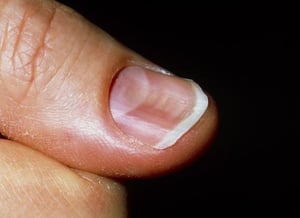
Median nail dystrophy

Melanonychia striata
Melanonychia striata are gray, brown, or black lines in the nail plate caused by the normal, brown skin pigment, melanin. The lines extend from the base of the nail to its tip. In dark-skinned people, these lines may be normal and require no treatment. Other noncancerous causes of melanonychia striata include moles, HIV infection, hyperthyroidism, use of certain drugs, pregnancy, nail injuries, Addison disease, and Cushing syndrome.


However, similar dark lines or discoloration in or around a nail can be an early sign of cancer, particularly melanoma, which can develop from the pigment cells of the nail-making tissue (nail matrix). Doctors usually do a biopsy of the nail matrix if they are concerned a discoloration might be cancerous.
Onycholysis
Onycholysis is partial separation of the nail plate from the nail bed or complete nail plate loss. It can result from
An injury (such as in prolonged hiking or skiing with poorly fitted footwear)
Overzealous nail cleaning
Frequent exposure to water, citrus fruits, and certain chemicals (such as those in cleaning agents)


People with onycholysis are at risk of infection with yeast and fungus. Keeping the nail dry and applying antifungal preparations to the nail unit can help.
Pincer nail deformity
In pincer nail deformity, the nail is overcurved horizontally (side-to-side). It is most often caused by a fungal infection (onychomycosis), psoriasis, tumors of the nail, and poorly fitting shoes. The deformity can also occur in people who have lupus, Kawasaki disease, end-stage renal disease (severe chronic kidney disease), and some genetic syndromes (for example, pachyonychia congenita). Sometimes it develops in older people and in those with arthritis in their fingers. People often have pain where the nail plate curves into the tips of the fingers.


