





Skin cancer is the most common type of cancer, and people of all skin tones can be affected. People who have light skin are particularly susceptible to developing most forms of skin cancer because they produce less melanin. Melanin, the protective pigment in the outer layer of skin (epidermis), helps protect the skin from ultraviolet (UV) light damage. However, skin cancer also can develop in people who have dark skin and in people who have not had significant sun exposure to their skin.
Skin cancer is more common among people who spend a lot of time outdoors for work or recreation. Skin cancers can be found on any location of the body but are most commonly diagnosed on areas that are often exposed to the sun such as the head and neck.
Skin cancers may also develop years after radiation therapy or exposure to substances that cause cancer (for example, ingestion of arsenic).
Over 5.4 million new cases of nonmelanoma skin cancer (such as basal cell skin cancer and squamous cell skin cancer) were diagnosed in 2012 in the United States.
The three most common types of skin cancer are
These three types are caused, at least in part, by long-term sun exposure.
Less common types of skin cancer are
Cancer of skin glands
Paget disease of the breast or extramammary Paget disease (usually in the groin or near the anus)
Squamous cell carcinoma in situ (formerly called Bowen disease) and possibly keratoacanthomas are forms of squamous cell carcinoma.
Many skin cancers are curable, especially when treated at an early stage. At first, skin cancers typically do not cause any symptoms. Therefore, any unusual skin growth that enlarges or lasts for more than a few weeks should be examined by a doctor.
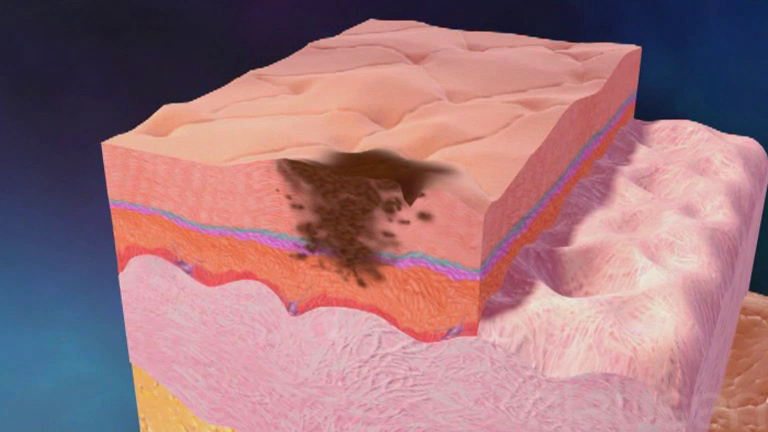
Treatment of Skin Cancer
Doctors treat most skin cancers by removing them surgically. Usually, the scar that is left after surgery depends on the size of the original cancer, which, if caught early, may be small.
In addition to surgical removal, very small or very thin skin cancers may be treated with medicated creams, liquid nitrogen, or procedural techniques such as curettage (the cancer tissue is scraped off).
Larger or more invasive cancer may require surgical removal of a significant amount of skin, which may have to be replaced with a skin graft or a skin flap.
With a skin graft, a piece of skin is removed from another area of the person's body, typically where the skin is loose. The piece of skin is sewn onto the area where the cancer was removed.
With a skin flap, doctors transfer skin from an adjacent area to replace the area where the cancer was removed. With a flap, but not with a graft, the transferred skin is not cut completely free, so it still has its own blood supply. Also, a flap is usually thicker than a graft.
Skin cancers that have spread to other parts of the body or that are too big to remove surgically may require additional forms of treatment, such as radiation or chemotherapy.
Prevention of Skin Cancer


Because many skin cancers are likely related to UV light exposure, doctors recommend a number of measures to limit UV light exposure, starting in early childhood:
Avoiding the sun: For example, seeking shade, minimizing outdoor activities between 10 AM and 4 PM (when the sun’s rays are strongest), and avoiding sunbathing and the use of tanning beds
Wearing protective clothing: For example, long-sleeved shirts, pants, and broad-brimmed hats
Using sunscreen: At least sun protection factor (SPF) 30 with UVA and UVB protection used as directed and reapplied every 2 hours and after swimming or sweating but not used to prolong sun exposure
Did You Know...
|
Doctors do not know whether these sun protection measures reduce the chances of people developing or dying of melanoma. However, sun protection does decrease the risk of developing basal cell carcinoma and squamous cell carcinoma.
Using tanning beds, particularly by young people, may increase the risk of melanoma.
Screening for skin cancer
People should regularly check their own skin and notify a health care professional if they notice any unusual or changed skin marks.
People may want to consider having an annual skin examination by a health care professional if they
Take medications that weaken their immune system (immunosuppressants)
Have a personal or strong family history of skin cancer
Have a known, increased susceptibility to skin cancer because of specific genetic mutations or environmental exposures (such as exposure to ionizing radiation)
More Information
The following English-language resources may be useful. Please note that THE MANUAL is not responsible for the content of these resources.
American Academy of Dermatology: Skin Cancer Resource Center: Patient-friendly information about finding, treating, and raising awareness for skin cancers
American Cancer Society: Skin Cancer: Information about different types of skin cancer, including detection, prevention, treatment options, and other resources
The Skin Cancer Foundation: Skin Cancer 101: Information about different types of skin cancer, including detection, prevention, treatment options, and other resources


