





Squamous cell carcinoma is cancer that begins in the squamous cells of the skin.
Thick, scaly growths appear on the skin and do not heal.
To diagnose the cancer, doctors do a biopsy.
Treatment with surgery, chemotherapy applied to the skin, and sometimes radiation therapy can usually cure the cancer unless it has spread.
If the cancer has spread, people may be given medications called PD-1 inhibitors.
If the cancer spreads to other parts of the body, it can be fatal.
Squamous cells (keratinocytes) are the main structural cells of the epidermis (the outer layer of skin). Squamous cell carcinoma is cancer of these cells. Each year in the United States, 1.8 million people are diagnosed with squamous cell carcinoma.
Squamous cell carcinoma, the second most common type of skin cancer after basal cell carcinoma, usually develops on sun-exposed areas. However, it may grow anywhere on the skin or in the mouth, where sun exposure is minimal.
People who have had more sun exposure to their skin have a higher risk of developing squamous cell skin cancer. People who have light skin are much more susceptible to squamous cell carcinoma than people who have dark skin.
Squamous cell carcinoma may develop on normal skin but is more likely to develop in damaged skin. Such damage includes
Precancerous skin growths caused by previous sun exposure (actinic keratoses)
Chronic sores on the skin or in the mucus membranes (such as those that line the eyes, nose, and lungs) or genitals
Skin that has been scarred, particularly by burns
In the mouth, precancerous skin growths appear as white or red spots (leukoplakia or erythroplakia).
Squamous cell carcinoma in situ and possibly keratoacanthomas are forms of squamous cell carcinoma.
Symptoms of Squamous Cell Carcinoma
Squamous cell carcinoma is characterized by its thick, scaly, irregular appearance, but it can have various appearances, and a doctor may be suspicious of any sores on sun-exposed surfaces that do not heal.
Squamous cell carcinoma typically begins as a red area with a scaly, crusted surface. As it grows, the tumor may become somewhat raised and firm, sometimes with a wartlike surface. Eventually, the cancer becomes an open sore and grows into the underlying tissue.
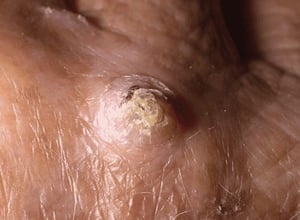
Image provided by Thomas Habif, MD.
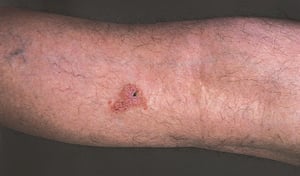
© Springer Science+Business Media
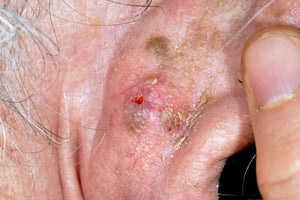
DR P. MARAZZI/SCIENCE PHOTO LIBRARY
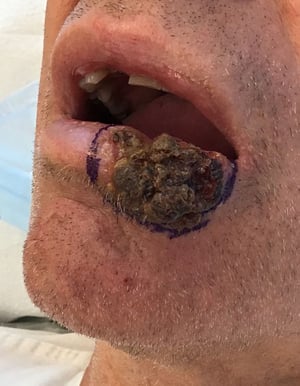
Photo courtesy of Gregory L. Wells, MD.


Image provided by Thomas Habif, MD.


© Springer Science+Business Media


DR P. MARAZZI/SCIENCE PHOTO LIBRARY


Photo courtesy of Gregory L. Wells, MD.
Diagnosis of Squamous Cell Carcinoma
Biopsy
When doctors suspect squamous cell carcinoma, they do a biopsy to differentiate the cancer from similar-looking diseases. In a biopsy, doctors remove a piece of the tumor and examine it under a microscope.
Treatment of Squamous Cell Carcinoma
Removal of the tumor (many different methods)
Doctors treat squamous cell carcinoma by scraping and burning the tumor with an electric needle (curettage and electrodesiccation), by cutting the tumor out (surgical excision), by destroying the cancer using extreme cold (cryosurgery), or by applying chemotherapy to the skin. Doctors may also use photodynamic therapy (see Using Lasers to Treat Skin Problems), in which chemicals and a laser are applied to the skin, or, occasionally, radiation therapy to treat squamous cell carcinoma.
People whose squamous cell carcinomas have returned or are large should be treated with a technique called Mohs microscopically controlled surgery. Radiation therapy may be done after surgery.
Squamous cell carcinoma that has spread (metastasized) to only one or a few other parts of the body is treated with radiation therapy. If the cancer is widespread, radiation therapy may not be used, and chemotherapy is usually not effective.
Because there is a greater risk of spread with squamous cell carcinoma than with basal cell carcinoma, doctors closely monitor treatment and follow-up.
Prognosis for Squamous Cell Carcinoma
Typically, the prognosis for small tumors that are removed early and adequately is excellent. Treatment is usually effective, and most people survive.
Most squamous cell carcinomas affect only the area around them, penetrating into nearby tissues. However, some spread (metastasize) to distant parts of the body, nearby skin and lymph nodes, and eventually to nearby organs and can be fatal. Tumors that are more than ¾ inch (2 centimeters) in diameter or grow more than 1/8 inch (2 millimeters) deep, or tumors that occur near the ears and lips, in scars, or around nerves are more likely to spread. About one third of cancers on the tongue or elsewhere in the mouth have spread before diagnosis (see Mouth and Throat Cancer).
If the cancer is treated before it spreads, the person is usually cured. However, if the cancer has spread, the chance of surviving the next 5 years, even with treatment, is only 34%.
Prevention of Squamous Cell Carcinoma
Because squamous cell carcinoma is caused by sun exposure, people can help prevent this cancer by doing the following, starting in early childhood:
Avoiding the sun: For example, seeking shade, minimizing outdoor activities between 10 AM and 4 PM (when the sun’s rays are strongest), and avoiding sunbathing and the use of tanning beds
Wearing protective clothing: For example, long-sleeved shirts, pants, and broad-brimmed hats
Using sunscreen: At least sun protection factor (SPF) 30 with UVA and UVB protection used as directed and reapplied every 2 hours and after swimming or sweating but not used to prolong sun exposure
More Information
The following English-language resources may be useful. Please note that THE MANUAL is not responsible for the content of these resources.
American Cancer Society: Squamous Cell Skin Cancer: Information about squamous cell carcinoma, including detection, prevention, treatment options, and other resources
The Skin Cancer Foundation: Squamous Cell Carcinoma: Information about squamous cell carcinoma, including detection, prevention, treatment options, and other resources


