





Tonsillar cellulitis is a bacterial infection of the tissues around the tonsils. A tonsillar abscess is a collection of pus behind the tonsils.
Sometimes, bacteria that infect the throat spread deep into surrounding tissues.
Typical symptoms include sore throat, pain when swallowing, fever, swelling, and redness.
The diagnosis is based on examination of the throat and sometimes the results of imaging studies.
Antibiotics help eliminate the infection.
An abscess is drained with a needle or through a small incision.
(For tonsillitis, see Throat Infection.)
Sometimes, bacteria (usually streptococci and staphylococci) that infect the throat can spread deeper into the surrounding tissues. This condition is called cellulitis.
If the bacteria grow unchecked, a collection of pus (abscess) may form. Abscesses may form next to the tonsils (peritonsillar) or in the side of the throat (parapharyngeal). Typically, a peritonsillar abscess bulges into the throat whereas a parapharyngeal abscess may protrude into the neck. A parapharyngeal abscess is more extensive and more dangerous than a peritonsillar abscess.
Tonsillar cellulitis and tonsillar abscesses are most common among adolescents and young adults.
Symptoms of Tonsillar Cellulitis and Abscess
With tonsillar cellulitis or a tonsillar abscess, swallowing causes severe pain that often radiates into the ear. People have a severe sore throat, feel ill, have a fever, and may tilt their head toward the side of the abscess to help relieve pain. Spasms of the chewing muscles make opening the mouth difficult (trismus).
Cellulitis causes general redness and swelling above the tonsil and on the soft palate.

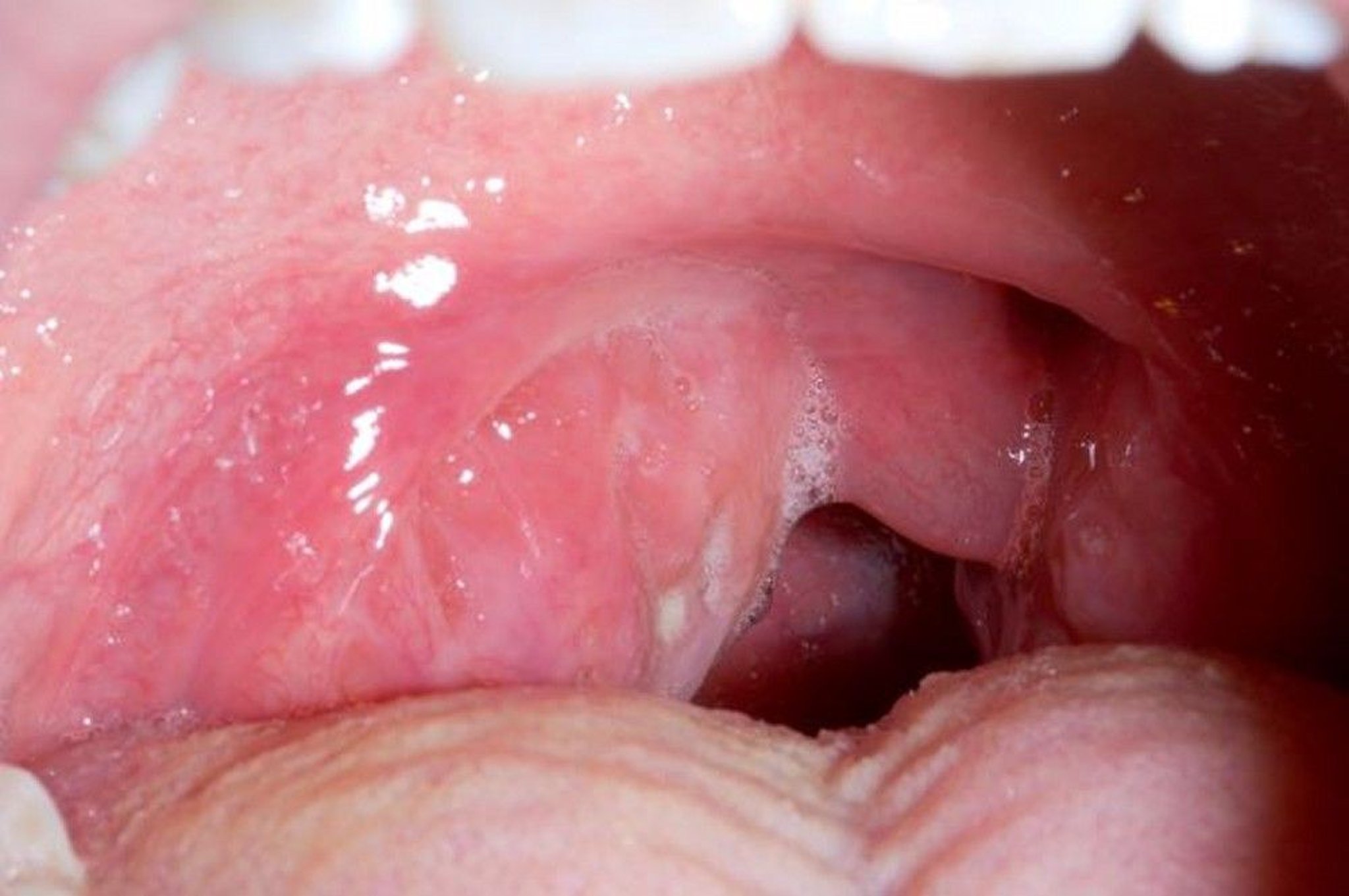
DR P. MARAZZI/SCIENCE PHOTO LIBRARY
Peritonsillar abscesses and some parapharyngeal abscesses push the tonsils forward. The uvula (the small, soft projection that hangs down at the back of the throat) is swollen and can be pushed to the side opposite the abscess. Other common symptoms include a "hot potato" voice (speaking as if a hot object is in the mouth), drooling, redness of the tonsils, white patches (exudates), swollen lymph nodes in the neck, and severe bad breath (halitosis).
Diagnosis of Tonsillar Cellulitis and Abscess
A doctor's evaluation
Sometimes computed tomography or ultrasonography
Sometimes insertion of a needle to check for an abscess
Peritonsillar abscess and often cellulitis are diagnosed in people who have a severe sore throat plus any of the following:
Difficulty opening their mouth (trismus)
"Hot potato" voice
A uvula that is pushed to one side (particularly in people with an abscess)
If a peritonsillar abscess is suspected, ultrasonography may be done to identify the abscess. The doctor may insert a needle into the area and try to remove the infected material or pus.
Samples of the infected material or pus are cultured (sent to the laboratory to try to grow bacteria) to identify the bacteria causing the infection.
Other tests are not usually done, but if the doctor is not sure whether a parapharyngeal abscess is present, computed tomography (CT) or ultrasonography can be used to identify one.
Treatment of Tonsillar Cellulitis and Abscess
Antibiotics
Drainage of pus
Sometimes tonsillectomy
If no abscess is present, the antibiotic usually starts to clear the infection within 48 hours.
If a peritonsillar abscess is present, a doctor must insert a needle in it or cut into it to drain the pus. The area is first numbed with an anesthetic spray or injection. Ultrasonography can help locate the abscess and thus determine where to insert a needle. Treatment with antibiotics is continued by mouth or by vein. Although most people can be treated as outpatients, some are hospitalized briefly to give antibiotics by vein and to monitor breathing.
Peritonsillar abscesses tend to recur. Recurrences can be prevented by removing the tonsils (tonsillectomy), which is usually performed 4 to 6 weeks after the infection has subsided or earlier if the infection is not controlled with antibiotics. Rarely, tonsillectomy is done immediately—for example, when the person is young and has often had tonsillitis or has obstructive sleep apnea.
If a parapharyngeal abscess is present, surgery is usually done to drain pus.


