





Vocal cord nodules, polyps, granulomas, and papillomas are noncancerous (benign) growths that cause hoarseness and a breathy voice.
Vocal cord polyps are often the result of an acute injury (such as from shouting at a football game) and typically occur on only one vocal cord. Polyps may have several other causes, including gastroesophageal reflux, hypothyroidism, or chronic inhalation of irritants (such as industrial fumes or cigarette smoke). Polyps due to these causes tend to involve both vocal cords. Polyps tend to be larger and bulge out more than nodules. Polyps are common among adults.

Vocal cord nodules occur on both vocal cords and result mainly from chronic trauma to the vocal cords from habitual yelling, singing, or shouting or using an unnaturally low frequency. Nodules can also occur in children.
Vocal cord granulomas (collections of immune cells caused by inflammation) are often the result of vocal cord injury due to uncontrolled gastroesophageal reflux (GERD) or damage during endotracheal intubation (insertion of a plastic breathing tube through the mouth into the windpipe [trachea]). Granulomas are common among adults.
Vocal cord papillomas (see also Recurrent Respiratory Papillomatosis) are noncancerous warty growths caused by certain human papillomaviruses (HPVs). The virus may be acquired during childbirth, and the growths most commonly occur between age 1 and 4 years, although they can develop at any time. Hoarseness or a weak cry are early signs, but the growths sometimes block the airway and interfere with breathing.
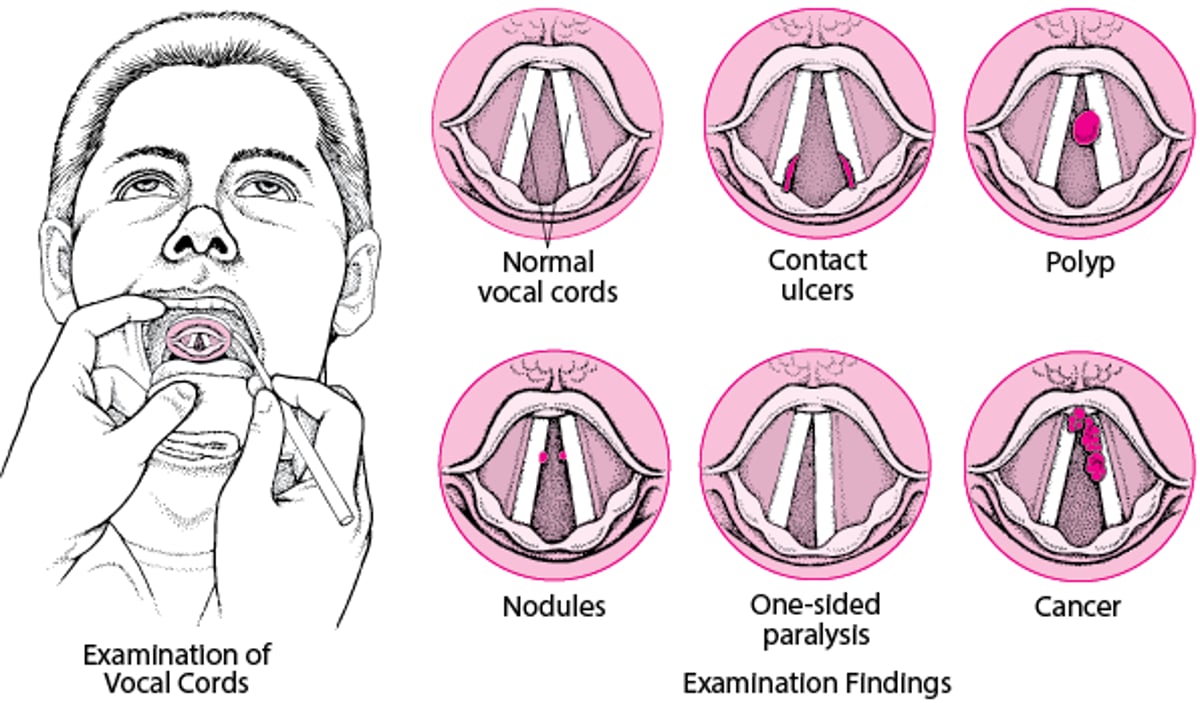
Vocal Cord Problems
When relaxed, the vocal cords normally form a V-shaped opening that allows air to pass freely through to the trachea. The cords open when air is drawn into the lungs (inspiration) and close during swallowing or speech. Holding a mirror in the back of a person's mouth, a specially trained doctor can often see the vocal cords and check for problems, such as contact ulcers, granulomas, polyps, nodules, paralysis, and cancer. All of these problems affect the voice. Paralysis may affect one (one-sided) or both vocal cords (two-sided—not shown). |

Symptoms
Symptoms of vocal cord nodules, polyps, and granulomas include chronic hoarseness and a breathy voice, which tend to develop over days to weeks.
Diagnosis
Inspection with a mirror or viewing tube
Sometimes biopsy
A doctor makes the diagnosis of vocal cord nodules, polyps, granulomas, and papillomas by examining the vocal cords with a mirror or a thin, flexible viewing tube (laryngoscopy).
Sometimes the doctor removes a small piece of tissue for examination under a microscope (biopsy) to diagnose papillomas and to make sure the growth is not cancerous (malignant).
Treatment
Resting the voice
Sometimes voice therapy
Sometimes surgery
Treatment of vocal cord nodules, polyps, and granulomas is to avoid whatever is irritating the voice box (larynx) and rest the voice. If trauma of the vocal cords is the cause, voice therapy conducted by a speech therapist may be needed to teach the person how to speak or sing without straining the vocal cords. A speech therapist may use a computer-based training program to help people avoid excessive loudness or vocal tension. Additional measures for people who use their voice professionally include ensuring adequate hydration and diet modifications.
Most nodules and granulomas go away with this treatment. Granulomas that do not go away can be removed surgically but tend to come back.
Most polyps must be surgically removed to restore the person's normal voice. After surgery, people may have speech rehabilitative therapy to learn to avoid harsh vocal habits (screaming, yelling, or speaking too long at one time).
Surgery or laser treatments are used for vocal cord papillomas. Doctors sometimes give antiviral drugs for severe cases. HPV vaccination in women can prevent infections in woman and decrease the rate of cases of the virus that are transmitted during childbirth and thus prevent development of vocal cord papillomas in children.


