Patients & CaregiversHealthcare ProfessionalsWorldwide
HomeAbout MerckProductsNewsroomInvestor RelationsCareersResearchLicensingThe Merck Manuals
THE MERCK MANUAL MEDICAL LIBRARY: The Merck Manual of Medical Information--Home Edition
Tips for better results
ABCDEFGHI
JKLMNOPQR
STUVWXYZ

Section

Subject

Topics

Glaucoma

Pronunciations

Glaucoma is optic nerve damage (often, but not always, associated with increased eye pressure) that leads to progressive, irreversible loss of vision.

  • Damage to the optic nerve can occur when pressure within the eye increases.
  • The vision loss occurs so slowly that it may not be noticed for a long time.
  • People at risk should have a complete eye examination, including measurement of eye pressures and testing of side (peripheral) vision.
  • Eye pressure needs to be controlled throughout life, usually with eye drops but sometimes with eye surgery.

Almost 3 million people in the United States and 14 million people worldwide have glaucoma. Glaucoma is the third leading cause of blindness worldwide and the second leading cause of blindness in the United States, where it is the leading cause of blindness among blacks and Hispanics. In the United States, about one third of glaucoma occurs with eye pressures within the average range, a condition called low-tension glaucoma.

People at highest risk are those with any of the following:

  • Age older than 40
  • African-American race
  • Family members who have (or had) the disease
  • Farsightedness or nearsightedness
  • Diabetes
  • Long-term use of corticosteroid drugs
  • Previous eye injury

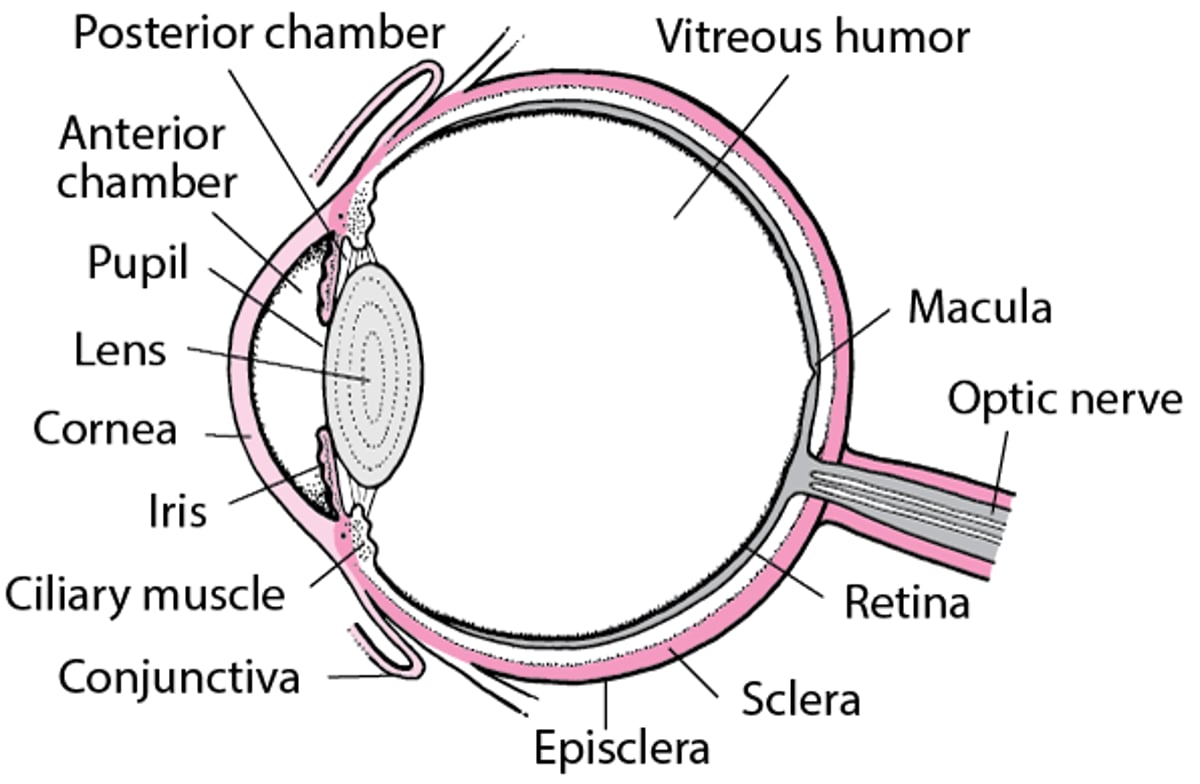
Glaucoma occurs when an imbalance in production and drainage of fluid in the eye (aqueous humor) increases eye pressure to unhealthy levels. Normally the aqueous fluid, which nourishes the eye, is produced by the ciliary body behind the iris (in the posterior chamber) and flows through the pupil to the front of the eye (anterior chamber), where it exits into drainage canals between the iris and cornea (the “angle”). When functioning properly, the system works like a faucet (ciliary body) and sink (drainage canals). Balance between fluid production and drainage—between an open faucet and a properly draining sink—keeps the fluid flowing freely and prevents pressure in the eye from building up.

Normal Fluid Drainage

Normal Fluid Drainage

Fluid is produced in the ciliary body behind the iris (in the posterior chamber), passes into the front of the eye (anterior chamber), and then exits through the drainage canals.

In glaucoma, the drainage canals become clogged, blocked, or covered. Fluid cannot leave the eye even though new fluid is being produced in the posterior chamber. In other words, the sink “backs up” while the faucet is still running. Because there is nowhere in the eye for the fluid to go, pressure in the eye increases. When the pressure becomes higher than the optic nerve can tolerate, damage to the optic nerve occurs. This damage is called glaucoma. Sometimes eye pressure increases within the range of normal but is nonetheless too high for the optic nerve to tolerate (called low tension glaucoma).

There are many forms of adult and childhood glaucomas. Most glaucomas fall into two categories: open-angle or closed-angle glaucomas.

Open-angle glaucoma is more common. In open-angle glaucoma, the drainage canals in the eyes become clogged gradually over months or years. Pressure in the eye rises slowly because fluid is produced at a normal rate but drains sluggishly.

Closed-angle glaucoma is less common than open-angle glaucoma. In closed-angle glaucoma, the drainage canals in the eyes become blocked or covered because the angle between the iris and cornea is too narrow. The blockage can occur suddenly or slowly. If the blockage occurs suddenly, pressure in the eye rises rapidly. If the blockage occurs slowly, the pressure in the eye rises slowly like in open-angle glaucoma.

In most people, the cause of glaucoma is not known, although both open-angle and closed-angle glaucomas tend to run in families. In others, damage to the eye caused by infection, inflammation, tumor, large cataracts or surgery for cataracts, or other conditions keeps the fluid from draining freely and leads to increased eye pressure and optic nerve damage (secondary glaucoma).

Symptoms

Open-Angle Glaucoma: Open-angle glaucoma is painless and causes no early symptoms. The most important symptom of open-angle glaucoma is the development of blind spots, or patches of vision loss, over months to years. The blind spots slowly grow larger and coalesce. Peripheral vision is usually lost first. Vision loss occurs so gradually that it is often not noticed until much of it is lost. Because central vision is generally lost last, many people develop tunnel vision: they see straight ahead perfectly but become blind in all other directions. If glaucoma is left untreated, eventually even tunnel vision is lost, and a person becomes totally blind.

Closed-Angle Glaucoma: If eye pressure rises rapidly in closed-angle glaucoma (acute closed-angle glaucoma), people typically notice an abrupt onset of severe eye pain and headache, redness, blurred vision, rainbow-colored halos around lights, and sudden loss of vision. They may also have nausea and vomiting as a response to the increase in eye pressure.

Acute closed-angle glaucoma is considered a medical emergency, because people can lose their vision as quickly as 2 to 3 hours after the appearance of symptoms if the condition is not treated.

People who have had open-angle or closed-angle glaucoma in one eye are likely to develop it in the other.

Screening and Diagnosis

Because the most common types of glaucoma can cause slow and silent loss of vision over years, early detection of the disease is extremely important. All people at high risk of glaucoma (see the bulleted list above) should have a comprehensive eye examination every 1 to 2 years.

There are four parts to a comprehensive eye examination for glaucoma. First, pressure in the eye is measured. This measurement is taken painlessly with an instrument called a tonometer (see Symptoms and Diagnosis of Eye Disorders: Tonometry). In general, eye pressure readings of greater than 20 to 22 millimeters of mercury (mm Hg) are considered higher than normal.

But measuring eye pressure is not enough, because a third or more of people with glaucoma have eye pressure in the average range. So doctors also use an ophthalmoscope and a slit lamp to look for changes in the optic nerve that indicate damage caused by glaucoma (see What Is an Ophthalmoscope?Figures and What Is a Slit Lamp?Figures).

In addition, visual field (peripheral vision) testing allows a doctor to detect blind spots. Most often, visual field testing is done with a machine that determines the person's ability to see small dots of light in all areas of the visual field (see Symptoms and Diagnosis of Eye Disorders: Visual Field Testing).

Finally, doctors may also use a special lens to examine the drainage channels in the eye, a procedure known as gonioscopy. The gonioscope allows the doctor to determine whether the glaucoma is of the open-angle or closed-angle type.

Did You Know...

  • Before older people take a drug with anticholinergic effects, their eyes should be checked to see whether development of closed-angle glaucoma is likely.

Treatment

Once a person loses vision because of glaucoma, the loss is permanent. But if glaucoma is detected, proper treatment can prevent further vision loss. So the goal of glaucoma treatment is to prevent the onset of vision loss or stop its progression.

Treatment of glaucoma is lifelong. It involves decreasing eye pressure by increasing fluid drainage out of the eyeball or by reducing the amount of fluid produced inside the eyeball. Some people with high eye pressure who do not have signs of optic nerve damage (known as glaucoma “suspects”) can be monitored closely without treatment.

Eye drops and surgery are the main treatments for open-angle and closed-angle glaucomas.

Eye drops containing beta-blockers, prostaglandin-like compounds, alpha-adrenergic agonists, carbonic anhydrase inhibitors, or cholinergic drugs are commonly used to treat glaucoma. Most people with open-angle glaucoma respond well to these drugs. These drugs are also used for people with closed-angle glaucoma, although surgery, not eye drops, is the main treatment. Glaucoma eye drops are generally safe, but they may cause a variety of side effects. People need to use them for the rest of their lives, and regular check-ups are necessary to monitor eye pressure, optic nerves, and visual fields. Sometimes a kind of diuretic (osmotic diuretic) given by mouth or by vein is also used briefly to help decrease eye pressure rapidly in acute closed-angle glaucoma.

Surgery may be needed if eye drops cannot effectively control eye pressure, if a person cannot take eye drops, or if people develop intolerable side effects from the eye drops. Laser surgery can be used to increase drainage in people with open-angle glaucoma (laser trabeculoplasty) or to make an opening in the iris (laser peripheral iridectomy or iridotomy) in people with acute closed-angle glaucoma. Laser surgery is done in the doctor's office or in a hospital or clinic. Anesthetic eye drops are used to prevent pain. People are usually able to go home the same day of any of these surgical procedures.

Glaucoma filtration surgery is the other form of surgery doctors use to treat glaucoma. With traditional glaucoma filtration surgery, doctors manually create a new drainage system (trabeculectomy or tube shunt) to allow fluid to bypass the clogged or blocked canals and filter out of the eye. Glaucoma filtration surgery is generally performed in a hospital. Newer filtration procedures (viscocanalostomy and Trabectome) remove only part of the drain to enhance the outflow of fluid. People are usually able to return home the day of the procedure.

The most common complication of glaucoma laser surgery is a temporary increase in eye pressure, which is treated with glaucoma eye drops. Rarely, the laser used in laser surgery may burn the cornea, but these burns usually heal quickly. With laser and glaucoma filtration surgery, inflammation and bleeding within the eye may occur but are usually short-lived. Glaucoma filtration surgery may occasionally lead to double vision, cataracts, or infection.

Because severe closed-angle glaucoma is a medical emergency, doctors may use very strong and fast-acting drugs that affect the eye pressure more rapidly than the standard eye drops or surgery. Doctors may use glycerin or acetazolamide Some Trade Names
DIAMOX
pills or drugs given by vein (such as mannitol) if they think the eye is vulnerable to high pressure. Eye drops are also given as soon as possible. Emergency surgery is performed if necessary.

The treatment of glaucoma caused by other disorders depends on the cause. For infection or inflammation, antibiotic, antiviral, or corticosteroid eye drops may provide a cure. A tumor obstructing fluid drainage should be treated, as should a cataract that is so large it causes eye pressure to rise. High eye pressure that results from cataract surgery is treated with glaucoma eye drops that reduce eye pressure. If eye drops do not work, glaucoma filtration surgery can be performed.

Drug Selected Side Effects Comments
Beta-blockers

Betaxolol Some Trade Names
BETOPTIC
KERLONE

Carteolol Some Trade Names
CARTROL
OCUPRESS

Levobetaxalol

Levobunolol Some Trade Names
BETAGAN

Metipranolol Some Trade Names
OPTIPRANOLOL

Timolol Some Trade Names
BLOCADREN
TIMOPTIC

Shortness of breath in people with asthma or other lung disorders that cause wheezing

Slow heart beat

Insomnia

Fatigue

Depression

Confusion

Sexual dysfunction

Hair loss

See also High Blood Pressure: Antihypertensive DrugsTables

How they work: Decrease aqueous humor production

Given as: Eye drops

These drops do not affect pupil size

Other comments: Some side effects are worse in people with heart or blood vessel disease

Some side effects may develop slowly and may be mistakenly attributed to aging or other bodily processes

Prostaglandin-like compounds

Bimatoprost Some Trade Names
LUMIGAN

Latanoprost Some Trade Names
XALATAN

Travoprost Some Trade Names
TRAVATAN

Unoprostone Some Trade Names
RESCULA

Increased eye and skin pigmentation

Elongated and thickened eyelashes

Muscle, joint, and back pain

Skin rash

Possible worsening of the disorder among people who have inflammation within the front part of the eye (uveitis)

How they work: Increase aqueous humor outflow

Given as: Eye drops

These drops have few serious bodywide side effects

Alpha-adrenergic agonists

Apraclonidine Some Trade Names
IOPIDINE

Brimonidine Some Trade Names
ALPHAGAN

Dipivefrin Some Trade Names
PROPINE
AK Pro

Epinephrine Some Trade Names
ADRENALIN

Increase in blood pressure or heart rate

Abnormal heart rhythm

May dilate the pupil

Apraclonidine Some Trade Names
IOPIDINE
: Decreased response if given over a period of time so that larger doses are required to have the same effect (tachyphylaxis)

Brimonidine Some Trade Names
ALPHAGAN
: May cause dry mouth; lower rate of allergic reactions than the other drugs; can be fatal in children less than 2 years of age

Dipivefrin Some Trade Names
PROPINE
AK Pro
and epinephrine Some Trade Names
ADRENALIN
: May be less reliable and cause more side effects than apraclonidine Some Trade Names
IOPIDINE
and brimonidine Some Trade Names
ALPHAGAN

How they work: Decrease aqueous humor production and increase aqueous humor outflow

Given as: Eye drops

Carbonic anhydrase inhibitors

Acetazolamide Some Trade Names
DIAMOX

Brinzolamide Some Trade Names
AZOPT

Dorzolamide Some Trade Names
TRUSOPT

Methazolamide Some Trade Names
NEPTAZANE
GLAUC

Acetazolamide Some Trade Names
DIAMOX
and methazolamide Some Trade Names
NEPTAZANE
GLAUC
: Fatigue

Altered taste

Loss of appetite

Depression

Kidney stones

Body salt (electrolyte) abnormalities

Numbness or tingling

Low or high blood cell counts (blood dyscrasias)

Weight loss

Nausea

Diarrhea

Brinzolamide Some Trade Names
AZOPT
and dorzolamide Some Trade Names
TRUSOPT
: Bad taste in the mouth

How they work: Decrease aqueous humor production

Given as: Acetazolamide Some Trade Names
DIAMOX
and methazolamide Some Trade Names
NEPTAZANE
GLAUC
given by mouth or by vein

Brinzolamide Some Trade Names
AZOPT
and dorzolamide Some Trade Names
TRUSOPT
given as eye drops

Cholinergic drugs

Carbachol Some Trade Names
MIOSTAT
CARBASTAT

Demecarium Some Trade Names
HUMORSOL

Echothiophate Some Trade Names
PHOSPHOLINE

Isoflurophate

Neostigmine

Physostigmine Some Trade Names
ANTILIRIUM

Pilocarpine Some Trade Names
ISOPTOCARPINE
PILOCAR

Hinder the eyes' ability to adapt to darkness

Pupil constriction

Blurred vision

Demecarium Some Trade Names
HUMORSOL
, echothiophate Some Trade Names
PHOSPHOLINE
, isoflurophate, neostigmine, and physostigmine Some Trade Names
ANTILIRIUM
: More likely to cause cataracts, retinal detachment, and bodywide side effects

How they work: Increase aqueous humor outflow

Given as: Eye drops

Other comments: People with darker pigmented pupils using carbachol Some Trade Names
MIOSTAT
CARBASTAT
and pilocarpine Some Trade Names
ISOPTOCARPINE
PILOCAR
may need higher strengths

Osmotic diuretics

Glycerin

Mannitol

Increase urine production

Can cause serious effects in some people (for example, dysfunction of the brain or nerves) by changing body salt (electrolyte) levels or may cause dehydration

How they work: Increase concentration of salts in the blood, which draws fluid from the eye by osmosis

Given: By mouth or by vein

Other comments: Used to treat acute closed-angle glaucoma

Last full review/revision August 2008 by Douglas J. Rhee, MD

Back to Top
Audio
Figures
Photographs
Pronunciations
Tables
Videos
Contact UsSite MapAccessibility StatementPrivacy PolicyTerms of UseCopyright 1995-2009 Merck & Co., Inc.