





Orbital cellulitis is infection affecting the tissue within the orbit and around and behind the eye.
Infection can spread to the orbit from sources such as the sinuses around the nose.
Symptoms include pain, swelling, red eye, fever, a bulging eye, impaired vision, and impaired eye movements.
Usually, computed tomography or magnetic resonance imaging of the orbits is done.
Antibiotics are given by vein and the person is admitted to the hospital.
(See also Introduction to Eye Socket Disorders.)
Both orbital cellulitis and preseptal cellulitis are more common among children. Preseptal cellulitis is far more common than orbital cellulitis. However, orbital cellulitis is more dangerous.
Orbital cellulitis usually is caused by spread of an infection to the orbit from the sinuses around the nose (nasal sinuses) but can also be spread from infection of the teeth or bloodstream. An animal or insect bite or another wound to the eyelids can also spread infection and lead to orbital cellulitis. A foreign body in the orbit, particularly if organic (for example, wood), can also cause orbital cellulitis.
Without adequate treatment, orbital cellulitis can lead to blindness as well as to severe illness. Infection can spread to the brain (meningitis) and spinal cord. Blood clots can form and spread from the veins around the eye to involve a large vein at the base of the brain (the cavernous sinus) and result in a serious disorder called cavernous sinus thrombosis.
Symptoms of Orbital Cellulitis
Symptoms of orbital cellulitis include
Pain
A bulging eye (proptosis)
Red eye
Reduced eye movement
Pain with eye movement
Swollen eyelids
Fever

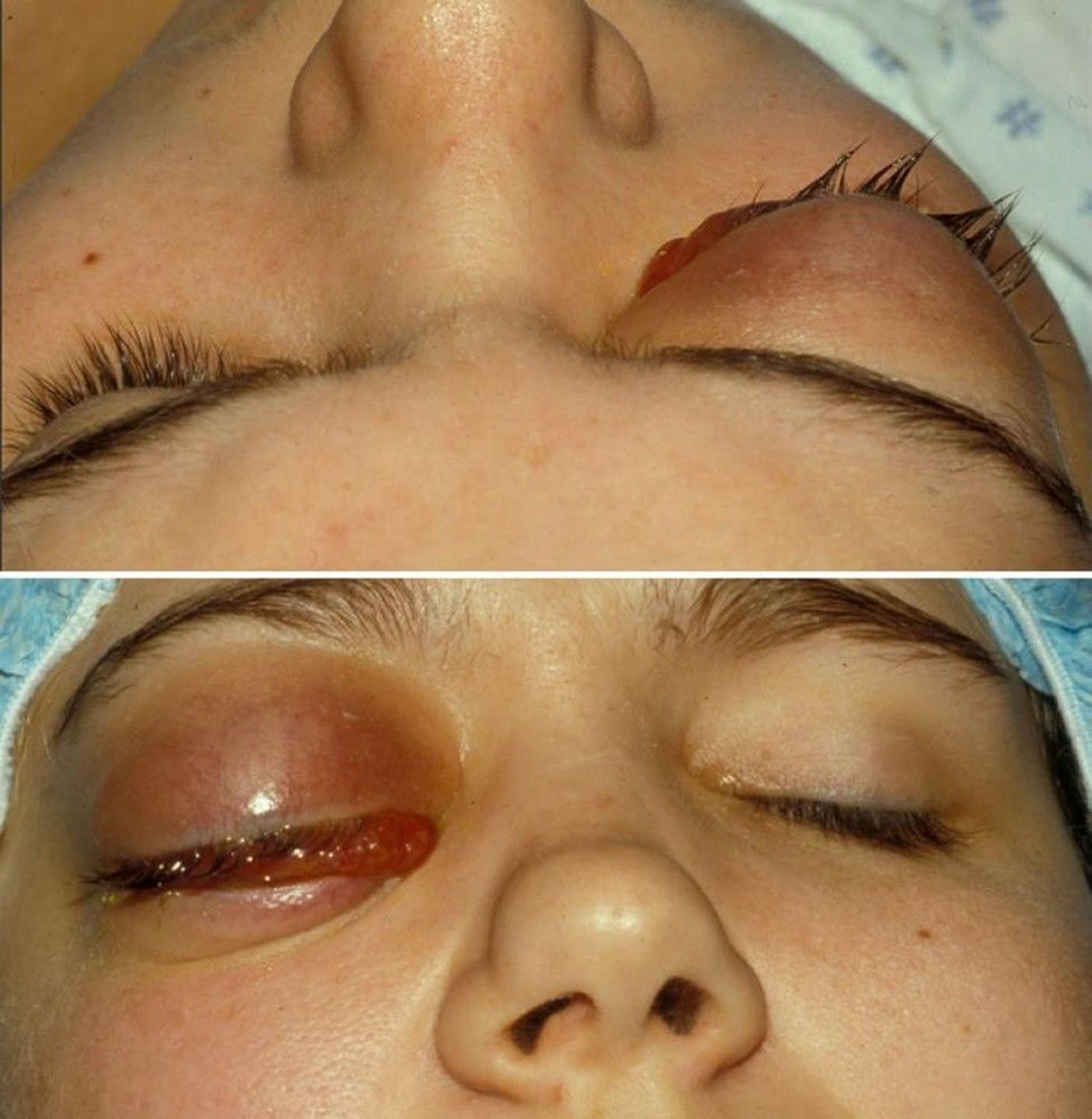
Photos courtesy of James Garrity, MD.
Eventually, vision becomes impaired.
Diagnosis of Orbital Cellulitis
Computed tomography or magnetic resonance imaging
Cultures of blood and samples from nasal sinus
Doctors can usually recognize orbital cellulitis without diagnostic tests. However, computed tomography (CT) or magnetic resonance imaging (MRI) usually is done to confirm the diagnosis. Also, determining the cause may require further assessment, including examination of the teeth and mouth and CT or MRI of the nasal sinuses.
Often, doctors obtain samples from the nasal sinuses as well as blood samples and send them to a laboratory for testing. The samples are cultured (to grow microorganisms) to determine what bacteria are causing the infection, which areas are infected, and which antibiotic should be used. A person with orbital cellulitis undergoes a more detailed examination by an ophthalmologist (a medical doctor who specializes in eye disorders).
Treatment of Orbital Cellulitis
Antibiotics
Surgery
People with orbital cellulitis are typically admitted to the hospital. Antibiotics are started as soon as possible, before the results of the laboratory testing are known. Antibiotics are given by vein. The antibiotic used at first may be changed if the culture results suggest that another antibiotic would be more effective. Sometimes surgery is needed if vision is impaired, to drain a collection of pus (abscess) or an infected nasal sinus, to remove a foreign body, or to help treat the infection if antibiotics alone are not effective.


