





In men, sexual dysfunction refers to difficulties engaging in sexual intercourse. Sexual dysfunction encompasses a variety of disorders that affect
Sex drive (libido)
The ability to achieve or maintain an erection (erectile dysfunction or impotence)
The ability to ejaculate
The ability to achieve an erection without a deformity in the penis
The ability to achieve an orgasm
Sexual dysfunction may result from either physical or psychologic factors. Many sexual problems result from a combination of physical and psychologic factors. A physical problem may lead to psychologic problems (such as anxiety, depression, or stress), which can in turn aggravate the physical problem. Men sometimes pressure themselves or feel pressured by a partner to perform well sexually and become distressed when they cannot (performance anxiety). Performance anxiety can be troublesome and further worsen a man’s ability to enjoy sexual relations.
Disorders of ejaculation are the most common sexual dysfunctions experienced by men. Disorders include
Early ejaculation before or shortly after penetrating the vagina (premature ejaculation)
Ejaculation into the bladder (retrograde ejaculation)
Inability to ejaculate (anejaculation)
Erectile dysfunction is common in middle-aged and older men. Decreased libido also affects some men.
Normal Male Sexual Function
Normal sexual function is a complex interaction involving both the mind and the body. The nervous, circulatory, and endocrine (hormonal) systems all interact with the mind to produce a sexual response. A delicate and balanced interplay among these systems controls the male sexual response.
Desire (also called sex drive or libido) is the wish to engage in sexual activity. It may be triggered by thoughts, words, sights, smell, or touch. Desire leads to the first stage of the sexual response cycle, excitement.
Excitement, or sexual arousal, follows. During excitement, the brain sends nerve signals down the spinal cord to the penis. The arteries supplying blood to the erectile tissues (corpora cavernosa and corpus spongiosum) respond by opening wider (relaxing and dilating). The widened arteries dramatically increase blood flow to these areas, which become engorged with blood and expand. This expansion exerts pressure that compresses the veins that normally drain blood from the penis, slowing the outflow of blood and thus elevating blood pressure within the penis. This elevated pressure in the penis results in rigidity and erection. Also, muscle tension increases throughout the body.
In the plateau stage, excitement and muscle tension are intensified.
Orgasm is the peak or climax of sexual excitement. At orgasm, muscle tension throughout the body further increases and the pelvic muscles contract, followed by ejaculation.
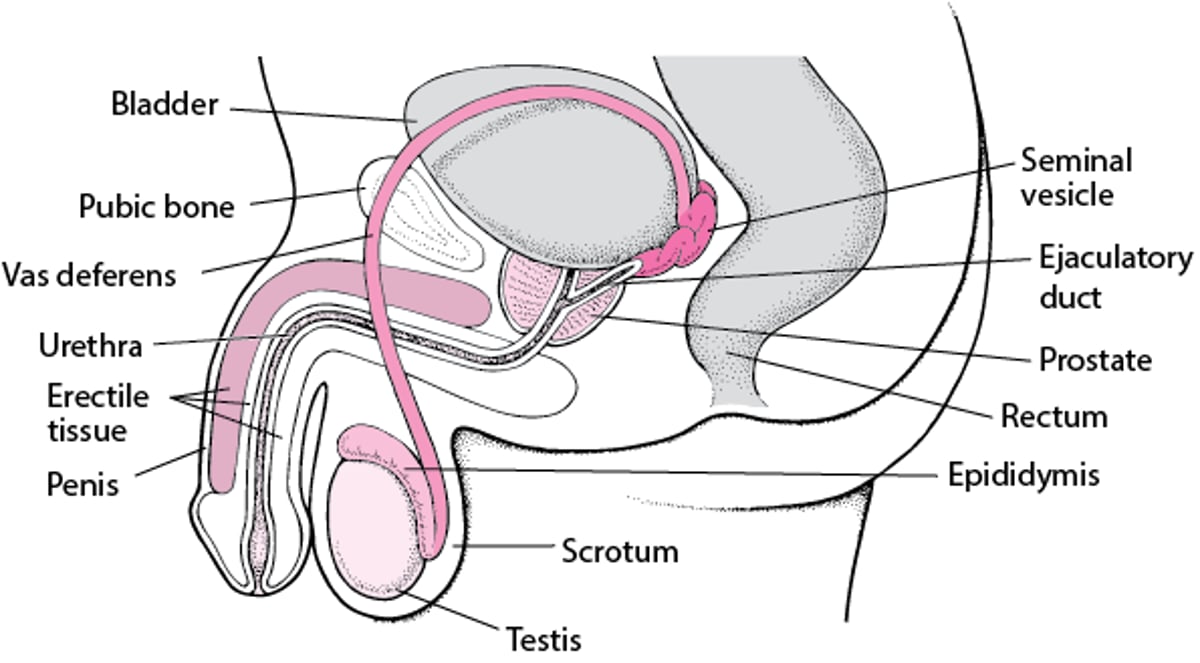
Ejaculation results when nerves stimulate muscle contractions in the male reproductive organs: the seminal vesicles, prostate gland, and the ducts of the epididymis and vas deferens. These contractions force semen into the urethra. Contraction of the muscles around the urethra further propels the semen out of the penis. The neck of the bladder also constricts, preventing semen from flowing backward into the bladder.
Male Reproductive Organs

Although ejaculation and orgasm often occur nearly simultaneously, they are separate events. Rarely, ejaculation can occur without orgasm. Also, orgasm can occur in the absence of ejaculation, especially before puberty, or as a side effect of certain drugs (such as antidepressants) or after surgery (such as removal of the colon or prostate gland). Orgasm is normally highly pleasurable.
In the resolution stage, the body returns to an unaroused state. Once ejaculation takes place or orgasm occurs, penile arteries constrict and the smooth muscle of the corpora cavernosa and corpus spongiosum contracts, reducing blood inflow, increasing blood outflow, and causing the penis to become limp (detumescence). After orgasm, erection cannot be obtained for a period of time (refractory period), often as short as 20 minutes or less in young men but longer in older men. The time between erections generally increases as men age.
Sexual Activity and Heart Disease
Sexual activity is generally less taxing than moderate to heavy physical activity and is therefore usually safe for men with heart disease. Although the risk of a heart attack is higher during sexual activity than it is during rest, the risk is still very low during sexual activity.
Nevertheless, sexually active men with disorders of the heart and cardiovascular system (which include angina, high blood pressure, heart failure, abnormal heart rhythms, and blockage of the aortic valve [aortic stenosis]) need to consult their doctor. Usually, sexual activity is safe if the disease is mild, if it causes few symptoms, and if blood pressure is normal. If the disease is moderate in severity or if the man has other conditions that make a heart attack likely, testing may be necessary to determine how safe sexual activity is. If the disease is severe or if the man has an enlarged heart that blocks the flow of blood leaving the left ventricle (obstructive cardiomyopathy), sexual activity should be deferred until after treatment reduces the severity of the symptoms.
People should ask their doctor how soon after a heart attack they should resume sexual activity. The American Heart Association advises that sexual activity may be resumed as early as 1 week after a heart attack if mild to moderate physical activity causes no chest pain or shortness of breath.
Most often, testing to determine the safety of sexual activity involves monitoring the heart for signs of poor blood supply while the man is exercising on a treadmill. If the blood supply is adequate during exercise, a heart attack during sexual activity is very unlikely.


