





Down syndrome is a chromosome disorder caused by an extra chromosome 21 that results in intellectual disability and physical abnormalities.
Down syndrome is caused by an extra chromosome 21.
Children with Down syndrome have delayed physical and mental development, specific head and facial features, and are often short.
Before birth, Down syndrome may be suspected based on ultrasonography or tests on the mother's blood and confirmed using chorionic villus sampling and/or amniocentesis.
After birth, the diagnosis is suggested by the child’s physical appearance and is confirmed by finding an extra chromosome 21, usually by testing a blood sample.
There is no cure for Down syndrome, but some specific symptoms and problems caused by the syndrome can be treated.
Most children with Down syndrome survive to adulthood.
(See also Overview of Chromosome and Gene Disorders.)
Chromosomes are structures within cells that contain DNA and many genes. Genes are segments of deoxyribonucleic acid (DNA) and contain the code for a specific protein that functions in one or more types of cells in the body. Genes contain instructions that determine how the body is supposed to look and function. (See Genes and Chromosomes for a discussion about genetics.)
An extra chromosome, making three of the same chromosome (instead of the normal two), is called trisomy.
The most common trisomy in a newborn is trisomy 21 (an extra chromosome 21, which is the smallest human chromosome). It is possible for an embryo to have trisomy of any chromosome; however, an extra of one of the larger chromosomes is more likely to end in miscarriage or stillbirth.
Trisomy 21 causes about 95% of the cases of Down syndrome. Thus, most people with Down syndrome have 47 chromosomes instead of the normal 46. However, about 4% of people with Down syndrome have 46 chromosomes, but the extra chromosome 21 is attached to another chromosome, creating an abnormal, but not extra, chromosome. This abnormal attachment is called translocation.


The extra chromosome usually comes from the mother, and a couple's risk of having a baby with an extra chromosome gradually increases with the mother's age. Yet, because most births occur to younger women, just 20% of infants with Down syndrome are born to mothers older than 35.
Women who have Down syndrome have a 50% chance of having a child with Down syndrome. However, there seems to be an increased risk of miscarriage of affected fetuses. Men with Down syndrome are usually infertile, unless they have mosaic Down syndrome. People who have mosaic Down syndrome have a mixture of two types of cells. Some of the cells contain the usual 46 chromosomes and some cells contain 47 chromosomes. The cells that have 47 chromosomes contain an extra chromosome 21.
Complications of Down syndrome
Down syndrome affects many parts of the body. Not all complications are present in each person.
About 50% of children with Down syndrome are born with heart defects, the most common of which are ventricular septal defect and atrioventricular septal defect.
About 6% of children have gastrointestinal problems. Hirschsprung disease and celiac disease also are more common among affected children.
Most affected people have hearing loss, and ear infections are very common.
About 60% of affected people have eye problems such as cataracts, glaucoma, and crossed eyes (strabismus).
The joints in the neck may be unstable, causing compression of the spinal cord, which can lead to changes in gait, use of the arms and hands, bowel or bladder function, or weakness.
Many people with Down syndrome develop thyroid disease (such as hypothyroidism) and diabetes.
They also have a higher risk of developing infections and leukemia and a much higher risk of developing obstructive sleep apnea.
Symptoms of Down Syndrome
In Down syndrome, physical and mental development is typically delayed. Children with Down syndrome are often short and are at increased risk of becoming obese.
Physical development
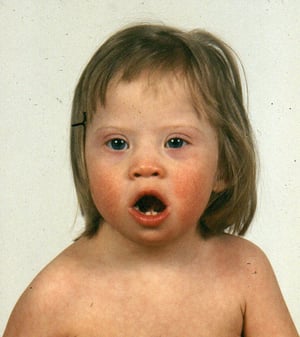
Infants with Down syndrome tend to be placid and passive and do not cry as often as expected. Many infants are born with heart and gastrointestinal defects, and they have somewhat limp muscles. They tend to have a small head and a face that is broad and flat with a short nose. There may be extra skin around the back of the neck (nuchal folds). However, some newborns do not have obvious characteristic facial features at birth and then develop noticeable characteristic facial features during infancy.
Typical physical features of people with Down syndrome include the following:
The eyes slant upward at the edges, and skin of the upper eyelid covers the inner corner of the eye (epicanthal fold).
The tongue is sometimes large. The larger tongue plus low facial muscle tone frequently causes children to hold their mouth open.
The ears are small, rounded, and set low in the head.
The hands are typically short and broad, with a single crease across the palm. The fingers are short, and the fifth finger, which often has two instead of three sections, curves inward.
The space between the first and second toes may also be widened (sandal-gap toes).

© Springer Science+Business Media
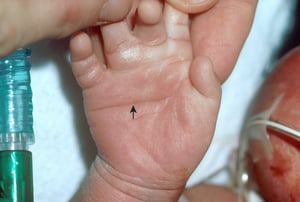
RALPH C. EAGLE, JR./SCIENCE PHOTO LIBRARY
© Springer Science+Business Media


© Springer Science+Business Media


RALPH C. EAGLE, JR./SCIENCE PHOTO LIBRARY


© Springer Science+Business Media
Cognitive (intellectual) development
The intelligence quotient (IQ) among children with Down syndrome varies but averages about 50, compared with children in the general population, whose average IQ is 100.
Children with Down syndrome often have delays in developing motor and language skills, but this is variable.
Behavior suggestive of attention-deficit/hyperactivity disorder is often seen in childhood. Children with Down syndrome are at greater risk of autistic behavior, especially those with severe intellectual disability.
There is an increased risk of depression among adults and depression among children.
Diagnosis of Down Syndrome
Before birth, ultrasonography of the fetus or blood tests of the mother
Before birth, chorionic villus sampling, amniocentesis, or both
After birth, the appearance of the infant and blood tests of the infant
(See also Next-generation sequencing technologies.)
Before birth, Down syndrome may be suspected based on findings detected during an ultrasound of the fetus or based on abnormal levels of certain proteins and hormones in the mother’s blood in the first 15 to 16 weeks of pregnancy. Doctors also can do a test to find deoxyribonucleic acid (DNA) from the fetus in the mother's blood and use this DNA to determine an increased risk of Down syndrome. This test is called noninvasive prenatal screening (NIPS) or cell-free fetal DNA analysis.
If doctors suspect Down syndrome based on the results of these screening tests, they often confirm the diagnosis using chorionic villus sampling, amniocentesis, or both.
Screening and diagnostic testing for Down syndrome before 20 weeks of pregnancy is recommended for all women regardless of age.
After birth, an infant with Down syndrome typically has a physical appearance that suggests the diagnosis. A doctor usually confirms the diagnosis by testing the infant’s blood.
After the diagnosis is made, doctors do other tests to screen for abnormalities associated with Down syndrome. Treating such abnormalities can often prevent them from impairing health. These tests are done at certain intervals and include the following:
Ultrasonography of the heart
Blood tests
Thyroid tests
Vision tests
Hearing tests
Height, weight, and head circumference measurements plotted at each well-child visit using a growth chart created specifically for children with Down syndrome
Evaluation for obstructive sleep apnea
Children who have neck or nerve pain, weakness, or other neurologic symptoms should have x-rays of the bony joints of the neck to check for instability. Children and adults who want to participate in the Special Olympics or other sporting events also may need to have x-rays of the bony joints of the neck.
Older adolescents and adults with Down syndrome should be screened at certain intervals for the following diseases associated with Down syndrome:
Diabetes
Underactive thyroid gland (hypothyroidism)
Alzheimer disease
Treatment of Down Syndrome
Screening for complications and associated diseases
Treatment of specific symptoms and problems
Genetic counseling
There is no cure for Down syndrome. However, some specific symptoms and problems caused by the syndrome can be treated. Doctors can surgically repair some heart and gastrointestinal defects. Other diseases (such as hypothyroidism, celiac disease, diabetes, and leukemia) are treated as needed.
Care for people with Down syndrome should also include genetic counseling for the family, social support, and educational programming appropriate for the level of intellectual functioning (see Treatment of Intellectual Disability). Early intervention with educational and other services improves the functioning of young children with Down syndrome.
Prognosis for Down Syndrome
Down syndrome has a better prognosis in comparison to most other disorders caused by an extra chromosome, such as trisomy 18 or trisomy 13.
The aging process seems to be accelerated, but most children with Down syndrome survive to adulthood. The average life expectancy is about 60 years, and some affected people live into their 80s. Symptoms of dementia, such as memory loss, further lowering of intellect, and personality changes, may develop at an early age. Heart abnormalities are often treatable with medications or surgery. Heart disease, infections, and leukemia account for most deaths among people with Down syndrome.
Research indicates that Black people with Down syndrome have a substantially shorter life span than White people with Down syndrome. This finding may be the result of poor access to medical, educational, and other support services.
More Information
The following English-language resources may be useful. Please note that THE MANUAL is not responsible for the content of these resources.
See the following sites for comprehensive information on everything from updates on research and funding initiatives to training for professionals and the general public, educational materials, and quick links to related topics:


