





During adolescence (usually considered age 10 to the late teens), boys and girls reach adult height and weight and undergo sexual maturation (puberty). The timing and speed with which these changes occur vary and are affected by both heredity and environment.
(See also Health Supervision of the Well Child.)
Physical Growth in Adolescents
For height and weight charts for children 2 years of age and older, see growth charts from the Centers for Disease Control and Prevention (CDC).
There is a growth spurt during adolescence. The growth spurt in boys occurs during mid-adolescence between the ages of about 12 years and 16 years (most commonly about age 13½) and usually begins a year after the testes start enlarging. Boys grow about 4 inches (about 10 centimeters) during their year of maximum growth. The growth spurt in girls occurs in early adolescence between the ages of about 9½ years and 13½ years (most commonly about age 11½). Girls grow about 3½ inches (about 9 centimeters) during their year of maximum growth. In general, boys weigh more and are taller than girls.
If the timing of growth is not typical, particularly in a boy whose physical development is delayed (see Delayed Puberty) or a girl whose development occurs early (see Early Puberty), emotional stress is possible. Most children who grow slowly eventually attain normal height (see Constitutional Delay of Puberty). However, adolescents whose growth is delayed or abnormal (see Growth Hormone Deficiency in Children) should be evaluated by doctors to rule out diseases and other physical causes and be given reassurance.
Sexual Maturation in Adolescents
Sexual maturation or puberty begins at different ages depending on genetic and environmental factors. Sexual maturity begins earlier today than a century ago, probably because of improvements in nutrition, general health, and living conditions. For example, the average age that girls begin menstruating has decreased by about 3 years over the past 100 years. However, whenever sexual maturation begins, it typically occurs in the same order.
In boys, sexual changes begin with enlargement of the scrotum and testes, typically followed by lengthening of the penis (see Puberty in Boys). Next, pubic hair appears. Armpit and facial hair appears about 2 years after pubic hair. The growth spurt usually begins a year after the testes start enlarging. Boys in the United States typically have their first ejaculation between 12½ years and 14 years of age, about 1 year after penis growth accelerates. Young adolescent boys often have slight enlargement of the breasts (gynecomastia) that usually resolves within several years.
In girls, breast budding is the first sign of sexual maturation, followed closely by the start of the growth spurt (see Puberty in Girls). Shortly after that, pubic and armpit hair appears. Menstruation typically begins about 2 years after breast development starts and when growth in height slows after reaching its peak velocity. In the United States, most girls start their period at 12 or 13 years of age, but there is a wide range.
In both boys and girls, pubic and/or axillary hair may appear first. This appearance may be a normal variation but should be discussed with a doctor.
Milestones in Sexual Development

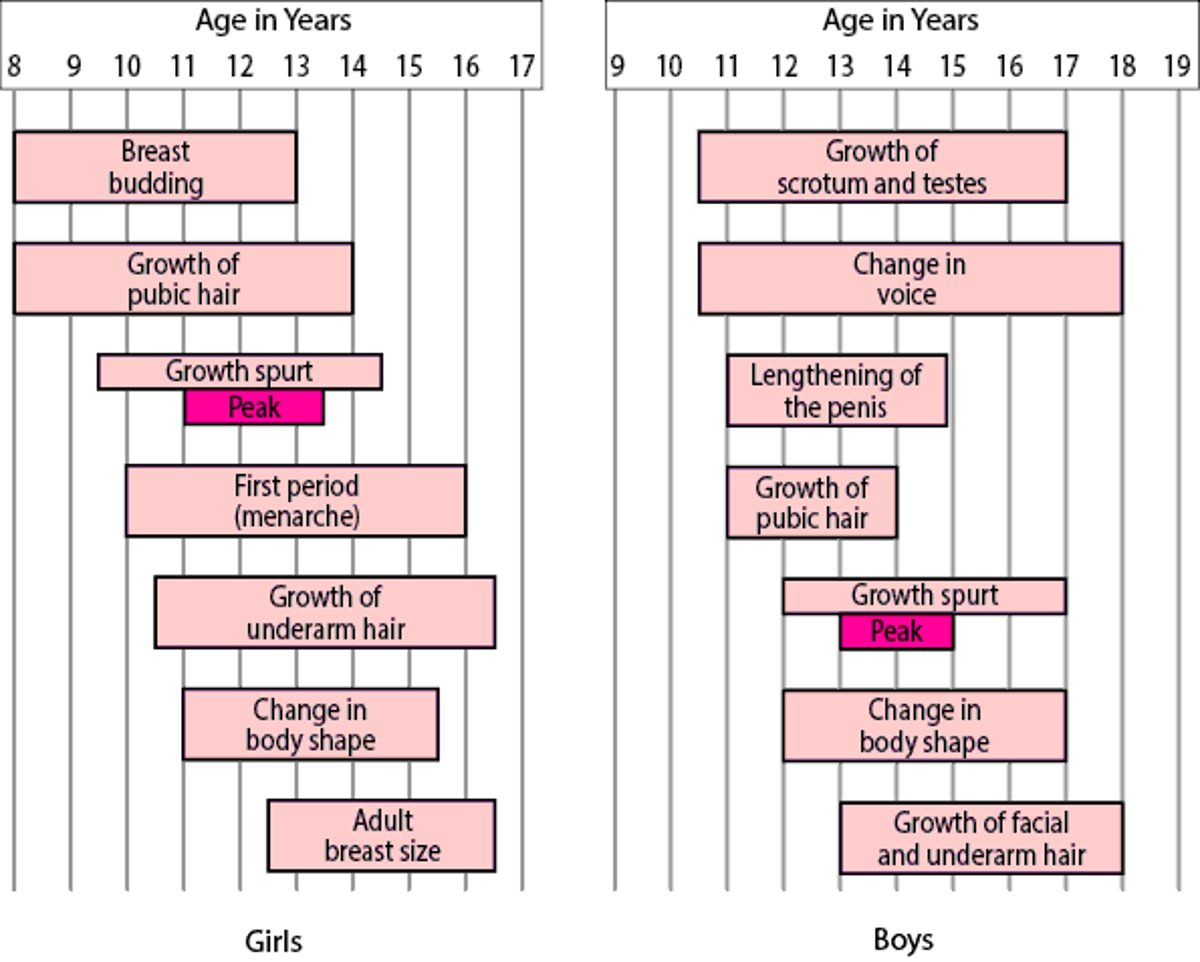
If sexual maturation begins too early (see Early Puberty) or is very delayed (see Delayed Puberty), doctors typically evaluate children for possible hormonal disorders.
More Information
The following English-language resource may be useful. Please note that THE MANUAL is not responsible for the content of this resource.
Centers for Disease Control and Prevention (CDC): Growth charts from the CDC for children and adolescents age 2 years and older in the United States


