





Early (precocious) puberty is sexual maturation that begins before the average age.
The cause of early puberty is often unknown, but it may be caused by structural abnormalities or tumors in the brain.
Symptoms include an early growth spurt and early development of pubic and underarm hair.
The diagnosis is based on x-rays, blood tests, and imaging tests.
Treatment depends on the type of precocious puberty but may include hormone therapy.
Normal Puberty
Puberty is a sequence of events in which physical changes occur, resulting in adult physical characteristics and the capacity to reproduce. Normally, these changes occur sequentially during puberty, resulting in sexual maturity.
The start of puberty takes place when the hypothalamus (the region of the brain that controls the pituitary gland) begins to secrete a chemical signal called gonadotropin-releasing hormone. The pituitary gland responds to this signal by releasing hormones called gonadotropins (luteinizing hormone and follicle-stimulating hormone), which stimulate the growth of the sex glands (the testes [testicles] in boys and the ovaries in girls). These sex glands secrete sex hormones, such as testosterone or estrogen, that cause puberty.
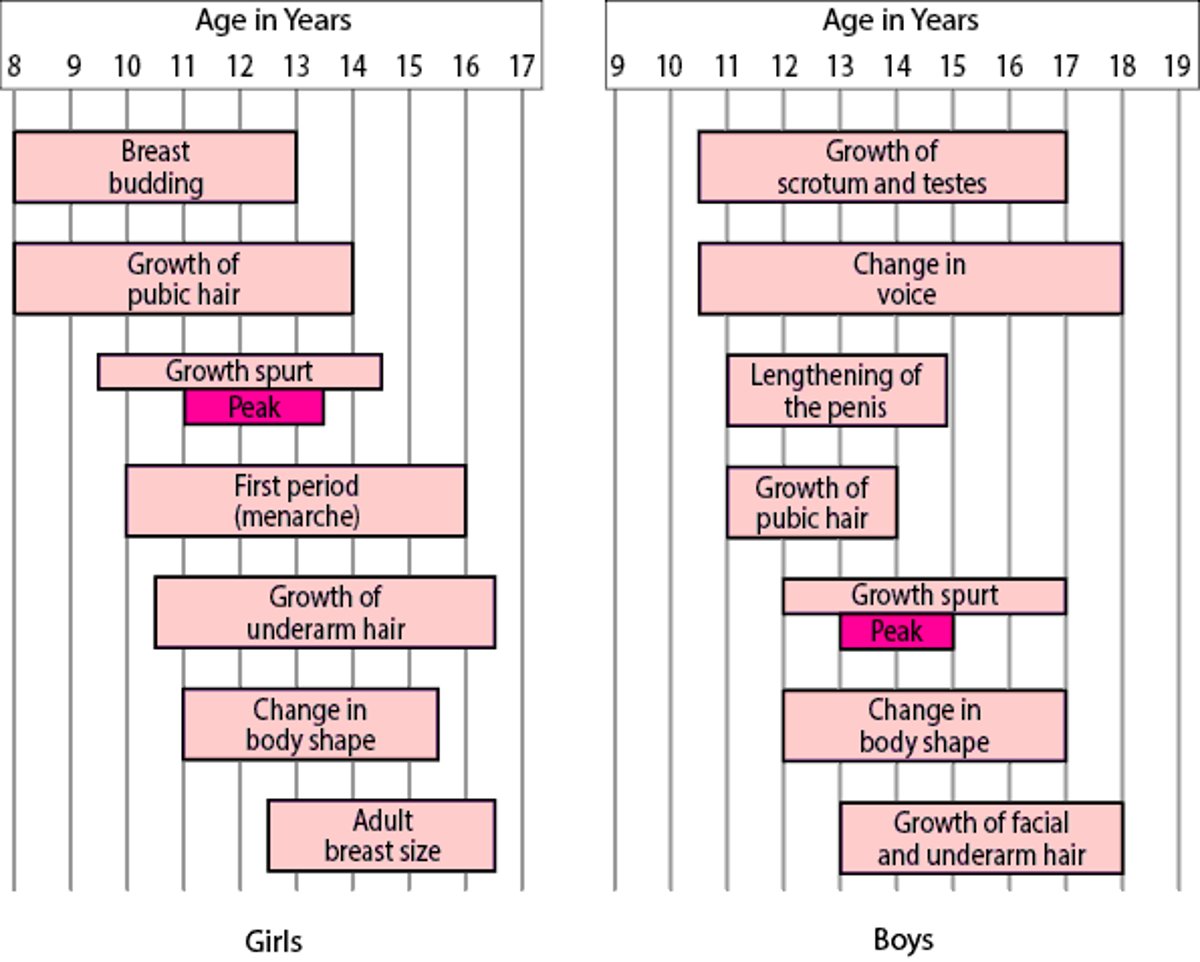
In boys, the first signs of puberty are enlargement of the testes and scrotum, followed by lengthening of the penis. Pubic and underarm hair (axillary hair) appear next. In boys, puberty usually begins between the ages of 9 years and 14 years (see Puberty in Boys).
In girls, the first change of puberty is usually the start of breast development (breast budding). Shortly afterward, pubic and underarm hair begin to grow. In girls, puberty usually begins between the ages of 8 years and 13 years (see Puberty in Girls).
Milestones in Sexual Development for Girls and Boys
During puberty, sexual development occurs in a set sequence. However, when the changes begin and how quickly they occur vary from person to person. For girls, puberty begins around age 8 to 13 years and lasts about 4 years. For boys, puberty begins around age 9 to 14 years and lasts about 4 to 6 years. The chart shows a typical sequence and normal range of development for the milestones of sexual development. |

In both sexes, around the time of puberty, the adrenal gland also begins to secrete hormones that lead to the appearance of pubic and underarm hair. These adrenal hormones are controlled by different chemical signals than the other puberty hormones.
In the United States, puberty seems to be occurring earlier than in the past, especially in girls. Additionally, breast development is increasingly occurring at younger ages, a trend that is reflecting the obesity epidemic, because a higher body mass index (BMI) is associated with earlier breast development. For girls, timing of puberty is also affected by race and ethnicity. Puberty begins earlier in Black and Hispanic girls compared to White girls.
Precocious Puberty
In precocious puberty, a child's body begins changing into an adult's body earlier than anticipated. The definition of precocious puberty has traditionally been before age 8 in girls or age 9 in boys. Precocious puberty is more common among some families.
There are three types of precocious puberty:
Central precocious puberty
Peripheral precocious puberty
Incomplete puberty
The causes and symptoms differ between the three types.
Central precocious puberty
This type of precocious puberty is more common overall and is 5 to 10 times more frequent in girls.
Puberty in this type is triggered by the early release of certain sex hormones (gonadotropins) from the pituitary gland. These hormones cause the ovaries or testes (the sex glands) to mature and enlarge. Once mature, the sex glands begin secreting other sex hormones, such as estrogen or testosterone, which triggers puberty. Physical changes are typically those of normal puberty for a child of that sex, except they begin at an earlier age.
Boys show enlargement of the testes, lengthening of the penis, and development of facial, underarm, and pubic hair, and they take on a masculine appearance.
Girls develop breasts and pubic hair and underarm hair and may begin to menstruate.
In both sexes, there is a growth spurt that leads to a rapid height increase. However, unlike in normal puberty, the rapid height increase in precocious puberty ends early so children are shorter as adults than would be expected.
Doctors do not usually find a cause for the early hormone release, particularly in girls, but sometimes it is caused by a tumor or other abnormality in the brain, typically in the pituitary gland or the hypothalamus (the region of the brain that controls the pituitary gland). Neurofibromatosis (a disorder where many fleshy growths of nerve tissue grow under the skin and in other parts of the body) and a few other rare disorders also have been linked to central precocious puberty. Severe, untreated hypothyroidism can cause central precocious puberty. Sometimes central precocious puberty is triggered by the use of treatments for certain disorders (such as surgery, radiation, or chemotherapy to treat cancer). Children who have family members with central precocious puberty are at increased risk of developing the disorder.
Peripheral precocious puberty
This type of precocious puberty is much less common. In peripheral precocious puberty, the release of estrogen or testosterone (and testosterone-like hormones called androgens) is not stimulated by gonadotropins from the pituitary gland. Instead, high levels of androgens or estrogen are produced by a tumor or other abnormality in the adrenal gland or in an immature testis or ovary. These hormones do not cause the testes or ovaries themselves to mature but do trigger the development of secondary sex characteristics.
Because boys and girls with peripheral precocious puberty may each produce estrogen or androgen, the physical changes of puberty depend on the hormone produced rather than the child's sex. Thus, tumors and abnormalities that produce estrogen result in growth of breast tissue in boys and girls, whereas those that produce androgens result in growth of pubic and underarm hair, adult body odor, and acne in boys and girls and, in boys, enlargement of the penis (but not the testes).
Incomplete puberty
Some children prematurely develop only a few signs of puberty. Typically they have premature breast development (thelarche) or premature pubic hair development (adrenarche) without any of the other changes of puberty such as growth of the testes or ovaries, menstruation, or a growth spurt. Some girls have breast development during the first 2 years of life, but they do not have elevated hormone levels. Children with early pubic hair development (typically between 6 years and 8 years of age) often have adult-like body odor and acne. Changes progress slowly.
These early physical changes are not caused by a disorder, and only a few children go on to develop actual precocious puberty. Early pubic hair development occurs because the adrenal gland increases the level of androgens it produces. However, levels of gonadotropins and estrogens are not increased with early pubic hair development.
Diagnosis of Early Puberty
X-rays of the hand and wrist
Blood tests
Possibly imaging of certain organs
Whenever a child has signs of premature, rapidly progressing, or disordered puberty, doctors take an x-ray of the hand and wrist to estimate bone maturity (called a bone age x-ray).
If x-rays show that a child’s bones have a more mature appearance than they should for a typical child of that age, a more complete evaluation usually is indicated. Blood tests are done to determine hormone levels.
For central precocious puberty, doctors may do magnetic resonance imaging (MRI) of the brain to check for tumors of the hypothalamus or pituitary gland. Doctors may do genetic testing in children who have family members who have central precocious puberty.
For peripheral precocious puberty, doctors may do ultrasonography of the pelvis and adrenal glands to check for ovarian or adrenal tumors.
Treatment of Early Puberty
Treatment of cause
Synthetic hormone therapy
Treatment of precocious puberty is usually not needed for children who have only premature pubic and underarm hair growth, but regular re-examination is needed to check for later development of precocious puberty. Children whose breast development began before age 2 are evaluated if breast growth remains past age 2.
Treating an identifiable cause of precocious puberty, such as removing a tumor or cyst, may stop the progression of puberty.
When no treatable cause is identified in central precocious puberty, drugs may slow the progression of puberty. The decision to give drugs depends on many factors, including the child's age, how fast puberty is progressing, how fast the child is growing, and how tall doctors think the child will be. The goals of drug treatment are to allow a child to grow to normal adult height and to relieve any anxiety the child feels due to developing sooner than peers.
Treatment options include synthetic hormone injections that stop the production of sex hormones. The injections are given monthly, every 3 months, or every 6 months. The hormones can also be given by an implant that is inserted under the skin every 12 months.
Peripheral precocious puberty can be stopped by drugs that block the action of the sex hormones.


