





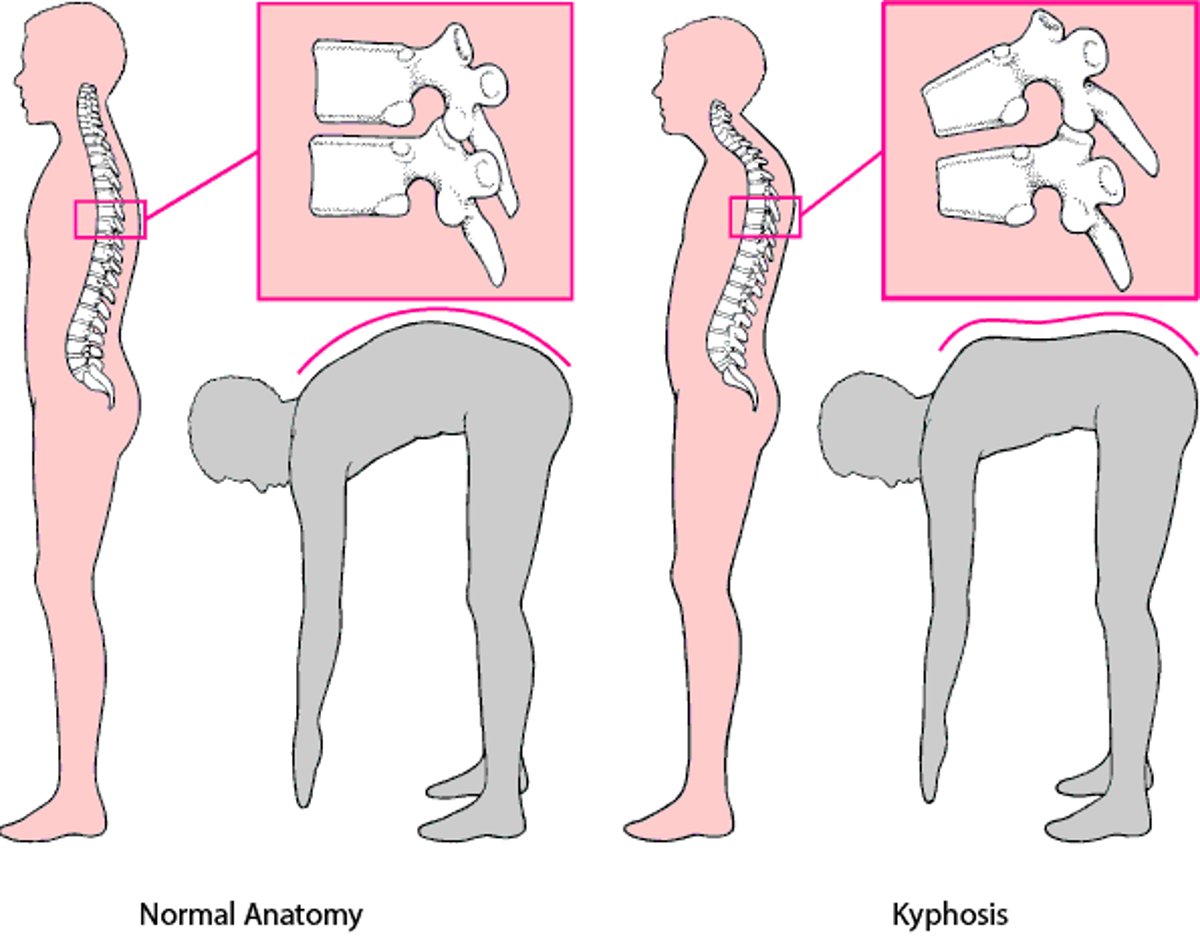
Kyphosis is an abnormal curving of the spine that causes a humpback.
(See also Overview of Bone Disorders in Children.)
The upper back normally curves forward somewhat. Some children have a greater degree of curvature. The excessive curvature may be
Flexible
Fixed (structural)
In flexible kyphosis, children can straighten the spine by tightening their muscles and the backbones (vertebrae) are normal. The cause is not known. Muscle-strengthening exercises may help, but no other specific treatment is needed.
In fixed kyphosis, children cannot straighten the spine because several of the vertebrae in the upper back are wedge-shaped rather than rectangular. Usually, 3 or more vertebrae are involved. Rarely, infants are born with fixed kyphosis, but it more commonly develops later in life, usually in adolescence. There are many rare causes, including fractures, infections, and cancer, but the most common cause is Scheuermann disease.
Kyphosis often causes no symptoms. Sometimes mild, persistent back pain develops. Kyphosis may be noticed only because it alters the body’s appearance. The shoulders may appear rounded. The upper spine may appear more curved than normal, or a hump may be visible. Some people have an appearance similar to those with Marfan syndrome, in whom the limbs are much longer than the trunk.
Mild kyphosis that does not cause symptoms is sometimes detected only during a routine physical examination. A doctor may confirm the diagnosis of kyphosis by taking x-rays of the spine.
Treatment of kyphosis is the same as described for Scheuermann disease.
Kyphosis: A Humpback

Scheuermann Disease
Scheuermann disease is the most common form of fixed kyphosis. It usually begins in adolescence, affecting boys slightly more often than girls. The cause of Scheuermann disease is unknown, but it sometimes runs in families. Scoliosis, a sideways curvature of the spine, also often develops in children with kyphosis (called kyphoscoliosis).
Scheuermann disease is an osteochondrosis, which is a group of disorders of the growth plate of bones that occur when the child is growing rapidly. Doctors are not sure what causes osteochondrosis, but the disorders do seem to run in families. Osgood-Schlatter disease, Legg-Calvé-Perthes disease, and Köhler bone disease are other osteochondroses.
Severe kyphosis is more likely to cause discomfort and sometimes can restrict chest motion, causing lung disease.
Scheuermann disease may be discovered at school during a routine screening for spinal problems. Doctors confirm the diagnosis of Scheuermann disease by taking x-rays of the spine. Sometimes magnetic resonance imaging (MRI) or computed tomography (CT) is done.
Treatment of Scheuermann Disease
Reducing weight-bearing and strenuous activities
Rarely a brace or surgery
Mild kyphosis can be treated by reducing weight-bearing stress and by avoiding strenuous activities. The spine may straighten slightly with treatment, although symptoms may not lessen. It is unclear whether treating mild kyphosis prevents the curve from worsening.
When kyphosis is more severe, treatment most often consists of wearing a spinal brace or sleeping on a rigid bed. Treatment may lessen symptoms and prevent the curve from worsening.
Rarely, despite treatment, kyphosis worsens to such an extent that surgery is needed to straighten the spine.


