Soft-tissue injuries include bumps and bruises (contusions) and small tears of muscles (strains) or of ligaments and tendons near joints (sprains)—see also Overview of Sprains and Other Soft-Tissue Injuries.
Contusions, mild strains, and mild sprains cause mild to moderate pain and swelling. The swelling can become discolored, turning purple after a day and becoming yellow or brown days later. The person usually can continue using the body part. People with more severe symptoms, such as deformity, an inability to walk or use an injured part, or severe pain, may have a complete separation of bones that were attached within a joint (dislocation), partial separation of bones that were attached within a joint (subluxation), fracture, severe sprain or strain, or other severe injury. People with severe symptoms usually need medical care to determine the nature of the injury.
First-Aid Treatment
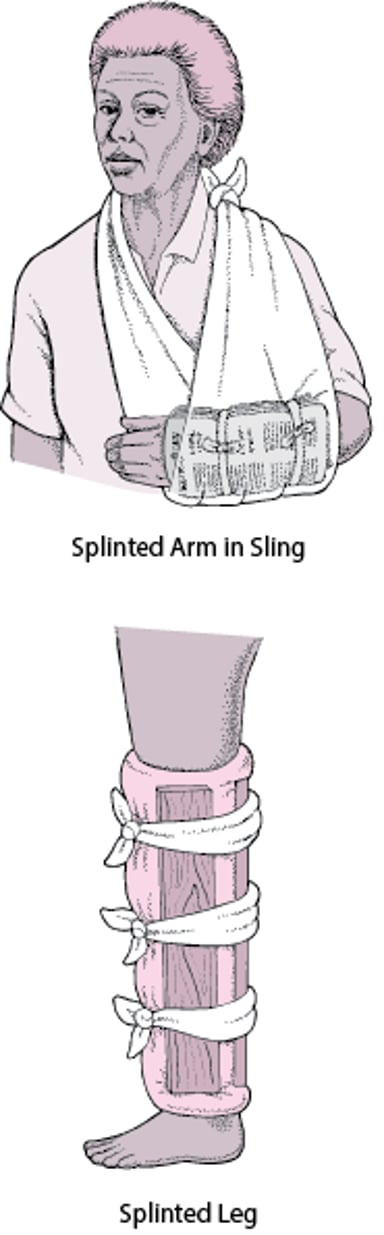
Contusions, mild strains, and mild sprains can be treated at home with protection rest, ice, compression, and elevation (PRICE), which speeds recovery and decreases pain and swelling. If a fracture, severe strain, severe sprain, subluxation (partial dislocation), or dislocation is a possibility, a splint should be applied until medical help is available.
Commonly Used Splints
A splint can be anything that prevents movement of a limb. A splint is used to prevent further damage and limit pain. To be effective, a splint must immobilize the joints above and below the injury. Splints can be made from readily available objects, such as a magazine or stack of newspapers. But splints usually consist of a rigid, straight object, such as a board, strapped to the limb. A sling may be used with a splint to support the forearm when an arm, a wrist, or a collarbone is injured. |