





Stasis dermatitis is inflammation, typically of the skin of the lower legs, caused by chronic edema. Symptoms are itching, scaling, and hyperpigmentation. Ulceration can be a complication. Diagnosis is clinical. Treatment is directed at the causes of edema and preventing ulceration.
(See also Definition of Dermatitis.)
Stasis dermatitis occurs in patients with chronic edema due to, for example, chronic venous insufficiency, right heart failure, or lymphedema. Increased capillary pressure with subsequent compromise of endothelial integrity in the microvasculature results in fibrin leakage, and disruption of the epithelial barrier function results in local inflammation. Stasis dermatitis occurs most commonly on the shins but can also affect other areas with chronic edema, such as the arms after radiation treatment of axillary lymph nodes.
Stasis dermatitis as well as chronic venous insufficiency and leg ulcers, which commonly accompany stasis dermatitis, are sometimes treated with various topical medications. Thus, contact dermatitis often complicates stasis dermatitis (1).
General reference
1. Erfurt-Berge C, Geier J, Mahler V: The current spectrum of contact sensitization in patients with chronic leg ulcers or stasis dermatitis: New data from the Information Network of Departments of Dermatology (IVDK). Contact Dermatitis 77(3):151–158, 2017. doi: 10.1111/cod.12763
Symptoms and Signs of Stasis Dermatitis
Manifestations typical of stasis dermatitis include pruritus, ill-defined erythema, scaling, and lichenification, most commonly on the shins. There are also plaques, often weeping and crusted, commonly with bacterial superinfection.
When chronic venous insufficiency is the cause, other manifestations usually include varicose veins, purpura jaune d'ocre (a yellow-brown discoloration due hemosiderin deposits in the dermis), and lipodermatosclerosis (sclerosis of subcutaneous fat caused by panniculitis, also called sclerosing panniculitis), giving the lower leg an inverted bowling pin shape with enlargement of the calf and narrowing at the ankle.
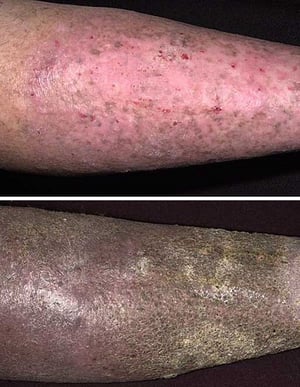
Images provided by Thomas Habif, MD.
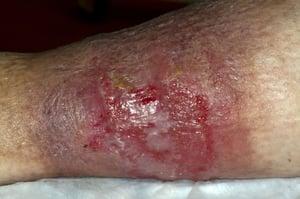
Roberto A. Penne-Casanova/SCIENCE PHOTO LIBRARY
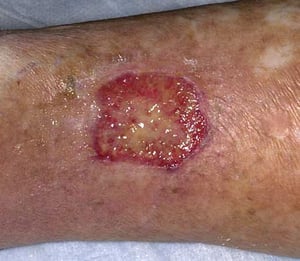
Image provided by Thomas Habif, MD.


Images provided by Thomas Habif, MD.


Roberto A. Penne-Casanova/SCIENCE PHOTO LIBRARY


Image provided by Thomas Habif, MD.
Diagnosis of Stasis Dermatitis
Clinical evaluation
Diagnosis of stasis dermatitis is clinical based on the characteristic appearance of the skin lesions and other signs of chronic leg swelling and venous insufficiency.
Consultation with a vascular specialist and testing (such as Doppler ultrasonography) may be needed.
Treatment of Stasis Dermatitis
Treatment of the causes of swelling
Compression and elevation
Treatment of complications (eg, secondary infection, allergic contact dermatitis, ulcers)
The cause of the chronic swelling should be corrected to the extent possible. Leg elevation and compression are often indicated. Chronic venous insufficiency should be treated.
an eroded (weeping) lesion, a hydrocolloid dressing may be best.
Ulcers see also Direct wound care). Ulcers in ambulatory patients may be healed with an Unna paste boot (zinc gelatin), a less messy zinc gelatin bandage, or a colloid dressing (all are available commercially). Colloid-type dressings used under elastic support are more effective than an Unna paste boot. It may be necessary to change the dressing every 2 or 3 days, but as edema recedes and the ulcer heals, once or twice/week is sufficient. After the ulcer heals, an elastic support should be applied before the patient rises in the morning. Regardless of the dressing used, reduction of edema (usually with compression) is paramount for healing.
Key Points
Stasis dermatitis results from chronic edema, most typically on the shins.
Signs include erythema, scaling, pruritus, and lichenification and may include weeping erosions and crusting.
Complications include secondary infections, ulcers, and contact sensitivities.
Elevation and compression are often required.


