





A hernia of the abdominal wall is a protrusion of the abdominal contents through an acquired or congenital area of weakness or defect in the wall. Many hernias are asymptomatic, but some become incarcerated or strangulated, causing pain and requiring immediate surgery. Diagnosis is clinical. Treatment is surgical repair.
(See also Acute Abdominal Pain.)
Abdominal hernias are extremely common, particularly among males, necessitating about 700,000 operations each year in the United States.
Classification of Abdominal Hernias
Abdominal hernias are classified as either
Abdominal wall hernias
Groin hernias
About 75% of all abdominal hernias are inguinal. Incisional hernias comprise another 10 to 15%. Femoral and unusual hernias account for the remaining 10 to 15%.
Strangulated hernias are ischemic because of physical constriction of their blood supply. Strangulation can result in bowel infarction, perforation, and peritonitis.
Abdominal wall hernias
Abdominal wall hernias include
Umbilical hernias
Epigastric hernias
Spigelian hernias
Incisional (ventral) hernias
Umbilical hernias (protrusions through the umbilical ring) are mostly congenital, but some are acquired in adulthood secondary to obesity, ascites, pregnancy, or chronic peritoneal dialysis.


Epigastric hernias occur through the linea alba.
Spigelian hernias occur through defects in the transversus abdominis muscle lateral to the rectus sheath, usually below the level of the umbilicus.
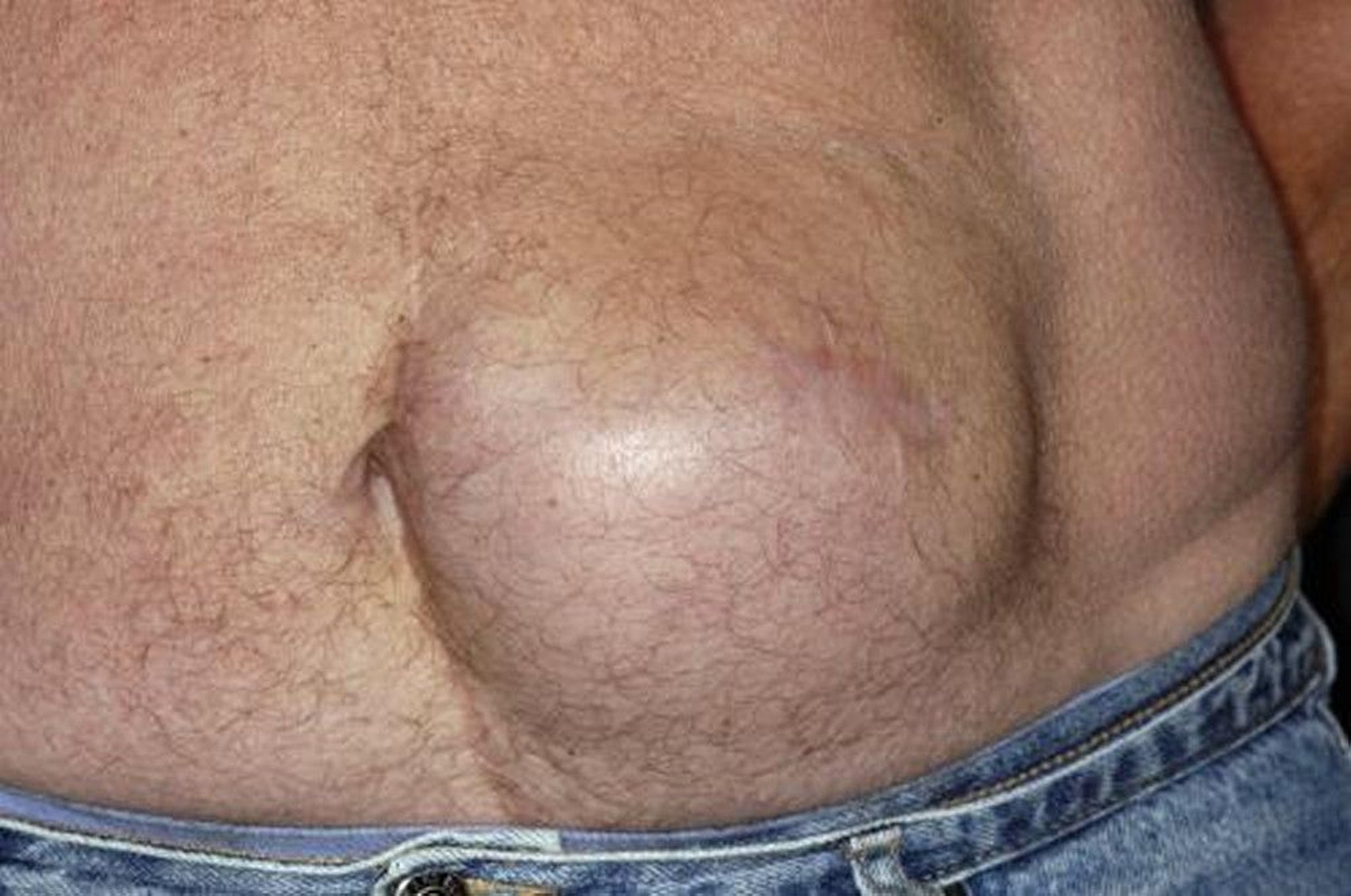
DR P. MARAZZI/SCIENCE PHOTO LIBRARY
Incisional hernias occur through an incision from previous abdominal surgery.
Groin hernias
Groin hernias include
Inguinal hernias
Femoral hernias
Inguinal hernias occur above the inguinal ligament. Indirect inguinal hernias traverse the internal inguinal ring into the inguinal canal, and direct inguinal hernias extend directly forward and do not pass through the inguinal canal. (See also Inguinal hernia in neonates.)

Femoral hernias occur below the inguinal ligament and go into the femoral canal.
Sports hernias
A sports hernia is not a true hernia because there is no abdominal wall defect through which abdominal contents protrude. Instead, the disorder involves a tear of one or more muscles, tendons, or ligaments in the lower abdomen or groin, particularly where they attach to the pubic bone. It is more appropriately termed athletic pubalgia.
Symptoms and Signs of Abdominal Wall Hernias
Most patients complain of only a visible bulge, which may cause vague discomfort or be asymptomatic. They can often reduce the hernia by pushing it back through the abdominal wall defect.
A strangulated hernia causes steady, gradually increasing pain, typically with nausea and vomiting. The hernia itself is tender, and the overlying skin may be erythematous; peritonitis may develop depending on location, with diffuse tenderness, guarding, and rebound.
Diagnosis of Abdominal Wall Hernias
Clinical evaluation
The diagnosis of an abdominal hernia is clinical. Because the hernia may be apparent only when abdominal pressure is increased, the patient should be examined in a standing position. If no hernia is palpable, the patient should cough or perform a Valsalva maneuver as the examiner palpates the abdominal wall. Examination is focused on the umbilicus, the inguinal area (with a finger in the inguinal canal in males), the femoral triangle, and any incisions that are present.
Most hernias, even large ones, can be manually reduced with persistent gentle pressure; placing the patient in the Trendelenburg position may help. An incarcerated hernia cannot be reduced and can be the cause of a bowel obstruction.
Inguinal masses that resemble hernias may be the result of adenopathy (infectious or malignant), an ectopic testis, or lipoma. These masses are solid and are not reducible. A scrotal mass may be a varicocele, hydrocele, or testicular tumor. Ultrasonography may be done if physical examination is equivocal.
Treatment of Abdominal Wall Hernias
Surgical repair
Groin hernias typically should be repaired electively because of the risk of strangulation, which results in higher morbidity (and possible mortality in older patients). Asymptomatic inguinal hernias in men can be observed; if symptoms develop, they can be repaired electively. Repair may be through a standard incision or laparoscopically.
An incarcerated or strangulated hernia of any kind requires urgent surgical repair.
Prognosis for Abdominal Wall Hernias
Congenital umbilical hernias rarely strangulate and are not treated; most resolve spontaneously within several years. Very large defects may be repaired electively after age 2 years.
Umbilical hernias in adults cause cosmetic concerns and can be electively repaired; strangulation and incarceration are unusual but can happen and usually contain omentum rather than intestine.


