





Benign liver tumors are relatively common. Most are asymptomatic, but some cause hepatomegaly, right upper quadrant discomfort, or intraperitoneal hemorrhage. Most are detected incidentally on ultrasound or other scans (see Imaging Tests of the Liver and Gallbladder). Liver tests are usually normal or only slightly abnormal. Diagnosis is usually possible with imaging tests but may require biopsy. Treatment is needed only in a few specific circumstances.
Hepatocellular Adenoma
Hepatocellular adenoma is the most important benign tumor to recognize. It occurs primarily in women of childbearing age, particularly those taking oral contraceptives, possibly via estrogen’s effects (1).
Most adenomas are asymptomatic, but large ones may cause right upper quadrant discomfort. Rarely, adenomas manifest as peritonitis and shock due to rupture and intraperitoneal hemorrhage. Rarely, they become malignant.
Diagnosis is often suspected based on ultrasound or CT results, but biopsy is sometimes needed for confirmation. Gadoxetate-enhanced MRI is more sensitive than CT and can differentiate subtypes of adenomas at increased risk of progressing to malignancy (2). Recognition of the beta-catenin subtype is particularly important, because it has a 5 to 10% risk of malignant transformation and should be resected.
Adenomas due to contraceptive use may regress if the contraceptive is stopped. If the adenoma does not regress or if it is subcapsular or > 5 cm, surgical resection is often recommended.
References
1. Marrero JA, Ahn J, Rajender Reddy K, et al: ACG clinical guideline: The diagnosis and management of focal liver lesions. Am J Gastroenterol 109(9):1328-1347, 2014. doi: 10.1038/ajg.2014.213
2. Bieze M , van den Esschert JW , Nio CY, et alAJR Am J Roentgenol 199:26– 34, 2012. doi: 10.2214/AJR.11.7750
Focal Nodular Hyperplasia
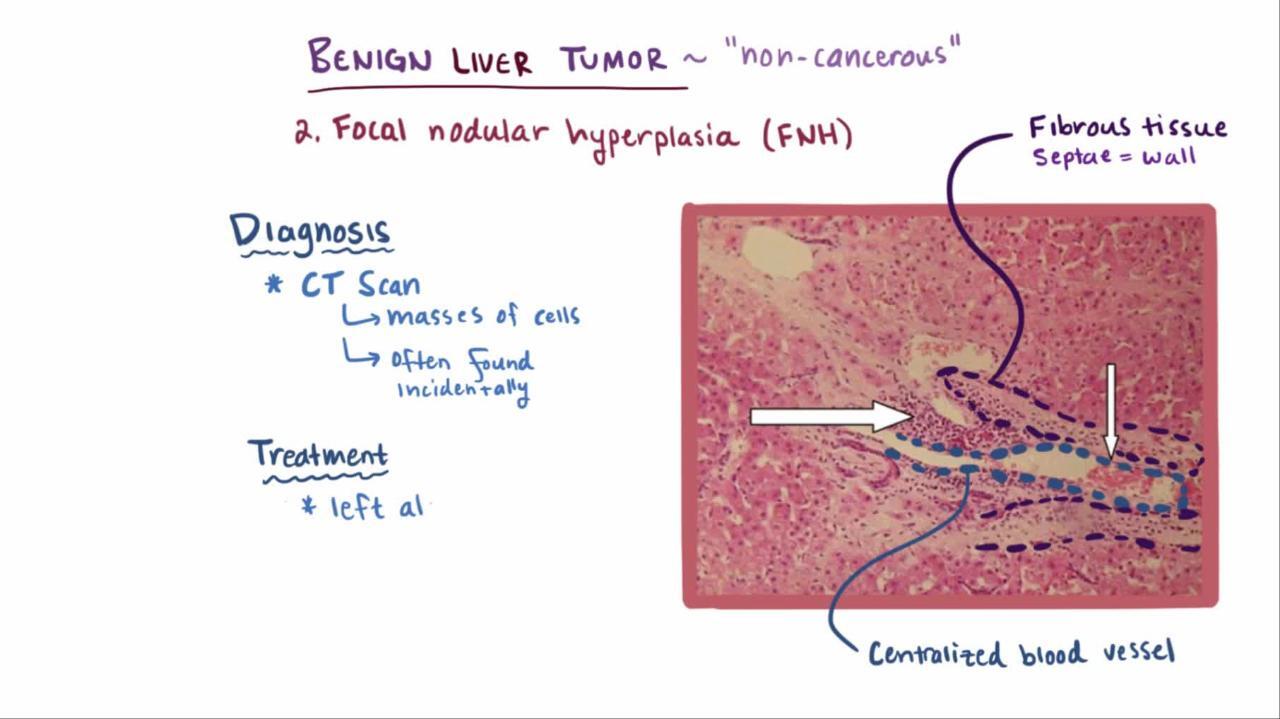
This localized hamartoma may resemble macronodular cirrhosis histologically. Diagnosis is usually based on MRI or CT with contrast; the classic appearance is a lesion with a central scar. But biopsy may be necessary for confirmation. Treatment is rarely needed.
Hemangiomas
Hemangiomas are usually small and asymptomatic; they occur in 1 to 5% of adults. Symptoms are more likely if they are > 4 cm; symptoms include discomfort, fullness, and, less often, anorexia, nausea, early satiety, and pain secondary to bleeding or thrombosis. These tumors often have a characteristic highly vascular appearance. Hemangiomas are found incidentally during ultrasonography, CT, or MRI. CT typically shows a well-demarcated, hypodense mass; when contrast is used, there is early peripheral enhancement, followed by later centrifugal enhancement. Treatment is usually not indicated. Resection can be considered if symptoms are troublesome or if a hemangioma is rapidly enlarging.
Other Benign Tumors
Lipomas (usually asymptomatic) and localized fibrous tumors (eg, fibromas) rarely occur in the liver.
Benign bile duct adenomas are rare, inconsequential, and usually detected incidentally. They are sometimes mistaken for metastatic cancer.


