





Cholelithiasis is the presence of one or more calculi (gallstones) in the gallbladder. Gallstones tend to be asymptomatic. The most common symptom is biliary colic; gallstones do not cause dyspepsia or fatty food intolerance. More serious complications include cholecystitis; biliary tract obstruction (by stones in the bile ducts [choledocholithiasis]), sometimes with infection (cholangitis); and gallstone pancreatitis. Diagnosis is usually by ultrasonography. If cholelithiasis causes symptoms or complications, cholecystectomy is necessary.
(See also Overview of Biliary Function.)
Risk factors for gallstones include female sex, obesity, increased age, American Indian ethnicity, a Western diet, rapid weight loss, and a family history. In the United States, gallstones are present in over 15% of those aged 60 to 75 (1). Most disorders of the biliary tract result from gallstones.
General reference
1. Everhart JE, Khare M, Hill M, et al: Prevalence and ethnic differences in gallbladder disease in the United States. Gastroenterology 117(3):632-639, 1999. doi: 10.1016/s0016-5085(99)70456-7
Pathophysiology of Cholelithiasis
Biliary sludge is often a precursor of gallstones. It consists of calcium bilirubinate (a polymer of bilirubin), cholesterol microcrystals, and mucin. Sludge develops during gallbladder stasis, as occurs during pregnancy or use of total parenteral nutrition. Most sludge is asymptomatic and disappears when the primary condition resolves. Alternatively, sludge can evolve into gallstones or migrate into the biliary tract, obstructing the ducts and leading to biliary colic, cholangitis, or pancreatitis.
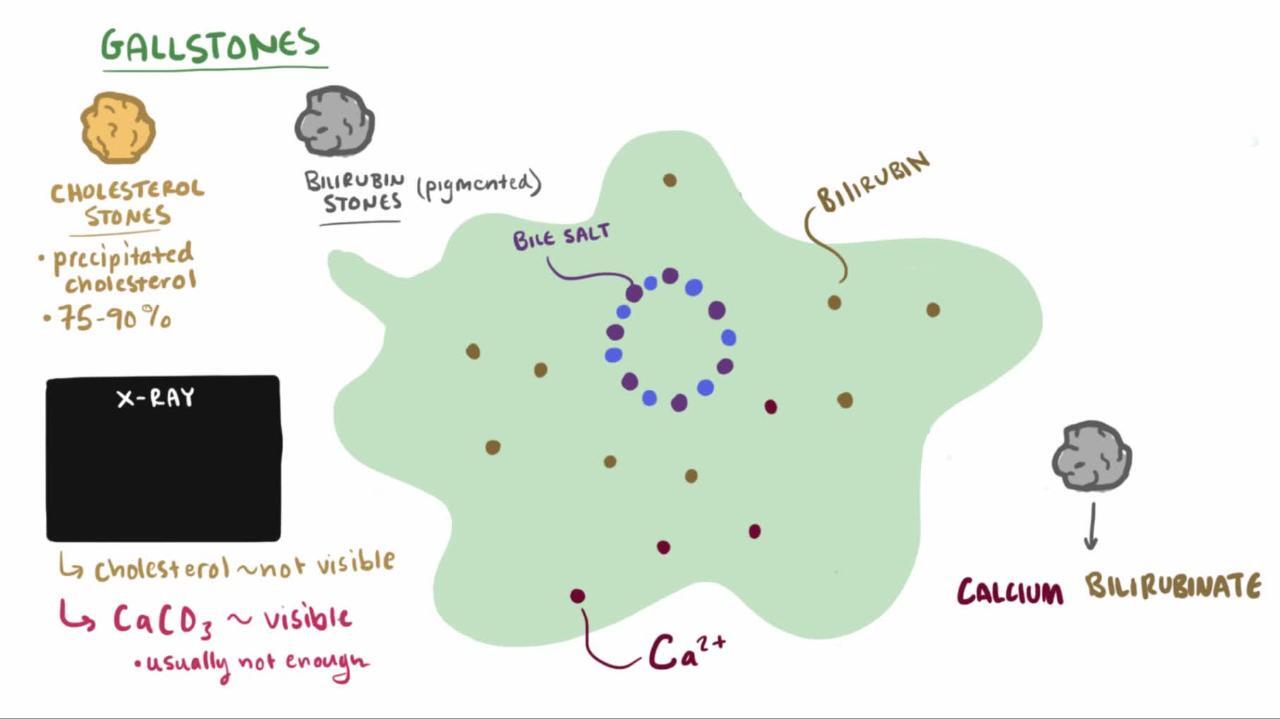
There are several types of gallstones.
Cholesterol stones account for > 85% of gallstones in the Western world (1). For cholesterol gallstones to form, the following is required:
Bile must be supersaturated with cholesterol. Normally, water-insoluble cholesterol is made water soluble by combining with bile salts and lecithin to form mixed micelles. Supersaturation of bile with cholesterol most commonly results from excessive cholesterol secretion (as occurs in obesity or diabetes) but may result from a decrease in bile salt secretion (eg, in cystic fibrosis because of bile salt malabsorption) or in lecithin secretion (eg, in a rare genetic disorder that causes a form of progressive intrahepatic familial cholestasis).
The excess cholesterol must precipitate from solution as solid microcrystals. Such precipitation in the gallbladder is accelerated by mucin, a glycoprotein, or other proteins in bile.
The microcrystals must aggregate and grow. This process is facilitated by the binding effect of mucin forming a scaffold and by retention of microcrystals in the gallbladder with impaired contractility due to excess cholesterol in bile.
Black pigment stones are small, hard gallstones composed of calcium (Ca) bilirubinate and inorganic Ca salts (eg, Ca carbonate, Ca phosphate). Factors that accelerate stone development include alcohol-related liver disease, chronic hemolysis, and older age.
Brown pigment stones are soft and greasy, consisting of bilirubinate and fatty acids (Ca palmitate or stearate). They form during infection, inflammation, and parasitic infestation (eg, liver flukes in Asia).
Gallstones grow at about 1 to 2 mm/year, taking 5 to 20 years before becoming large enough to cause problems. Most gallstones form within the gallbladder, but brown pigment stones form in the ducts. Gallstones may migrate to the bile duct after cholecystectomy or, particularly in the case of brown pigment stones, develop behind strictures as a result of stasis and infection.
Pathophysiology reference
1. European Association for the Study of the Liver (EASL): EASL Clinical Practice Guidelines on the prevention, diagnosis and treatment of gallstones. J Hepatol 65(1):146-181, 2016. doi: 10.1016/j.jhep.2016.03.005
Symptoms and Signs of Cholelithiasis
About 80% of people with gallstones are asymptomatic. The remainder have symptoms ranging from a characteristic type of pain (biliary colic) to cholecystitis to life-threatening cholangitis. Biliary colic is the most common symptom.
Stones occasionally traverse the cystic duct without causing symptoms. However, most gallstone migration leads to cystic duct obstruction, which, even if transient, causes biliary colic. Biliary colic characteristically begins in the right upper quadrant but may occur elsewhere in the abdomen. It is often poorly localized, particularly in diabetics and older patients. The pain may radiate into the back or down the arm.
Episodes begin suddenly, become intense within 15 minutes to 1 hour, remain at a steady intensity (not colicky) for up to 12 hours (usually < 6 hours), and then gradually disappear over 30 to 90 minutes, leaving a dull ache. The pain is usually severe enough to send patients to the emergency department for relief. Nausea and some vomiting are common, but fever and chills do not occur unless cholecystitis has developed. Mild right upper quadrant or epigastric tenderness may be present; peritoneal findings are absent. Between episodes, patients feel well.
Although biliary colic can follow a heavy meal, fatty food is not a specific precipitating factor. Nonspecific gastrointestinal symptoms, such as gas, bloating, and nausea, have been inaccurately ascribed to gallbladder disease. These symptoms are common, having about equal prevalence in cholelithiasis, peptic ulcer disease, and functional gastrointestinal disorders.
Pearls & Pitfalls
|
Little correlation exists between the severity and frequency of biliary colic and pathologic changes in the gallbladder. Biliary colic can occur in the absence of cholecystitis. If colic lasts > 12 hours, particularly if it is accompanied by vomiting or fever, acute cholecystitis or pancreatitis is likely.
Diagnosis of Cholelithiasis
Ultrasonography
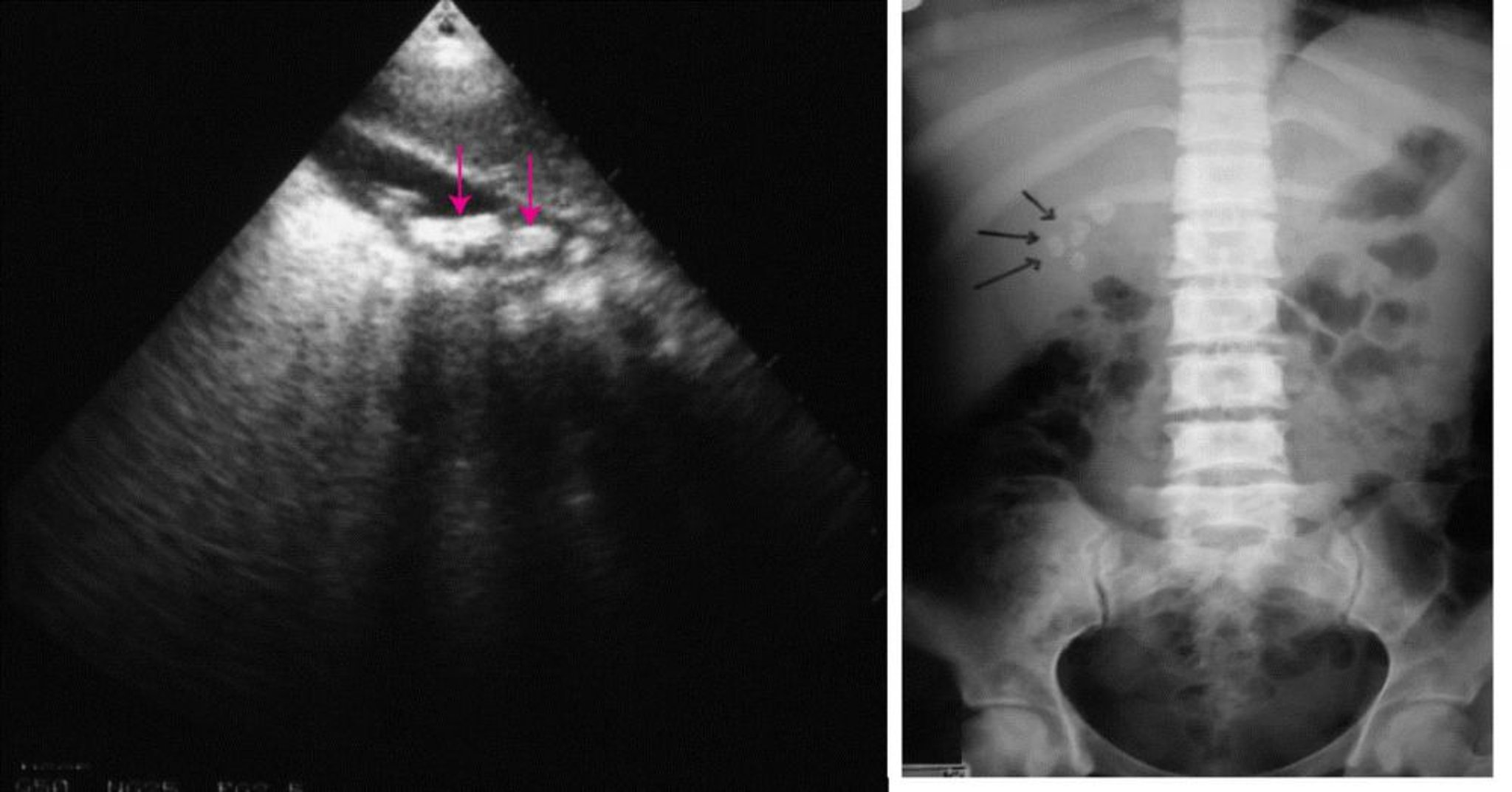
Gallstones are suspected in patients with biliary colic. Abdominal ultrasonography is the imaging test of choice for detecting gallbladder stones; sensitivity and specificity are 95%. Ultrasonography also accurately detects sludge. CT and MRI are alternatives. Endoscopic ultrasonography accurately detects small gallstones (< 3 mm) and may be needed if other tests are equivocal.

© Springer Science+Business Media
Laboratory tests usually are not helpful; typically, results are normal unless complications develop.
Asymptomatic gallstones and biliary sludge are often detected incidentally when imaging, usually ultrasonography, is done for other reasons. About 10 to 15% of gallstones are calcified and visible on plain x-rays.
Treatment of Cholelithiasis
For asymptomatic stones: Expectant management
Most asymptomatic patients decide that the discomfort, expense, and risk of elective surgery are not worth removing an organ that may never cause clinical illness. However, if symptoms occur, gallbladder removal (cholecystectomy) is indicated because pain is likely to recur and serious complications can develop.
Surgery
Surgery can be done with an open or a laparoscopic technique.
Open cholecystectomy, which involves a large abdominal incision and direct exploration, is safe and effective. Its overall mortality rate is about 0.1% when done electively during a period free of complications.
Laparoscopic cholecystectomy is the treatment of choice. Using video endoscopy and instrumentation through small abdominal incisions, the procedure is less invasive than open cholecystectomy. The result is a much shorter convalescence, decreased postoperative discomfort, improved cosmetic results, yet no increase in morbidity or mortality. Laparoscopic cholecystectomy is converted to an open procedure in 4 to 8% (1) of patients, usually because biliary anatomy cannot be identified or a complication cannot be managed. Older age typically increases the risks of any type of surgery.
Cholecystectomy effectively prevents future biliary colic but is less effective for preventing atypical symptoms such as dyspepsia. Cholecystectomy does not result in nutritional problems or a need for dietary limitations. Some patients develop diarrhea, often because bile salt malabsorption in the ileum is unmasked. Prophylactic cholecystectomy is warranted in asymptomatic patients with cholelithiasis only if they have large gallstones (> 3 cm) or a calcified gallbladder (porcelain gallbladder); these conditions increase the risk of gallbladder carcinoma.
Stone dissolution
For patients who decline surgery or who are at high surgical risk (eg, because of concomitant medical disorders or advanced age), gallbladder stones can sometimes be dissolved by ingesting bile acids orally for many months. The best candidates for this treatment are those with small, radiolucent stones (more likely to be composed of cholesterol) in a functioning nonobstructed gallbladder (indicated by normal filling detected during cholescintigraphy or by absence of stones in the gallbladder neck).
< 0.5 cm in diameter within 6 months (2
Stone fragmentation (extracorporeal shock wave lithotripsy) to assist stone dissolution and clearance is rarely done.
Treatment references
1. European Association for the Study of the Liver (EASL): EASL Clinical Practice Guidelines on the prevention, diagnosis and treatment of gallstones. J Hepatol 65(1):146-181, 2016. doi: 10.1016/j.jhep.2016.03.005
2. Portincasa P, Di Ciaula A, Bonfrate L, et al: Therapy of gallstone disease: What it was, what it is, what it will be. World J Gastrointest Pharmacol Ther 3(2):7-20, 2012. doi: 10.4292/wjgpt.v3.i2.7
Prognosis for Cholelithiasis
Patients with asymptomatic gallstones become symptomatic at a rate of about 2% per year (1). The symptom that develops most commonly is biliary colic rather than a major biliary complication. Once biliary symptoms begin, they are likely to recur; pain returns in 20 to 40% of patients per year, and about 1 to 2% of patients per year develop complications such as cholecystitis, choledocholithiasis, cholangitis, and gallstone pancreatitis (2).
Prognosis references
1. European Association for the Study of the Liver (EASL): EASL Clinical Practice Guidelines on the prevention, diagnosis and treatment of gallstones. J Hepatol 65(1):146-181, 2016. doi: 10.1016/j.jhep.2016.03.005
2. Friedman GD, Raviola CA, Fireman B: Prognosis of gallstones with mild or no symptoms: 25 years of follow-up in a health maintenance organization. J Clin Epidemiol 1989;42(2):127-36. doi: 10.1016/0895-4356(89)90086-3
Key Points
Gallstones are common, but 80% are asymptomatic.
Abdominal ultrasonography is 95% sensitive and specific for detecting gallbladder stones.
Once symptoms develop (usually biliary colic), pain returns in 20 to 40% of patients/year.
Treat most patients who have symptomatic gallstones with laparoscopic cholecystectomy.


