Patients & CaregiversHealthcare ProfessionalsWorldwide
HomeAbout MerckProductsNewsroomInvestor RelationsCareersResearchLicensingThe Merck Manuals
THE MERCK MANUAL MEDICAL LIBRARY: The Merck Manual of Diagnosis and Therapy
Tips for better results
ABCDEFGHI
JKLMNOPQR
STUVWXYZ
In This Topic
Introduction
Back to Top

Section

Subject

Topics

Introduction

Update Me

(See also Tumors of the Head and Neck: Otic Tumors)

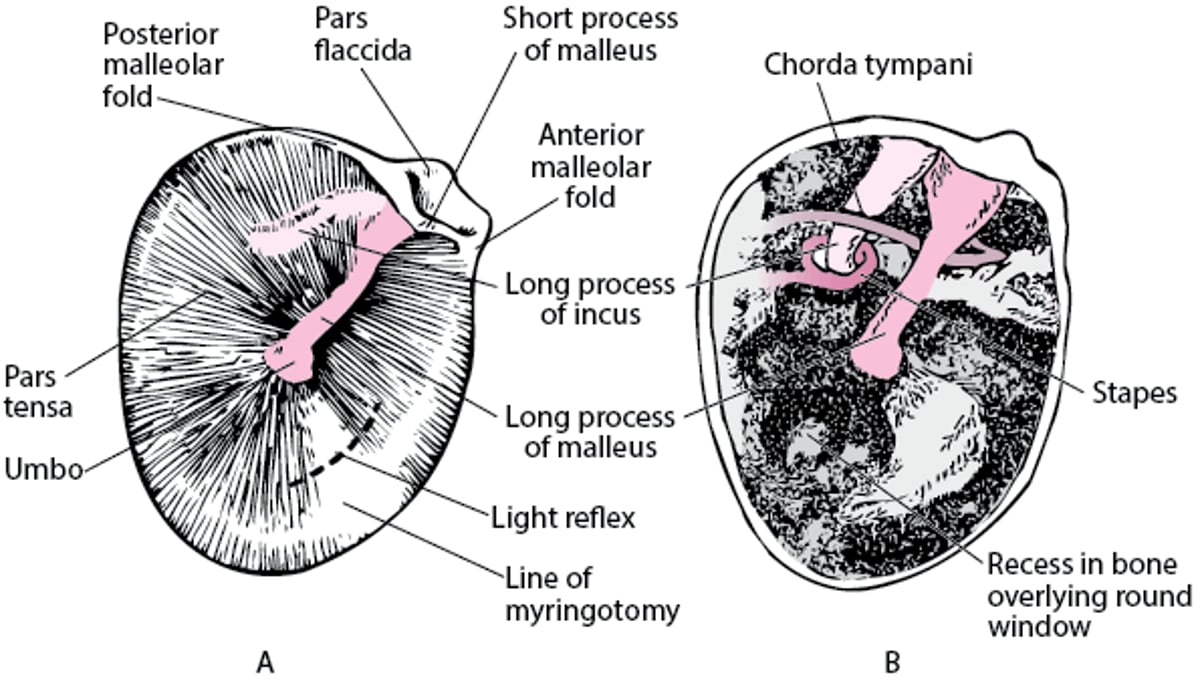
Middle ear disorders may be secondary to infection, eustachian tube obstruction, or trauma. Information about objects placed in the ear and symptoms such as rhinorrhea, nasal obstruction, sore throat, URI, allergies, headache, systemic symptoms, and fever aid diagnosis. The appearance of the external auditory canal and tympanic membrane (see Fig. 1: Middle Ear and Tympanic Membrane Disorders: Tympanic membrane of right ear (A); tympanic cavity with tympanic membrane removed (B).Figures) often yields a diagnosis. The nose, nasopharynx, and oropharynx are examined for signs of infection and allergy and for evidence of tumors. Middle ear function is evaluated with use of pneumatic otoscopy, Weber's tuning fork test and the Rinne tuning fork test, tympanometry, and audiologic tests (see Hearing Loss: Physical examination).
Fig. 1

Tympanic membrane of right ear (A); tympanic cavity with tympanic membrane removed (B).

Tympanic membrane of right ear (A); tympanic cavity with tympanic membrane removed (B).

Last full review/revision February 2008 by Richard T. Miyamoto, MD

Content last modified February 2008

Back to Top

Next: Mastoiditis

Audio
Figures
Photographs
Tables
Videos
Contact UsSite MapAccessibility StatementPrivacy PolicyTerms of UseCopyright 1995-2009 Merck & Co., Inc.