





Keratoconjunctivitis sicca is chronic, bilateral desiccation of the conjunctiva and cornea due to an inadequate tear film. Symptoms include itching, burning, irritation, and photophobia. Diagnosis is clinical; the Schirmer test may be helpful. Treatment is with topical tear supplements and sometimes blockage of the nasolacrimal openings.
Etiology of Keratoconjunctivitis Sicca
The conjunctival and corneal surface epithelial cells need to be hydrated. If there is interruption of a continuous, unbroken layer of tears over the exposed surface, desiccation of surface cells leads to tissue damage and inflammation.
There are 2 main types:
Aqueous tear-deficient keratoconjunctivitis sicca is caused by insufficient coverage of the ocular surface by tears due to inadequate tear volume.
Evaporative keratoconjunctivitis sicca (more common) is caused by insufficient coverage of the ocular surface by tears due to accelerated tear evaporation resulting from poor tear quality.
Aqueous tear-deficient keratoconjunctivitis sicca is most commonly an isolated idiopathic condition in postmenopausal women. It is also commonly part of Sjögren syndrome, rheumatoid arthritis (RA), or systemic lupus erythematosus (SLE or lupus). Less commonly, it is secondary to other conditions that scar the lacrimal ducts (eg, cicatricial pemphigoid, Stevens-Johnson syndrome, and trachoma). It may result from a damaged or malfunctioning lacrimal gland due to graft-vs-host disease, HIV (diffuse infiltrative lymphocytosis syndrome), local radiation therapy, or familial dysautonomia.
Evaporative keratoconjunctivitis sicca is caused by loss of the tear film due to abnormally rapid evaporation caused by an inadequate oil layer on the surface of the aqueous layer of tears. Symptoms may result from abnormal oil quality (ie, meibomian gland dysfunction) or a degraded normal oil layer (ie, seborrheic blepharitis). Patients frequently have acne rosacea.
Drying can also result from exposure due to inadequate eye closure at night (nocturnal lagophthalmos or Bell or facial nerve palsy) or from inadequate frequency of reapplication of tears to the cornea due to an insufficient blink rate (eg, in Parkinson disease).
Systemic drugs can cause or aggravate dry eyes. Different classes of drugs contribute to different types of dry eye, as in the following examples:
Aqueous tear-deficient dry eyes: Diuretics, anticholinergics, antidepressants, beta-blockers, decongestants, oral contraceptives
Dry eyes due to poor eyelid closure: Major antipsychotics, adrenergic agonists, botulinum toxin injections
Symptoms and Signs of Keratoconjunctivitis Sicca
Patients report itching; burning; a gritty, pulling, or foreign body sensation; or photosensitivity. A sharp stabbing pain, eye strain or fatigue, and blurred vision may also occur. Some patients note a flood of tears after severe irritation. Typically, symptoms fluctuate in intensity and are intermittent. Certain factors can worsen symptoms:
Prolonged visual efforts (eg, reading, working on the computer, driving, watching television)
Local environments that are dry, windy, dusty, or smoky
Dehydration
Symptoms lessen on cool, rainy, or foggy days or in other high-humidity environments, such as in the shower. Recurrent and prolonged blurring and frequent intense irritation can impair daily function. However, permanent impairment of vision is rare.
With both types, the conjunctiva is hyperemic, and there is often scattered, fine, punctate loss of corneal epithelium (superficial punctate keratitis
With the aqueous tear-deficient type, the conjunctiva can appear dry and lusterless with redundant folds. With the evaporative type, abundant tears may be present as well as foam at the eyelid margin. Very rarely, severe, advanced, chronic drying leads to significant vision loss due to keratinization of the ocular surface or loss of corneal epithelium, leading to sequelae such as scarring, neovascularization, infections, ulceration, and perforation.
Diagnosis of Keratoconjunctivitis Sicca
Schirmer test and tear breakup test (TBUT)
Diagnosis is based on characteristic symptoms and clinical appearance. The Schirmer test and tear breakup time (TBUT) may differentiate type. Both tests are done before instilling drops of any kind.
The Schirmer test determines whether tear production is normal. After blotting the closed eye to remove excess tears, a strip of filter paper is placed, without topical anesthesia, at the junction of the middle and lateral third of the lower eyelid. If < 5.5 mm of wetting occurs after 5 minutes on 2 successive occasions, the patient has aqueous tear-deficient keratoconjunctivitis sicca. With evaporative keratoconjunctivitis sicca, the Schirmer test is usually normal.
To determine the tear breakup time, the tear film is first made visible under cobalt blue light at the slit lamp< 10 seconds) is characteristic of evaporative keratoconjunctivitis sicca.
If aqueous tear-deficient keratoconjunctivitis sicca is diagnosed, Sjögren syndrome should be suspected, especially if xerostomia is also present. Serologic tests and labial salivary gland biopsy are used for diagnosis. Patients with primary or secondary Sjögren syndrome are at increased risk of several serious diseases (eg, primary biliary cholangitis, non-Hodgkin lymphoma). Therefore, proper evaluation and monitoring are essential.
Several newer tests are being developed to help diagnose keratoconjunctivitis sicca. These include instruments for imaging the eyelid oil glands and measuring the quality of the tear lipid layer and tear osmolarity. Results can vary (eg, from day to day) and may correlate poorly with clinical findings. Also, an office test for ocular surface inflammation (that measures the increased matrix metalloproteinase-9 in tears) is now available. The clinical application of these tests is still uncertain.
Treatment of Keratoconjunctivitis Sicca
Sometimes occlusion of nasolacrimal punctum or tarsorrhaphy
Staying hydrated, using humidifiers, and avoiding dry, drafty environments can often help. Not smoking and avoiding secondary smoke are important. Most evidence shows that neither diet nor supplements, such as omega-3 fatty acid, improve dry eye disease.
In recalcitrant cases, occlusion of the nasolacrimal punctum may be indicated. In severe cases, a partial tarsorrhaphy can reduce tear loss through evaporation.
Natural tear volume can be augmented by a device that uses soft-tip probes placed into the nose several times a day to apply electrical impulses to stimulate tear production or by applying a nasal spray twice a day that contains a highly selective cholinergic agonist that binds to cholinergic receptors with high affinity, activating the trigeminal parasympathetic pathway to stimulate tear production.

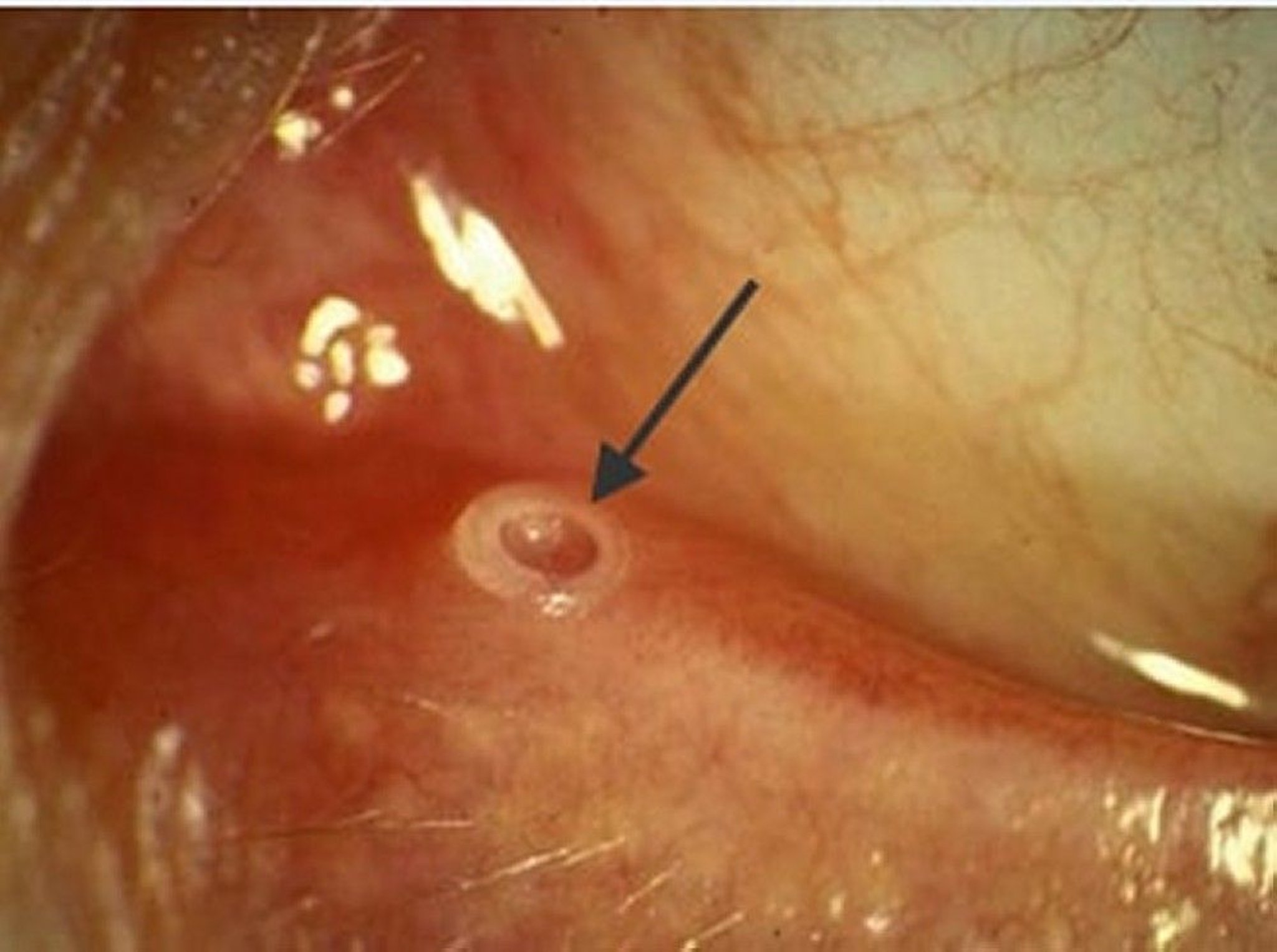
© Springer Science+Business Media
Patients with evaporative keratoconjunctivitis sicca often benefit from treatment of concomitant blepharitis and associated acne rosacea with measures such as the following:
Because of the variability of symptoms, validated questionnaires can help monitor response to therapy.
Key Points
Keratoconjunctivitis sicca is chronic, bilateral desiccation of the conjunctiva and cornea caused by too little tear production or accelerated tear evaporation.
Typical symptoms include intermittent itching; burning; blurring, a gritty, pulling, or foreign body sensation; and photosensitivity.
Findings include conjunctival hyperemia and often scattered, fine, punctate loss of corneal epithelium (superficial punctate keratitis) and conjunctival epithelium.
The Schirmer test and tear breakup test may help determine whether the cause is deficient tear production or accelerated tear evaporation.
Treatment of concomitant blepharitis is often beneficial.


