





Corneal transplantations are done for several reasons:
To reconstruct the cornea (eg, replacing a perforated cornea)
To relieve intractable pain (eg, severe foreign body sensation due to recurrent ruptured bullae in bullous keratopathy)
To treat a disorder unresponsive to medical management (eg, severe, uncontrolled fungal corneal ulcer)
To improve the optical qualities of the cornea and thus improve vision (eg, replacing a cornea that is scarred after a corneal ulcer, is clouded because of edema as occurs in Fuchs dystrophy or after cataract surgery, is opaque because of deposits of nontransparent abnormal corneal stromal proteins as occurs in hereditary corneal stromal dystrophy, or has irregular astigmatism as occurs with keratoconus)
Indications
The most common indications are the following:
Bullous keratopathy (pseudophakic or aphakic, Fuchs endothelial dystrophy)
Repeat graft
Keratitis or postkeratitis (caused by viral, bacterial, fungal, or Acanthamoeba infection or perforation)
Corneal stromal dystrophies
Procedure
Tissue matching is not routinely done. Cadaveric donor tissue can be used unless the donor is suspected of having a communicable disease.
Corneal transplantation can be done using general anesthesia or local anesthesia plus IV sedation.
Topical antibiotics are used for several weeks postoperatively and topical corticosteroids for several months. To protect the eye from inadvertent trauma after transplantation, the patient wears shields, glasses, or sunglasses.

RALPH C. EAGLE, JR./SCIENCE PHOTO LIBRARY
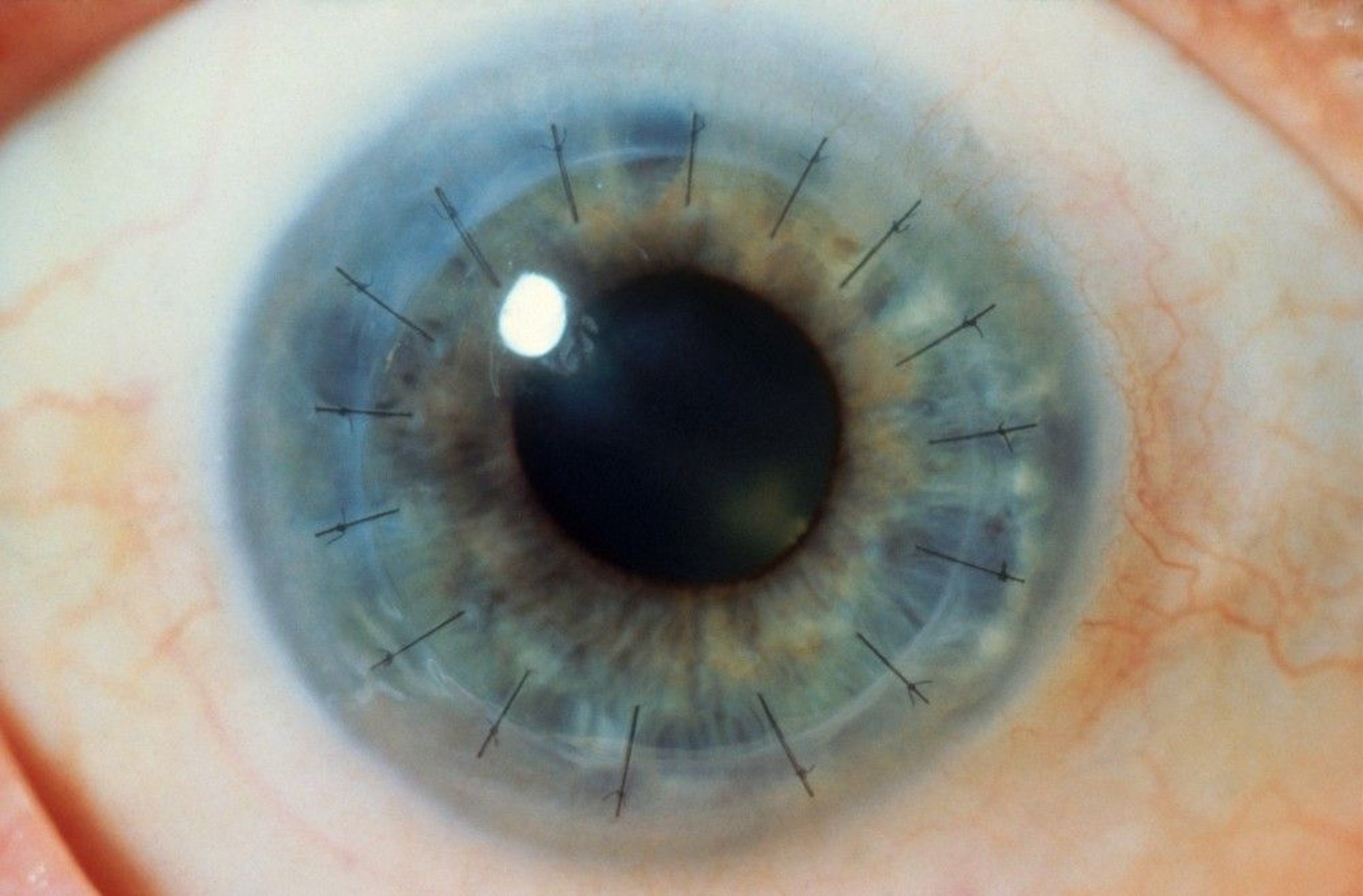
If transplantation involves the full thickness of the cornea (as in penetrating keratoplasty, or PKP), achievement of full visual potential may take up to 18 months because of changing refraction with wound healing and after suture removal.
For corneal disease limited to the corneal stroma and well-functioning endothelium, such as keratoconus, in a corneal transplant technique known as deep anterior lamellar keratoplasty (DALK) the donated corneal tissue replaces the corneal stroma and epithelium only. The surgery is more technically difficult, and the procedure takes more time to perform than a full-thickness corneal transplant.
Only the corneal endothelium needs to be transplanted in diseases where the corneal stroma is clear, has a smooth stromal surface with a regular curvature, and only the corneal endothelium is not functioning well (eg, Fuchs dystrophy, bullous keratopathy resulting from cataract surgery). In corneal endothelium transplantation, there are 2 techniques: Descemet stripping endothelial keratoplasty (DSEK) and the newest technique, Descemet membrane endothelial keratoplasty (DMEK). DMEK uses a thinner graft than DSEK and has superior results (eg, faster healing, fewer rejections, and better visual acuity) compared to both DSEK and full-thickness corneal transplantation. However, DMEK is a more difficult technique and more frequently requires additional surgery to correct complications (eg, repositioning a graft that has slipped out of position).
In patients with Fuchs corneal dystrophy involving the central cornea only, another corneal transplant technique called Descemet stripping only (DSO, not a true transplant because nothing is transplanted) has been used. The central corneal endothelium is removed, and the use of topical rho kinase inhibitors speeds the migration of peripheral corneal endothelium cells to fill the defect. The migrated cells reduce the corneal stromal edema and vision improves. There is less concern for rupturing of the globe with minor trauma because the incision is so small. The corneal edema does not clear in everyone. In that case, a DMEK or DSEK can be done.
Complications
Complications include the following:
Graft rejection
Infection (intraocular and corneal)
Wound leak
Graft failure
High refractive error (especially astigmatism, myopia, or both)
Recurrence of disease (with herpes simplex or hereditary corneal stromal dystrophy)
Because no foreign endothelium is transplanted in DSO, there is no risk of rejection. Graft rejection rates for penetrating keratoplasty are usually < 10% (eg, in patients with early bullous keratopathy), but they may be up to 68% in higher-risk patients (eg, those with chemical injury). Rejection rates are lower for DSEK than penetrating keratoplasty and even lower for DMEK at 1 to 3%.
Prognosis for Corneal Transplantation
The chance of long-term transplant success is
> 90% for keratoconus, traumatic corneal scars, early bullous keratopathy, or hereditary corneal stromal dystrophies
80 to 90% for more advanced bullous keratopathy or inactive viral keratitis
50% for active corneal infection
0 to 50% for chemical or radiation injury
Use of a rigid corneal lens can result in earlier and better vision for many patients who have had penetrating keratoplasty. Maximum improvement in vision usually occurs after 6 months in DSEK and 2 months in DMEK. 20/20 vision is more common with DMEK than with DSEK.
The generally high rate of success of corneal transplantation is attributable to many factors, including the avascularity of the cornea and the fact that the anterior chamber has venous drainage but no lymphatic drainage. These conditions promote low-zone tolerance (an immunologic tolerance that results from constant exposure to low doses of an antigen) and a process termed anterior chamber–associated immune deviation, in which there is active suppression of intraocular lymphocytes and delayed-type hypersensitivity to transplanted intraocular antigens. Another important factor is the effectiveness of the corticosteroids used topically, locally, and systemically to treat graft rejection.
Corneal Limbal Stem Cell Transplantation
Corneal limbal stem cell transplantation surgically replaces critical stem cells at the limbus (the area where the conjunctiva meets the cornea). Host stem cells normally reside in this area. Transplantation is done when the host stem cells have been too severely damaged to recover from disease or injury.
Conditions such as severe chemical burns, Stevens-Johnson syndrome, and severe damage caused by chronic contact lens overwear may cause persistent nonhealing corneal epithelial defects. These defects result from failure of corneal epithelial stem cells to produce sufficient epithelial cells to repopulate the cornea. If untreated, persistent nonhealing corneal epithelial defects are vulnerable to infection, which can lead to scarring, perforation, or both. Under these circumstances, a corneal transplant, which replaces only the central cornea and not the limbus, is insufficient. Stem cells are needed to produce new surface epithelium cells that will repopulate the cornea, restoring the regenerative capacity of the ocular surface.
Corneal limbal stem cells can be transplanted from the patient’s own healthy eye or from a cadaveric donor eye. The patient’s damaged corneal epithelial stem cells are removed by a partial-thickness dissection of the limbus (ie, all the epithelium and the superficial stroma of the limbus). Donor limbal tissue, which is prepared by a similar dissection, is sutured into the prepared bed. Systemic immunosuppression is required after cadaveric limbal grafts.
Key Points
Indications for corneal transplantation are manifold and include treatment of bullous keratopathy, keratoconus, keratitis, corneal chemical burns, and corneal stromal dystrophies.
Depending on the indication, the entire thickness of the cornea, corneal stroma, the corneal endothelium alone, or corneal stem cells are transplanted.
Tissue matching is not usually done; posttransplant care includes topical antibiotics and corticosteroids and eye protection (eg, shields).
Descemet membrane endothelial keratoplasty (DMEK) has the lowest rejection rates and highest rates of achieving 20/20 vision and can take only 2 months for maximal improvement in vision.


