





Papilledema is swelling of the optic disk due to increased intracranial pressure. Optic disk swelling resulting from causes that do not involve increased intracranial pressure (eg, malignant hypertension, central retinal vein occlusion) is not considered papilledema. There are often no early visual symptoms, although vision may be disturbed for a few seconds. Papilledema requires an immediate search for the cause. Diagnosis is by ophthalmoscopy with further tests, usually brain imaging and sometimes subsequent lumbar puncture, to determine cause. Treatment is directed at the underlying condition.
Papilledema is a sign of elevated intracranial pressure and is almost always bilateral. Causes include the following:
Arachnoidal adhesions
Cavernous or dural sinus thrombosis
Idiopathic intracranial hypertension (pseudotumor cerebri), a condition with elevated cerebrospinal fluid (CSF) pressure and no mass lesion
Symptoms and Signs of Papilledema
In patients with papilledema, vision is usually not affected initially, but seconds-long graying out of vision, flickering, or blurred or double vision may occur. Patients may have symptoms of increased intracranial pressure, such as headache or nausea and vomiting. Pain is absent.
Ophthalmoscopic examination reveals engorged and tortuous retinal veins, a hyperemic and swollen optic disk (optic nerve head), and retinal hemorrhages around the disk but not into the retinal periphery. Isolated disk edema (eg, caused by optic neuritis or ischemic optic neuropathy) without the retinal findings indicative of elevated cerebrospinal fluid pressure is not considered papilledema (unless the intracranial pressure is elevated on concurrent lumbar puncture).

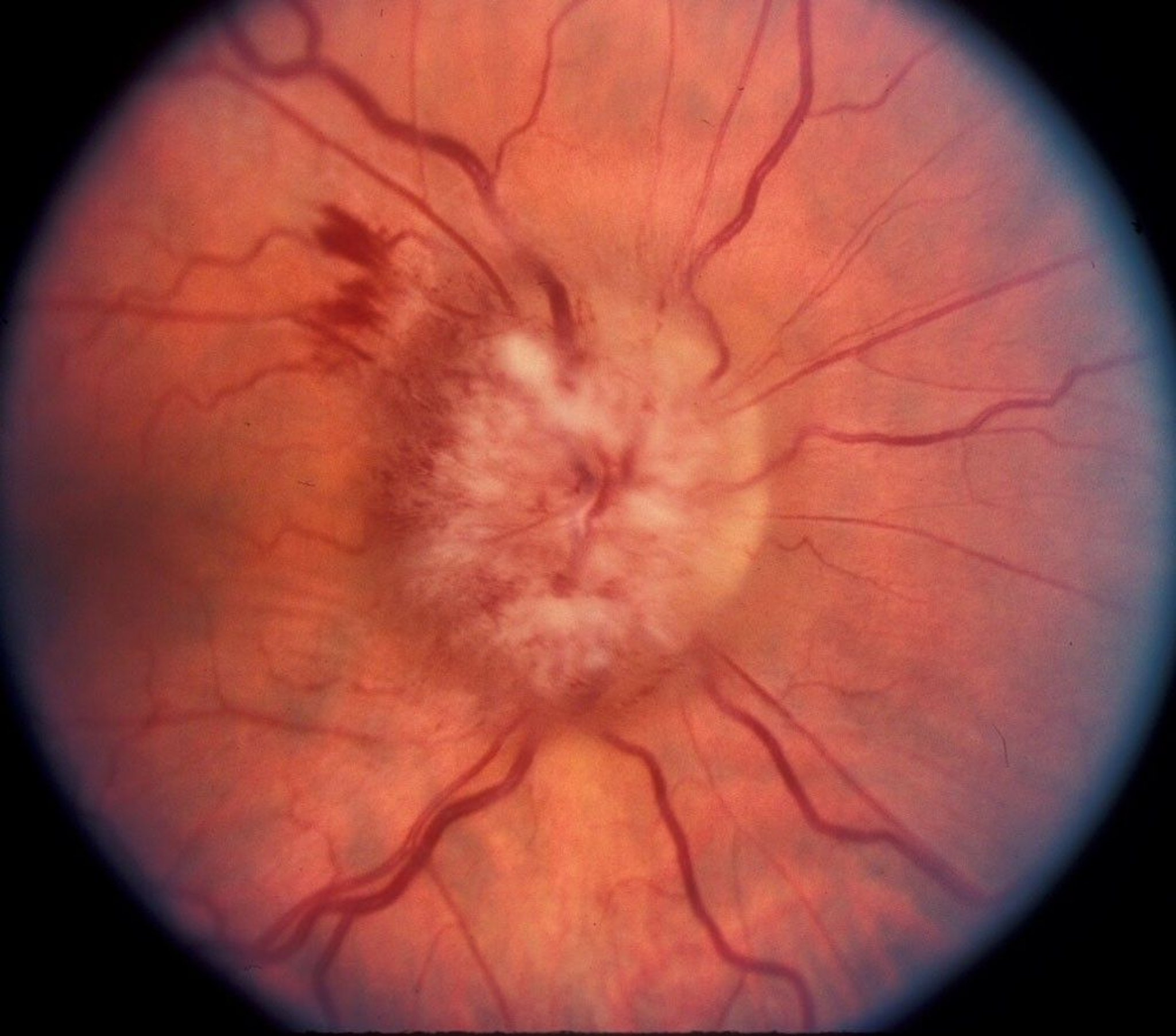
Image provided by James Garrity, MD.
In the early stages of papilledema, visual acuity and pupillary response to light are usually normal and become abnormal only after the condition is well advanced. Visual field testing may detect an enlarged blind spot. Later, visual field testing may show peripheral vision loss with arcuate defects that follow the nerve fiber bundle defects.
Diagnosis of Papilledema
Clinical evaluation
Immediate neuroimaging
The degree of disk swelling can be quantified by comparing the plus lens numbers needed to focus an ophthalmoscope on the most elevated portion of the disk and on the unaffected portion of the retina. Swelling can also be quantified by measuring nerve fiber layer thickness using optical coherence tomography (OCT); OCT is done to quantify the degree of papilledema so that changes can be monitored.
Differentiating papilledema due to elevated intracranial pressure from other causes of a swollen optic disk, such as optic neuritis, ischemic optic neuropathy, hypotony (intraocular pressure ≤ 5 mm Hg), central retinal vein occlusion, uveitis, or pseudo swollen disks (eg, optic nerve drusen), requires a thorough ophthalmologic evaluation. If papilledema is suspected clinically, magnetic resonance imaging (MRI) of the brain with gadolinium contrast or computed tomography (CT) with contrast is done immediately to exclude causes such as an intracranial mass. MR venogram or CT venogram is often done to rule out a dural venous sinus thrombosis. Lumbar puncture with measurement of CSF pressure and analysis of CSF should be done if a mass lesion has been ruled out. Lumbar puncture in patients with intracranial mass lesions can result in brain stem herniation. If no mass is seen on MRI, the opening pressure is elevated and other causes of raised intracranial pressure have been ruled out, the diagnosis is idiopathic intracranial hypertension. B-scan ultrasonography, OCT, and fundus autofluorescence are the best diagnostic tools for the pseudo disk edema of optic nerve drusen.
Treatment of Papilledema
Treatment of underlying disorder
Urgent treatment of the underlying disorder is indicated to decrease intracranial pressure. If intracranial pressure is not reduced, secondary optic nerve atrophy and vision loss eventually occur.
Key Points
Papilledema indicates increased intracranial pressure.
In addition to bilateral hyperemic and swollen optic disks (optic nerve heads), patients typically have engorged and tortuous retinal veins, and retinal hemorrhages around the disk but not into the retinal periphery.
Funduscopic abnormalities usually precede visual disturbances.
Do immediate neuroimaging and, if no mass lesion is seen, obtain CSF for analysis and measure CSF pressure with a lumbar puncture.
Treat the underlying disorder.


